2 months ago
13
2 months ago
13
Authorities also interviewed other associates of Saadieh, including a friend he had made at the University of Western Sydney who was a licensed gun owner, court documents reveal.
“(The associate) stated that he had met with two ASIO officers in 2018 who had questioned him for 1 – 1.5 hours about Saadieh,” a court document says.
“(The associate) said that in this meeting he was never advised to disassociate from Saadieh.”
The associate said he told ASIO agents he was a member of the Muslim Students’ Association and tried to “deradicalise” Saadieh, fearing he might try to carry out an attack if he was ostracised.
Saadieh was ultimately convicted of being an associate of Islamic State.
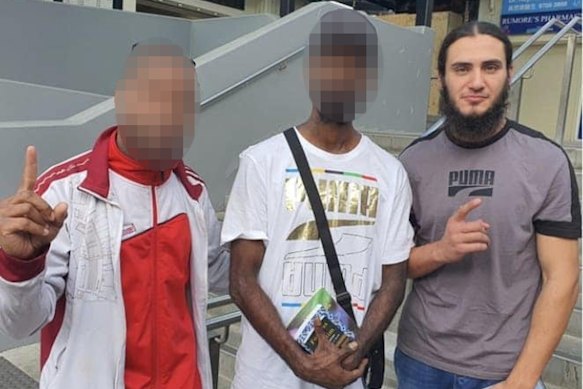
Joseph Saadieh, a convicted ISIS associate, photographed with Street Dawah in 2021, shortly before his arrest.Credit: Street Dawah
But NSW Police only realised that Saadieh had befriended the gun owner, and that the gun owner had been spoken to by counter-terror officers, months after the IS sympathiser was charged in mid-2021.
“Police (were) only aware that he was in Saadieh’s circle of friends; they were unaware of (his) role in attempting to deradicalise Saadieh,” the document says.
Loading
It’s not clear, from the court document, whether the wider JCTT, which includes NSW Police, were aware of the interview and failed to alert their counterparts in the firearms registry.
NSW firearms police said in the court document that they feared IS members would inspire people with no criminal histories to carry out “lone wolf” attacks in Australia.
“(Police) deposed that it is advantageous to high-risk groups to have access to a ‘cleanskin’, particularly if they hold a firearms licence and therefore can legally acquire firearms, as it can facilitate criminal activity without alerting law enforcement,” the court document notes.
Police alleged Saadieh’s associate would be “a desirable target for any criminal group as he has knowledge of the use of firearms and is the former owner of firearms”.
The court ultimately rejected the police case to remove the associate’s gun licence, noting he hadn’t spoken to the Saddieh for two years, and held no extremist views.
Naveed, the alleged Bondi gunman, was deemed too insignificant to warrant a criminal charge in the JCTT probe and, instead, placed on a Known Entity Management List.

Vision of Sajid Akram being tackled at during the Bondi Beach shooting. The 50-year-old was a licensed gun owner.
Other street preachers affiliated with SDM, or its members, were charged, however.
Isaac el Matari, a self-appointed IS commander in Australia, was arrested in the JCTT probe in mid-2019 for plotting to carry out a terror attack in Sydney’s CBD. Naveed, one day later, was pictured preaching on the street in Bankstown.
Loading
Court documents show before his arrest el Matari had been enquiring about purchasing guns and explosives and had talked about establishing an IS insurgency in Australia based on the terror group’s five-month siege of the Philippine city of Marawi in 2017.
He discussed accessing firearms “so the brothers would start a STATE out in the bush here like the boys in Marawi did”.
Marawi is on the southern island of Mindanao, where Naveed and Sajid Akram visited last month. The father and son flew to the city of Davao, which is about six hours’ drive from Marawi. It is unclear what they did for the month they spent in the country.
Court documents seen by this masthead show el Matari was bragging about his ability to import firearms and other weapons into Australia while in prison, and outlined plans to adopt “militancy” similar to “the brothers in the Philippines”.
In a letter to his cellmate, Tuki Lawrence, who was subsequently convicted of hatching a terror plot, el Matari bragged that he could facilitate “the purchase of a wide range of firearms, munitions and explosives” from Lebanon, as well as explosives and suicide vests.
In a three-page letter, el Matari outlined plans for an “effective form of activity militancy” in Australia which, he wrote, had been used by “the brothers in the Philippines and has proven successful”.
Extremist researcher Associate Professor Josh Roose said most IS plots, to date, have been unsophisticated.
Jihadis have focused on knives, or gas bottles; one Melbourne plotter wanted to grab a police officer’s handgun.
Loading
“It seems, finally, two individuals, maybe more, have accumulated these weapons to carry out a violent attack,” Roose told this masthead.
“If they could have got their hands on illegal firearms it would have been deadlier, but also drawn more attention.”
Also on Wednesday, Indian police announced they had no “adverse record” of elder Bondi shooter Sajid Akram, who was an Indian citizen from Hyderabad.
Indian police from the southern state of Telangana said in a statement Akram had a commerce degree, and that his family were unaware of his “radical mindset”.
“The family members have expressed no knowledge of his radical mindset or activities, nor of the circumstances that led to his radicalisation.”
Bondi Beach incident helplines:
- Bondi Beach Victim Services on 1800 411 822
- Bondi Beach Public Information & Enquiry Centre on 1800 227 228
- NSW Mental Health Line on 1800 011 511 or Lifeline on 13 11 14
- Kids Helpline on 1800 55 1800 or chat online at kidshelpline.com.au
More Bondi terror coverage
- Moment by moment: How the horrifying Bondi terror attack unfolded
- Bondi shooter held gun licence: The prime minister will propose strengthening Australian gun laws
- Watch: Alleged Bondi gunman tells bystanders to move away, while shooting at Hanukkah crowd
- Who are the alleged Bondi gunmen? Bondi shooters visited Philippines weeks before beach massacre
Start the day with a summary of the day’s most important and interesting stories, analysis and insights. Sign up for our Morning Edition newsletter.