2 months ago
3
2 months ago
3
Australian authorities have said early indications were that the massacre was inspired by Islamic State. The shooters had draped a flag of the jihadist organisation on the windscreen of their car and 24-year-old Naveed had other extremist links.
A group with ties to Islamic State in 2017 carried out a five-month siege of the Muslim city of Marawi in western Mindanao before being defeated by Philippine forces.
According to the Australian government’s national security website, Islamic State East Asia (ISEA) “remains a deadly terrorist threat in the Philippines”, where it has been based, and the country is “a target destination for foreign terrorist fighters”.
But the Armed Forces of the Philippines said in a statement the “neutralisation of high-value individuals” and other efforts to crush militants in Mindanao had reduced local terrorist group numbers from 1257 members in 2016 to 50 in 2025.
Drieza Lininding, chairman the Moro Consensus Group, a non-government organisation in Marawi, posted on Facebook that “Marawi is now one of the safest places in Mindanao” where “tourists can freely roam around the city”.
“ISIS were defeated and eliminated in 2017 … there are some remnants according to the military but we can count them in our fingers and those remaining are hiding. I doubt if they can organise a training camp,” Lininding said.
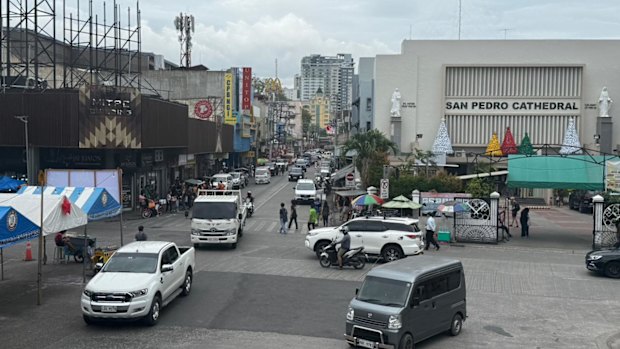
Sajid and Naveed Akram travelled to Davao last month before the mass shooting at Bondi.
The elder terrorist shot dead by police at Bondi was an Indian citizen from the southern city of Hyderabad.
Sajid Akram, 50, visited India six times after he migrated to Australia on a student visa in 1998. Indian police said they had no “adverse record” of him before he left, and his family didn’t know he had a “radical mindset”.
Loading
Indian police from the southern Indian state of Telangana said in a statement that Sajid Akram had obtained a commerce degree in the capital of Hyderabad, a sprawling tech hub.
He moved to Australia in November 1998 to find work and married a woman described as of European origin, with whom he had a son and a daughter. He retained his Indian passport. Naveed Akram was born in 2002 and is an Australian citizen.
Sajid Akram had lived in the Tolichowki area of Telangana, according to a report in The Hindu. Government officials who ran a background check on Akram found he had last travelled to India for a two-week visit in 2022.
The masthead also reported that another official said Akram’s immediate family still lived in Hyderabad, and his elder brother was a doctor. His late father worked in the United Arab Emirates.
Indian police said in their statement Akram went back to India six times for family-related reasons, such as property matters and to visit his parents, but did not return when his father died in 2017.
Police said they had no “adverse record” of him before he migrated to Australia, and his relatives said he had limited contact with his family in Hyderabad in the past 27 years.
“The family members have expressed no knowledge of his radical mindset or activities, nor of the circumstances that led to his radicalisation.
Loading
“The factors that led to the radicalisation of Sajid Akram and his son, Naveed, appear to have no connection with India or any local influence in Telangana,” the police statement said.
Responding to the pair’s alleged connections to Islamic State, the Indian police statement said that “further investigation in this regard is being carried out by Australian authorities”.
NSW Police sources said the Akrams had prepared a manifesto before the massacre.
They are also probing how Sajid Akram – who had six firearms registered to him – had legally secured high-powered weapons despite his son’s long-known links to extremist circles.
Naveed Akram was a volunteer member of a street preaching group in Sydney’s west, which has links to multiple Islamic State devotees, including self-declared martyrs and would-be soldiers, before he and his father carried out the country’s worst terror attack.
Prime Minister Anthony Albanese on Monday confirmed domestic spy agency ASIO had taken an interest in Naveed Akram in 2019.
“He was examined on the basis of being associated with others, and the assessment was made that there was no indication of any ongoing threat or threat of him engaging in violence,” Albanese said.
“The assessment was made because of the son’s associations that he had at that time, and the investigation went for a period of six months.”
With Reuters
More coverage on the Bondi terror attack
- Bondi shooter held gun licence: The prime minister will propose strengthening Australian gun laws
- Who are the alleged Bondi gunmen? On Sunday morning, father-and-son shooters told family they were going fishing
- Bondi hero Ahmed ‘in good spirits’: Ahmed al Ahmed, father of two young girls, is in hospital recovering from gunshot wounds
- The victims: 10-year-old Matilda is the youngest victim. What we know about the Bondi terror victims so far
Start the day with a summary of the day’s most important and interesting stories, analysis and insights. Sign up for our Morning Edition newsletter.