2 months ago
16
2 months ago
16
As a writer, Percival Everett has always wanted to disappear. But that’s difficult when you have a bestseller that has won the Pulitzer Prize, the Kirkus Prize and the National Book Award for fiction in the US and was shortlisted for the Booker Prize in the UK. And there’s going to be a film, produced by Steven Spielberg.
So he has dutifully attended awards ceremonies and signed up for a book tour that will bring him to Australia in February. “I’m not terribly interested in myself as a commodity,” he says. “As long as I disappear when somebody is reading the book.”

The prolific Percival Everett.Credit: Rich Barr
As for awards, “they are invidious comparisons of works of art. It’s wonderful to be considered with other writers I think are good. But it’s always a compromise: the judging committee meets on Thursday, and if they met on Wednesday someone else would have won.”
The book that has won all the acclaim is James, his reimagining of The Adventures of Huckleberry Finn told by Huck’s companion Jim, the runaway slave. How did that idea come to him? “I’d like to say it was a long-held burning desire, but that’s not true,” he says via Zoom from his home in Los Angeles. “It came to me pretty suddenly.”
His idea was a response to American culture’s depiction of a slave as a two-dimensional superstitious and simple-minded person. “It wasn’t meant as a corrective to Mark Twain,” he says, and indeed Twain’s book is one of his favourite novels (along with Laurence Sterne’s Tristram Shandy). But Twain was a man of his time and place, so although Jim is a good fellow, he’s also credulous and easily fooled by the mischievous Huck.
Instead of a 13-year-old boy, Everett’s narrator is a highly intelligent and resourceful adult who plays the fool. He has taught himself to read and write in secret. He hopes to rescue his wife and child, but will face pain and death if he’s captured. “Much of Twain’s novel takes place with Jim offstage, so those are the places that allowed me complete authority over what was going on,” Everett says.
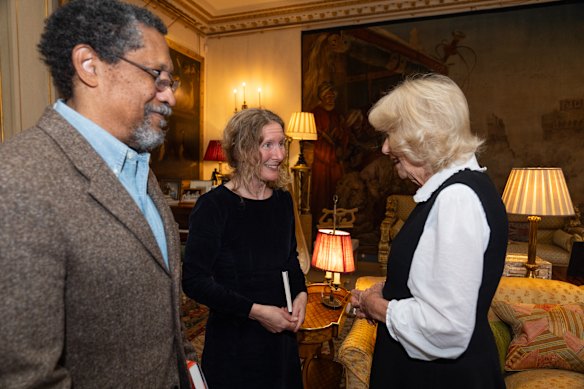
Everett, with Samantha Harvey, meeting Queen Camilla last year.Credit: Getty Images
He approached the task by rereading Huck Finn 15 times. “At the end I felt 10 times would have been enough! I needed to make myself sick of the text. I wanted to inhabit the world but not the novel. It became nonsense after a while, but it lived on as a function of memory.”
A crucial change was the dialect spoken by the slaves in Twain’s version. Everett makes it a sly construct, something spoken in front of white people but dropped in favour of ordinary speech when the slaves talk among themselves. James teaches his daughter Lizzie how to receive Miss Watson’s gift of not very nice corn bread: “Dat be sum of conebread lak neva I et.” Better to be mocked than punished.
“It’s a matter of survival,” Everett says. “They have to create a language to comply with the expectations of people who would damage them.” But the language he has created is an illusion: “There really is no slave dialect. Who knows how the enslaved sounded when they talked to each other?”
James is adopted by a troupe of black and white minstrels led by Daniel Emmett, a real figure from history who composed the song Dixie. James has to blacken his face to become a proper minstrel entertaining the folks with silly darkie songs. There were indeed some famous black blackface performers who did very well, Everett says. “The irony of it all was never lost on them. The irony of a white audience not understanding the black performers parodying the whites.”
I tell Everett that as a kid in 1960s England I watched The Black and White Minstrel Show on TV and had no idea there was anything wrong with it. Everett counters that as recently as 2021 he caught an old Abbott and Costello movie on TV, Africa Screams, featuring superstitious cannibal black folk. “Some producer somewhere thought that was OK.” How did he feel about that? “As a black person living in American culture, I’m used to that. It happens more frequently than anyone cares to admit.”
While James has put Everett firmly on the international circuit, he’s been writing for more than 40 years and has a coterie of fans. He studied philosophy and worked on a PhD “but I was very young and not ready to do a dissertation, and it turned out that fiction was a much better way for me to do philosophy.”
He can’t remember how many books he’s written. According to publishers, it’s 33, not including three versions of one novel, Telephone. “Apparently I write quickly, though it doesn’t feel all that quick to me. I don’t encourage anyone to work the way I do.” He’s easily distracted: “I don’t think I’ve ever uttered the words ‘I have to work.’ I stay up very late. I have to frequently remind myself that this whole process is enjoyable.”
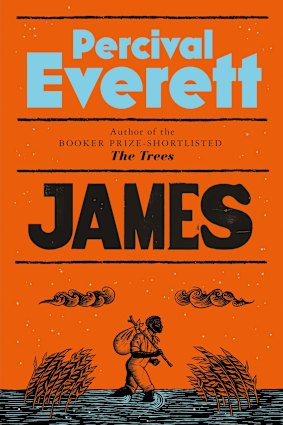
Everett’s novel James has won awards including the 2025 Pulitzer Prize for Fiction, the 2024 National Book Award for Fiction, the Kirkus Prize for Fiction, and was also a Booker Prize finalist.
Before James, probably his best-received work was his 2001 novel Erasure, which was adapted as a film, American Fiction. Everett doesn’t do autobiographical fiction, but he admits his hero, Monk, is “alarmingly similar to me”. Monk writes highly intellectual novels that don’t sell well. Annoyed by the success of a stereotypical novel portraying the “black experience” in the ghettoes, he decides to write his own outrageous parody. To his horror, it’s taken seriously, attracts a huge advance and gets nominated for awards.
Critics find it hard to pigeonhole Everett but agree he’s a satirist. Does he agree? “I don’t think about it much. That puts me in the camp of Swift and Sterne, so I’m flattered. I’m critical of my culture and that’s apparent in my work.” As to satire in the age of Trump, “I don’t know how one can avoid it. I don’t write humour, but my work is ironic.”
I ask why he thinks so many recent novels have depicted the experience of slavery. “I was actually sick of all that. I wasn’t writing about slavery as much as a character. It was one thing to have a book like Roots in the ’70s. But what can you say when you’ve read a book about slavery? ‘That’s changed my mind’?”
For a man who writes so many books, Everett has been very busy with other things. He’s an artist, he’s run a ranch, trained horses, done carpentry, played jazz guitar, mended musical instruments and gone fly-fishing.
“I’m a writer and a painter, that’s what I do,” he says. “I was never going to be a great jazz guitarist, but I loved playing. Training horses is the opposite of a profession, it’s a way of losing money. Everything else is just hobbies.”
Loading
He also teaches theory and writing: he’s a distinguished professor of English at the University of Southern California. “I like the energy, I get paid to hang out with smart young people. They remind me why I ever started doing this, because it’s easy at my age to become jaded about things and miss the excitement of it,” he says.
“As much as I get excited … it’s the frustration of my agent that I never seem terribly thrilled about anything.”
Percival Everett appears at The Wheeler Centre in Melbourne on 26 February, the Opera House in Sydney on 1 March and at Adelaide Writers Week (March 2 and 3).
Most Viewed in Culture
Loading