2 months ago
17
2 months ago
17
Opinion
December 13, 2025 — 5.00am
December 13, 2025 — 5.00am
Is there a country on the planet that made a more sure-footed start to the 21st century than Australia? Is there a nation that ushered in the new millennium with such panache? The Sydney Olympics, the superlative summer games, offered a near-perfect start. And already in 2000, the economy had sailed through the dot.com global downturn, offering more proof of what was dubbed the “Australian economic miracle”. No wonder the country experienced a flowering of face-paint patriotism, and newfound pride in the green and gold.
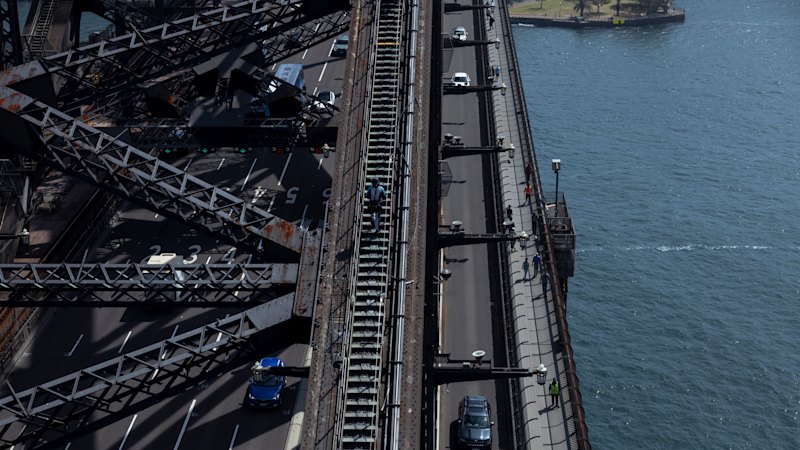
Before we wallow for too long in the sunroom of sentimentalism, let’s ask ourselves a more awkward question. In the 25 years since fireworks illuminated the Sydney Harbour Bridge and Opera House, those 20th century monuments of Australian self-realisation, what have been the landmarks of 21st century success?
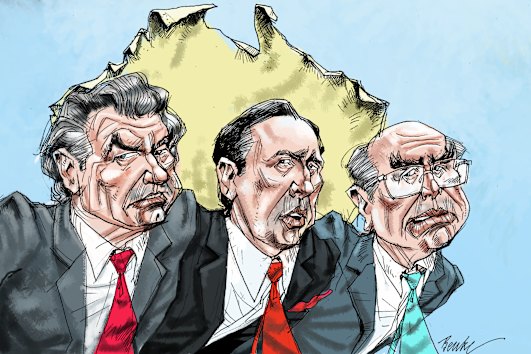
Illustration by Jozsef Benke Credit:
That near recession-proof “wonder Down Under” economy has been the most conspicuous marker of achievement. Only once, in COVID-blighted 2019-2020, did we experience a year of negative growth. Even then, it was only a 0.3 per cent contraction. Yet the robustness of the Australian economy in the 21st century still owes enormously to the Australian model created in the late 20th century under the Hawke/Keating/Howard governments. But wealth has been accrued unevenly. By 2020, among 34 OECD nations, Australia had the 17th-highest level of income inequality.
The introduction in July 2000 of the GST is commonly cited as this century’s most significant economic reform, But the legislation, A New Tax System (Goods and Services Tax) Act, was enacted in 1999. The carbon tax introduced in 2012 by the Gillard government was repealed by the Abbott government in 2014. That leaves the National Disability Insurance Scheme as the most notable durable structural reform. Here, though, ballooning costs, rising at 22 per cent per annum by 2022, have made reform of the NDIS an urgent fiscal necessity. Ironically, Bill Shorten, who lost the 2019 election partly because his manifesto as Labor leader was considered too bold, was the prime architect of arguably the boldest legislative change.
The National Broadband Network was touted as a landmark of the digital age, but Australia now ranks 48th on the international league table of fixed broadband speed, according to the Speedtest Global Index. That is below Albania. That is below Ecuador and Costa Rica.
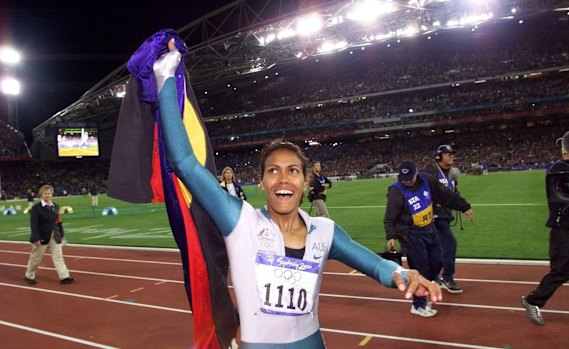
Cathy Freeman on her victory lap at the 2000 Olympic Games, flourishing both the national and Aboriginal flags. Credit: AP
The Snowy 2.0 renewable energy scheme, Malcolm Turnbull’s signature project, recalls ambitious nation-building infrastructure projects of yesteryear. Yet because of delays and cost blowouts – from $2 billion to a projected $20 billion on some estimates – it will not be operational until at least 2028, four years late and outside the 25-year time frame.
Australia weathered COVID better than most other nations, demonstrating that adversity often brings to the fore valuable national traits, namely the ability to deal pragmatically rather than ideologically with a crisis. But the vaccine stroll-out was needlessly sluggish, while Fortress Australia restrictions often felt punitive and overbearing.
After early advances, such as Cathy Freeman’s Olympian “400 metres of reconciliation” and Kevin Rudd’s national apology to members of the stolen generations, reconciliation with First Nations people has gone backwards. The failure of the Voice referendum was a giant retrograde step. Data released this week revealed the highest level of Indigenous deaths in custody since records began in 1979.
Now a more consequential country in a more consequential region, Australia has continued to institutionalise its diplomatic influence through organisations, such as APEC and the G20, which it was instrumental in creating. Advocates of AUKUS, by far the most monumental strategic shift of the past 25 years, would claim the delivery of nuclear submarines will safeguard Australia’s security well into the 21st century. Yet we cannot say for sure when, or if, those subs will reach these shores. Nor what will be the diplomatic and commercial fallout with our biggest trading partner, China.
Loading
As we were reminded only this week, when the world-first social media ban on under-16s came into effect, countries now regard Australia as a laboratory of reform. This is especially so with the fissile issue of unauthorised immigration. Australia succeeded in stopping the boats, disrupting the business model of people smugglers and policing its borders more strictly than the United States and European nations. However, the Pacific Solution, centred on the indefinite offshore detention of asylum seekers, came at a high moral cost and brought an acid shower of criticism from the United Nations.
For most of the century, federal politics has been in a recessionary slump, with eight different prime ministerships at one stage in the space of 11 years. John Howard has been the only incumbent this century to serve more than four years. But he was less productive in the early noughties than the late ’90s. Aside from his ill-fated push for WorkChoices, Howardism was starting to peter out. In 2006, on Howard’s 10th anniversary in power, then-foreign affairs minister Alexander Downer observed the government did not have a big reform idea, to which Howard evidently responded: “Well, we’ve done all the things that we really wanted to do.”
Thrusting reformers, such as Kevin Rudd and Malcolm Turnbull, struggled to command loyalty from their party rooms, partly because they were seen as overly – and ruthlessly – ambitious. The climate and culture wars have taken up too much bandwidth. Three-year terms have embedded short-termism in policymaking and made politics a ceaseless campaign. The constructive bipartisanship evident at the height of the reform era, when Paul Keating often looked upon Howard as a useful, if unlikely, ally, is not so evident today. Gaining power, rather than contemplating what to do with it, has become a recurring motif, leading to the primacy of politics over policy.
Coup capital Canberra not only experienced killing seasons but a killing era.
Party and personal politics became relentlessly oppositional. Much of John Howard’s efforts were devoted to pushing back against Keating’s attempt to redefine national identity. Because Howardism became synonymous with anti-Keatingism, it seemed he was serving both as prime minister and opposition leader.
Loading
Kevin Rudd, after losing the Labor leadership, spent too much time undercutting the woman who ousted him. The Liberal years between 2013 and 2022 are remembered more for internecine combat than nation-building. Coup capital Canberra not only experienced killing seasons but a killing era.
On both sides of politics, the orthodoxy took hold that leaders offering bold reform agendas would get punished by voters. It’s an ugly legacy of 1993, when the then opposition leader, John Hewson, lost an unlosable election because of campaigning on Fightback!, a 650-page policy package brimming with policy. Big ideas create big targets. Among political professionals – whose proliferation has contributed to the problem of over-politicisation – it has become an article of faith that you are losing when you are explaining.
Just imagine if Keating had accepted that brainless dogma before introducing superannuation, or Howard in proposing the GST. Meaningful change requires patient, and often passionate, elucidation.
Loading
Preserving the status quo has proven a more powerful force than effecting change. Maybe one way of thinking about politics this century is that John Howard proved a doughty defender of Menziesism and slayer of cultural Keatingism, while Labor leaders were not prepared to advance Keatingism and too timid to rebuff Howardism. In that formulation, you will note a glaring omission: the name of a single prime minister who came to office this century. After Howard’s defeat in 2007, no prime minister has come close to having the word era attached to his or her name. Anthony Albanese has that opportunity, but there is a danger he could become a touch-the-earth-lightly prime minister.
For sure, Australia has fared better than most Western nations. It remains the lifestyle superpower. The capital cities have become staples on those lists of the world’s most liveable domains. But the Aussie way of life has become unaffordable for too many Australians and an “Australian Dream” centred on home ownership has become a chimera for too many young people.
At least 25 years in the making, the housing crisis is symptomatic of a broader malaise. But mea culpa. Property owners have been complicit by refusing to back policies, such as changes to negative gearing and planning laws enabling higher urban density, that risk depressing sale prices. As John Howard famously remarked back in 2003: “I don’t get people stopping me in the street and saying, ‘John, you’re outrageous. Under your government the value of my house has increased.’” Housing is a case where voters get the policy and politics we deserve.
Sometimes we refer to lost decades in national life. Yet as we approach the end of 2025, we should reflect on 25 years of national underachievement and speak instead of Australia’s lost quarter-century.
Nick Bryant is the author of The Rise and Fall of Australia: How A Great Nation Lost its Way.
Get a weekly wrap of views that will challenge, champion and inform your own. Sign up for our Opinion newsletter.
Most Viewed in National
Loading