2 months ago
15
2 months ago
15
“If the Poms bat first, let’s tell the taxi to wait.” So read a banner during one of Australia’s many Ashes maulings of England in the 1990s.
After a breathless and borderline ridiculous Boxing Day at the MCG, with the urn’s fate already decided and 20 wickets falling in the space of 75.1 overs, it may at least be worth scheduling an Uber home for day two – much to the chagrin of more than 90,000 ticket-holders for day three.
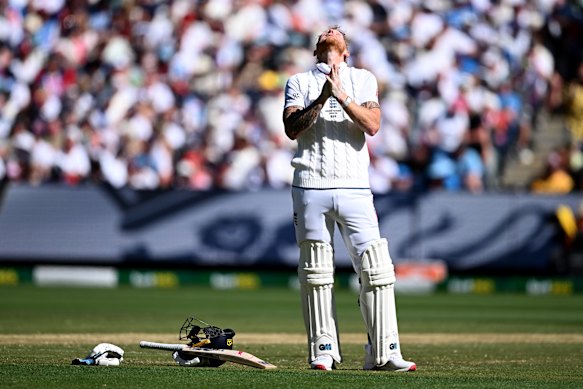
Ben Stokes prays for a Boxing Day miracle.Credit: Getty Images
If the MCG is cricket’s greatest colosseum – and it certainly felt that way with a record crowd of 94,199 in attendance on a cool and breezy day – then this felt less like a gladiatorial contest than bowling lions versus batting Christians.
For an England side at their wits’ end after an Ashes campaign that had been so enormously hyped only to fall in a heap in 11 days, the cross of St George was at least a useful signal for an ambulance for their sorry batters.
After being bowled out for a modest 152, Australia’s bowlers did not appear overly worried about the game situation. Rather, they simply looked eager to get their own chance, on a pitch that had been left juicy, grassy and “furry” by the curator Matt Page.
They were right to be so enthusiastic. In 29.5 overs, Mitchell Starc (2-23), Michael Neser (4-45) and Scott Boland (3-30) razed England for 110, needing some agricultural blows by Gus Atkinson even to get to three figures.
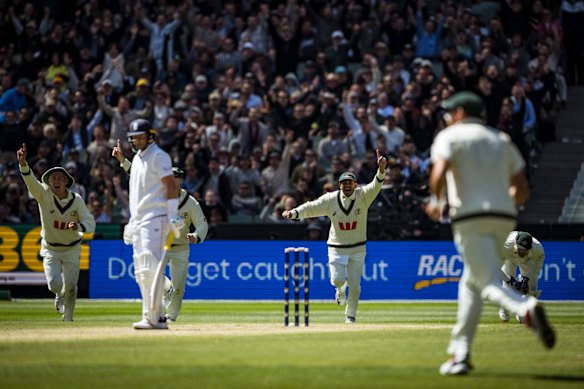
Joe Root joins the procession.Credit: Photograph by Chris Hopkins
While Starc is clearly the best bowler on either side this series and Boland is the undisputed master of seam bowling at the MCG, the repeated success of Neser in Brisbane and Melbourne will be particularly galling to English eyes.
Supremely accurate and persistent, Neser is not far removed in velocity or skill from numerous English seamers, not least the recently retired pair of James Anderson and Stuart Broad. While Broad went of his own accord, Anderson would have happily carried on to this series if wanted, rather than being given the hard word from coach Brendon McCullum a little over a year ago.
Instead, England brought an attack to Australia that seemed to be geared at fighting some earlier wars on far flatter pitches. McCullum’s final tour of Australia with New Zealand in 2015-16, for instance, had featured an extremely high-scoring draw in Perth, but Australian pitches and the Kookaburra ball are much changed since.
Loading
Why Page left 10mm of grass on the surface was apparently to do with forecast hot weather on days three and four. But by offering so much lavish assistance to bowlers early on, he has opened the distinct possibility that Melbourne’s golf courses will be more populated by then than its cricket ground.
After Ben Stokes won the toss, England’s early incisions with the ball were as much about batter error as anything in the pitch. Travis Head dragged a cut onto his stumps, Jake Weatherald glanced into the wicketkeeper’s gloves and Marnus Labuschagne drove at a length ball in a manner more reminiscent of the tourists.
Steve Smith was genuinely bowled by a lovely nip-backer from the speedy Josh Tongue, who was curiously considered a second-rank bowler for England at the start of the series but has done much to indicate he’s better than that.
For a while, Australia looked like rebuilding through Usman Khawaja and Alex Carey, then Cameron Green with Neser. Each time, though, a wicket was found. Khawaja did little wrong when nicked off by the persevering Gus Atkinson, but Green was far more culpable for his run out – the first by England in an Ashes since 2021-22.
From there, it appeared the Australian bowlers were thinking mainly of getting their hands on the new ball, and the following procession showed why.
Noosa’s latest tourism ambassador, Ben Duckett, lasted all of five balls before spooning Starc to mid-on, then Ollie Pope’s replacement Jacob Bethel touched a cracker from Neser through to Carey. So much for the new blood.
Four balls later, Zak Crawley’s statuesque forward prod offered up another edge from Starc, this time to Smith. And Joe Root’s 15-ball stay was ended by another immaculate delivery from Neser that the former captain could only snick through to Carey. Four for 16 and the day had swung violently back to Australia.
Harry Brook and Ben Stokestried to resist in their wildly contrasting ways, but could not endure long enough to make a substantial dent in the play.
Brook effectively walked for an lbw, pinned in front by Boland, and Stokes’ half-drive, half-cut at Neser succeeded only in slips catching practice for Smith. Jamie Smith and Will Jacks had both been cut in half by Boland’s sharp seam back into them.
All of a sudden, Australia found themselves having to bat again. Boland put his hand up to nightwatch and face a solitary over. The fifth ball saw yet another England dropped catch, this time a tough one to Bethel in the gully, and the last was steered away to the third man rope. Atkinson could only hang his head.
This gallery of the grotesque was watched by ECB chair Richard Thompson and team performance director Rob Key from Cricket Australia’s hospitality box in the Harrison Room. They will soon have some hard decisions to make about the sequence of events that led to this tour, and McCullum will be among the first to face up to the ECB’s scrutiny.
Loading
At the same time, the preparation of this pitch will also require some introspection.
Walking into the MCG this morning, we all knew that England’s batsmen were unlikely to hang around; by day’s end, it was worth wondering how many spectators will be given the choice to do so after tomorrow.
News, results and expert analysis from the weekend of sport are sent every Monday. Sign up for our Sport newsletter.
Most Viewed in Sport
Loading