3 months ago
29
3 months ago
29
Raymond Chen, chief executive of takeaway chain Sushi Hub, wants this much on the record. “We are not for sale,” he said.
Sushi Hub’s reported $1 billion valuation, a figure wrangled by The Australian Financial Review late last year, triggered a flurry of unsolicited calls from eager investors who want a bite of the company’s success.
“I received more than 100 phone calls from private equity, from fund [managers],” said Chen. “We were never for sale.”
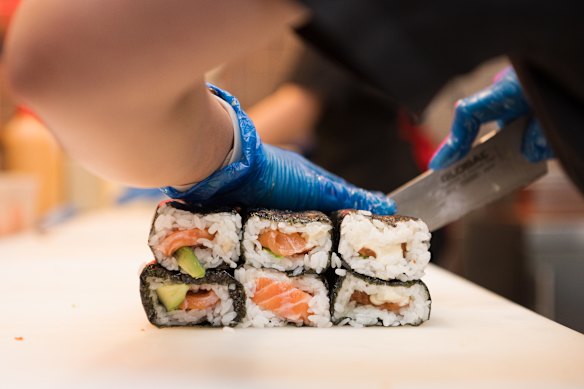
Sushi Hub is one of thousands of shops selling grab-and-go hand rolls in Australia.Credit: Flavio Brancaleone
Chen is among a small handful of early trailblazers that has carved a place for sushi in the nation’s fast-food landscape. Australian sushi has, over the years, formed its own identity: the hand-rolls we see so commonly are a homegrown invention, and so are the fillings we favour, such as teriyaki beef and salmon, chicken katsu and tempura prawn, writes Adam Liaw, who made a case for the hybrid cuisine for Good Food.
But when it comes to this particular form of fast food, Australians don’t seem as brand loyal as they are with burgers (McDonald’s v Hungry Jack’s) or burritos (Guzman y Gomez v Zambrero).
Australia’s two biggest takeaway sushi chains are Sushi Hub and Sushi Sushi, but the difference between the two – beginning with their names – is not as widely understood.
Both companies have roughly the same number of stores (just under 200) across Australia, although Sushi Hub is more widely known in NSW, where it has more than 90 stores, while Sushi Sushi has a stronger presence in Victoria (95 stores). Both have similar goals to expand domestically (500 stores by 2036 for Sushi Hub, 450 by 2035 for Sushi Sushi), and both aspire to have a strong international presence.
Investors have learnt the difference. While Chen, who is media-shy and declined to be photographed, is fending off calls from investors (the $1 billion valuation is the minimum, and also hypothetical, he clarifies), Sushi Sushi’s majority owner Odyssey has been seeking a buyer since May last year.
“The process is progressing,” said Sushi Sushi chief executive Stephen Anders, who was chief financial officer before being promoted to the top job.
“There is very good interest in the business, which is to be expected when you consider that we have a category-leading platform. We’ve got multiple growth pillars within an Australian market context and an emerging international footprint. At this time, there are no further details I can provide.”
The mutual respect expressed by both Chen and Anders belies a friendly rivalry. “Every time I receive a phone call, I say, Sushi Sushi is for sale,” said Chen. “I’m helping them. I’m helping Stephen.”
The birth of Australian sushi
Much of Australia’s takeaway sushi market is dominated by independent mum-and-pop stores, which account for about 65-70 per cent of sushi stores. Put together, Sushi Sushi and Sushi Hub account for about 15 per cent of all sushi outlets, but about 40 per cent of total takeaway sushi sales.
A third player, Sushi Izu, has more than 240 locations, but are almost exclusively within Woolworths supermarkets.
Chen is one of three co-founders of Sushi Hub, the other two being James Chen and Leon Li. Their first venture had nothing to do with rice or fish, however; the trio, who met at university and became flatmates in 2002, opened and ran an outpost of Asian bakery chain Bread Top in western Sydney’s suburb of Cabramatta. There, the landlord suggested they open a sushi outlet.

The Sushi Hub in Sydney’s CBD.Credit: Dominic Lorrimer
“When we started it 19 years ago, there were many people who had never tried any sushi before,” Chen said. “We had to start educating the customer, giving free samples to the customer, telling them that, you know, sushi is not all about raw fish.”
The co-founders quickly cottoned onto, and learned to standardise, the unique way Australians like to eat sushi: a preference for familiar cooked like beef and chicken, as well as prawn and veggie tempura, delivered in the beloved handroll shape.
The lack of experience in sushi-making helped them approach the product from a customer’s perspective. “I don’t like cold rice, to be honest. I want it warm. Warm rice, you can smell it, and you can taste it’s softer,” said Chen.
“From day one, we always realised that there’s no secret about making sushi ... keep it fresh, provide the best ingredients, keep it clean, and that’s it.”
Australia’s best-selling rolls are consistently crispy chicken and chicken teriyaki rolls, salmon and avocado hand rolls and tuna salad rolls.
But there is a formula: sushi is a numbers game. Freshness, and the appearance of it, is everything. Sushi Hub’s glass counters attract the eyes to rows of nigiri and inari on display, hand-made, on demand. There are regional differences, too; Queenslanders have a distinct preference for chicken sushi paired with beer.
Most rolls and nigiri are made and sold within two hours. “Our business is based on volume, not based on high margin,” said Chen.
Australia’s best-selling rolls are consistently crispy chicken and chicken teriyaki rolls, salmon and avocado hand rolls and tuna salad rolls, according to both Sushi Hub and Sushi Sushi chiefs.
Sushi’s popularity is multilayered and crosses generations: it is fast, fresh, convenient, healthy and affordable, appealing to everyone from high schoolers to the corporate worker.

Sushi Sushi store, Balwyn, Victoria.
“Younger generations snack five times a day compared to older generations’ three meals a day, so sushi roll size and price point is appealing,” said retail property consultant and Titanium Food director Suzee Brain. “They can still use their phone in the other hand compared to knife and fork-style takeaway options.”
Takeaway sushi outlets thrive in high foot-traffic, high visibility areas, and requires less floor space than other fast food outlets, or about half of a Guzman y Gomez in a typical high street or shopping centre, Brain said.
Sushi Hub and Sushi Sushi are part of a new generation of ascending Australian fast food chains – Lebanese chicken chain El Jannah being one, frozen yoghurt maker Yo-Chi being another – looking to export their brand to the world.
Loading
So far, Sushi Sushi has made more headway with international expansion: it operates several stores in New Zealand, plans to open 40 stores in Saudi Arabia, and have inked a deal to enter the Indian market.
Sushi Hub is focusing primarily on the domestic market, but is eyeing the US, Europe, Asia, and the Middle East. It’s not as easy to open a Sushi Hub outlet: one can only become a franchise partner when they have worked in a store for five or more years.
“We are quite relaxed these days because our focus is always Australian market,” said Chen. “International expansion is only when [the] opportunity comes.”
Hungry investors shouldn’t give up hope.
“It doesn’t mean that we will never consider selling in the future,” said Chen. “But our priority and focus was always, always on the business itself. Even [if] the business is for sale, it has to be strong.”
The Business Briefing newsletter delivers major stories, exclusive coverage and expert opinion. Sign up to get it every weekday morning.
Most Viewed in Business
Loading