3 months ago
32
3 months ago
32
A shallow Sorrento bay that was once an unhappy home to almost 500 convicts and settlers in Victoria’s first, failed colony has become a beach house battleground between brother and sister in one of the state’s wealthiest families.
Celia Burrell and Richard Shelmerdine, siblings in Australian retailing dynasty the Myer family, are fighting in the state planning tribunal over Burrell’s plans to build a $3 million, three-storey beach house next door to her brother’s beach house, facing Sullivan Bay in Sorrento.
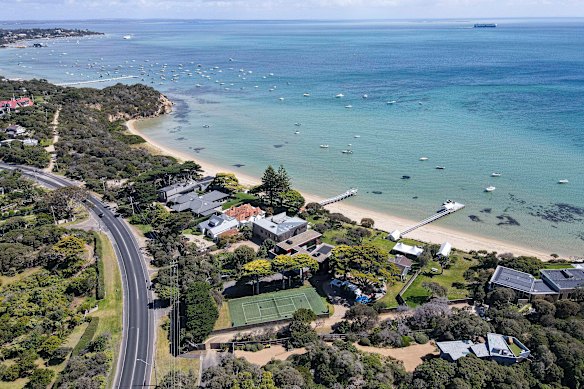
Sullivan Bay, in Sorrento, with the house and tennis court of Richard Shemerdine, Celia Burrell’s undeveloped property, and Martin Strode’s beach house side by side in the foreground.Credit: Eddie Jim
Both properties occupy an exclusive row of beachfront homes on land that was part of the historic Collins Settlement Site, where the British established a doomed colonial outpost in 1803.
Shelmerdine sold his sister the undeveloped property for $3.4 million in 2011, but is attempting to thwart her plans to build there, even though the dwelling has been approved by the Mornington Peninsula Shire Council.
Shelmerdine is seeking to overturn the council’s approval by an appeal in the Victorian Civil and Administrative Tribunal.
He has been joined in his cause by property developer Martin Strode, who also owns a multistorey beach house next door to Burrell’s land, on a property that he also purchased from Shelmerdine.
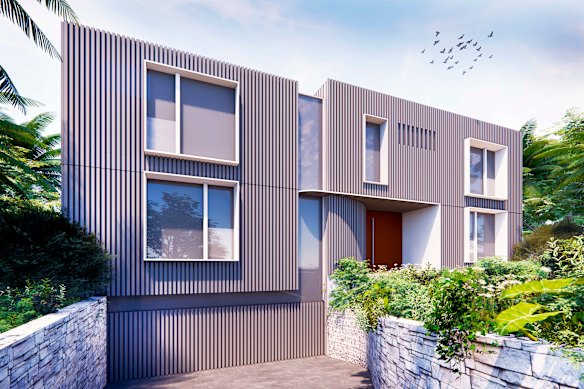
A render of the proposed beach house at 3080A Point Nepean Road, which has council approval but is being contested in VCAT by neighbours on either side.
Court documents show that Shelmerdine and Strode both argue that Burrell’s approved beach house is too bulky, exceeds the approved building envelope, is unsympathetic to the landscape and would require unacceptable destruction of coastal moonah vegetation.
Shelmerdine has also argued that the plans would enable people to look into his house.
His objection states: “As a result of the topography of the land, if the driveway is built as planned, pedestrians and people arriving in cars will look directly into my private open space – including my children’s bedrooms and my dining room. Car lights at night will also cause significant disruption.”
His objection also details the loss of a “significant moonah tree”, which has already been “aggressively and extensively pruned”, the removal of a section of shared driveway fence without approval and excavation for a staircase that is “contrary to retaining the flowing & continuous nature of the 1803 Parade Ground”.
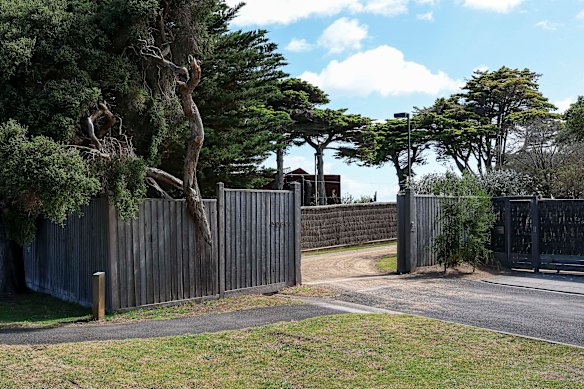
The Sorrento properties of Myer siblings Richard Shelmerdine and Celia Burrell share a driveway, which has become contested turf.Credit: Eddie Jim
Strode’s objections mostly mirror Shelmerdine’s.
The pair’s joint tribunal appeal has forced Mornington Peninsula Shire Council to defend its decision to approve Burrell’s beach house.
Mornington Peninsula Shire Council is arguing in VCAT that Burrell’s planned beach house “is consistent with the character and form of nearby housing”, and will not cause unreasonable overlooking, overshadowing or building bulk.
It said it weighed up the objectors’ arguments but found the house should be approved, including consent for works outside the building envelope.
“The applicants for review seems to be applying and seeking a very high bar test to be applied in this instance,” the council’s submission states.
A three-day hearing was held in December, with a decision expected this year.
The Sullivan Bay foreshore has been disputed turf since Europeans first set foot there.
A British party composed mostly of convicts arrived at the Sorrento beach in 1803, displacing Boon Wurrung people who regularly camped there, according to a Heritage Victoria citation.
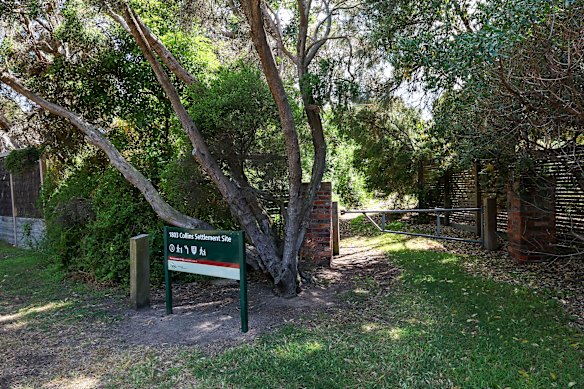
The Collins Settlement Site at Sullivan Bay has been compared to The Rocks in Sydney for its links to Australia’s first European inhabitants.Credit: Eddie Jim
The settlers found conditions difficult, with poor soil and no running water nearby, and within seven months they abandoned the settlement for Tasmania.
The Heritage Victoria citation records the site as “one of the few Australian ‘founding’ sites that have survived two centuries of change”.
“Like The Rocks in Sydney and Risdon Cove in Tasmania, the landscape of Sullivan Bay has revealed evidence from its founding period. More evidence may survive to be revealed as a result of future investigations,” it reads.
Shelmerdine bought the 1.2-hectare site in 2008 for a then record $18.4 million. He later subdivided it into five properties, successfully appealing to VCAT after Mornington Peninsula Shire Council did not grant approval to do so, amid a heritage and conservation campaign to preserve the site as public parkland.
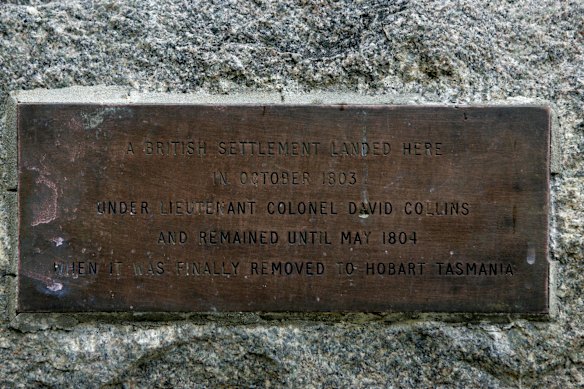
A plaque commemorates Victoria’s first, failed colony at Sullivan Bay in Sorrento. Credit: Justin McManus
He has retained ownership of the original home on the site and a jetty that extends into Sullivan Bay.
Burrell’s property is currently undeveloped, other than an old boat shed. Burrell, who founded the El Questro outback resort in the Kimberley region of Western Australia with her husband, has sought to use her brother’s tribunal win in 2010 as a key argument for why her own development plans should not be blocked.
She argues that the development proposal “is not contrary to the tribunal’s decision in Shelmerdine v Mornington Peninsula SC”: the 2010 decision in which her brother won the right to subdivide.
Burrell has submitted to VCAT that the proposed three-storey house “will not unreasonably impact on amenity of surrounding properties and is appropriately respectful of the immediate neighbourhood character”.
Her statement of grounds argues that the removal of a moonah tree and the landscaping outcome are acceptable, mirroring the council’s arguments for why it approved her plans.
The Age attempted to contact Burrell and Shelmerdine.
Start the day with a summary of the day’s most important and interesting stories, analysis and insights. Sign up for our Morning Edition newsletter.
Most Viewed in National
Loading