3 months ago
30
3 months ago
30
Opinion
January 12, 2026 — 6.00am
January 12, 2026 — 6.00am
Life in the ’Burbs is a series that highlights the good, bad and beautiful of Brisbane suburbs. Writers from around the city are penning love letters (mostly) to their suburbs every week.
Having a pet is a great way to meet the neighbours.
Around my Paddington patch, my ragdoll cat, Runty the Magnificent, is a street celebrity – a magnet for residents and passers-by to fawn over and photograph.
He’s introduced me to friendly families along our narrow one-way street and cat-loving tenants from his favourite haunt – the ’80s brick rental unit block directly opposite.
So when your cat gets trapped behind the jammed security gate of an upmarket renovation and you politely ask your neighbour to hand him over to you, but they curtly respond, “I don’t do cats” – well, it’s a pretty clear sign times have changed.
During my first quarter-century as a Paddo local, my closest neighbours were a retired working-class couple who had bought their three-bedroom pre-war Queenslander in the 1950s for the princely sum of 12 pounds. They were humble, salt-of-the-earth folk and conscientious “good neighbours” who looked out for us. I paid my respects at their funerals.
Developers bought and subdivided the property. Relaxation of council rules allowed the building to be moved to just over a metre from our dividing fence, which enabled another house to be built beside it. The heritage-protected home was raised a storey to incorporate a huge extension.
A family of three acquired the made-over monolithic mansion, which now lacked side access to the rear of the property. The owner’s solution was to unilaterally install a gate in our shared dividing fence for hired help and their equipment to transit via our property instead.
Nice try.
Meanwhile, the eight flats across the street and the four adjacent ones will soon be demolished and replaced with luxury four-bedroom residences. I’m not expecting the address to remain quite so welcoming for Runty or me.
These outsized transformations have driven the median house price up to $2.4 million, only feeding the Paddington stereotype of pretentious elitism. How likely is it, if Bluey’s family were real, that they’d be able to afford that magical house high on one of Paddington’s scenic rises?
How likely is it, if Bluey’s family were real, they’d be able to afford that magical Paddington house?
When I bought here in 1990, Paddington’s demographic was vibrantly egalitarian. Sure, there were grand and expensive homes of the prominent and well-to-do – foremost, the governor’s mansion on Fernberg Road – but it was nevertheless considered a working-class, low-income suburb. The population predominantly comprised older blue-collar and migrant families, alongside students and young “alternative” singles and couples renting cheaply in sharehouses or flats.
Even then, though, a character home in liveable condition was out of reach for a 20-something single on an average income. The compromise for me was an elevated townhouse with views to the city and Mount Coot-tha. It was also under three kilometres to just about everywhere I needed to get to regularly.
I loved that Paddington was an artistic hub: a hangout for my social circle in the performing arts community centred around the original La Boite Theatre in Hale Street, and a broader group of art and craft makers who ran cottage industries from their shopfront heritage houses on Latrobe Terrace.
Vestiges of that eclectic creativity remain scattered along the terrace’s kilometre-long easy walk towards Bardon, with art galleries, quirky gift shops, retro fashion stores and op shops culminating in the Aladdin’s Cave of the former Paddington Antique Centre, now Empire Revival.
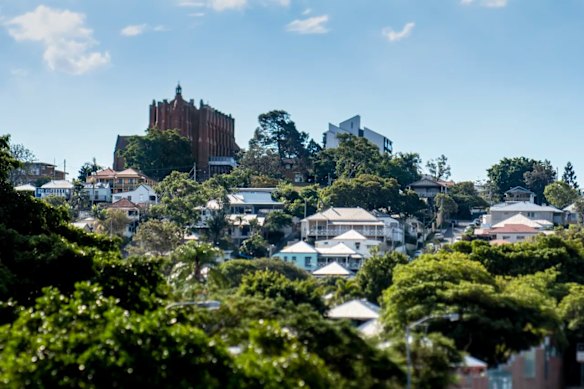
Can you spot Bluey’s house?Credit: Martin K Jacobsen
The Given Terrace stretch was bustling at night. The legendary Le Scoops was the meeting place, where you could enjoy a post-performance coffee or hot chocolate, or the seven-scoop explosion of indulgence – topped off with sparklers – irreverently dubbed the “Mururoa” (“Krakatoa” and “Vesuvius” completed the menu’s darkly themed decadence).
And when everything else had closed, the Kookaburra Cafe was still serving and delivering late-night pizza.
It remained a Paddo institution for 35 years until 2017, when the building was acquired by another local institution, Paddington Hardware, at which you can find just about anything – and plenty of knowledgeable and patient staff to give you a hand.
Retail turnover is quite high in this niche market, which is confined by the hilly geography that has made Paddington so picturesque. This has also largely protected it from the commercial development undergone by other inner-city locales.
Loading
Apparently though, Paddington can’t have too many coffee shops. I have a choice of 10 within a 600-metre radius of my place. That’s something I am quite happy about.
Some of the communal energy and excitement that drew me to Paddington still exists. After 35 years, I still love hearing the roar of the crowd at Suncorp Stadium from my home – knowing who’s scored or won a match by its volume – and making out the song from a concert carried 900 metres by the evening breeze. The sound of fireworks is a call to head to my balcony to watch the show above the city skyline.
It’s heartening to feel that connection to the broader community, and it’s only a 10-minute walk if I decide to get among it – especially handy for FOMO-inspired last-minute decisions like seeing Paul McCartney, and the FIFA Women’s World Cup 2023 third-place playoff between the Matildas and Sweden.
While I lament the community changes of the past decade, and the loss of my Mount Coot-tha view to redevelopment, nowhere in Brisbane can match all the benefits that living in Paddington still affords me.
What I want the council, its planners, developers, business people, and even cashed-up, status-seeking buyers to realise is that the further Paddington moves away from its roots as a suburb of the people, the more its uniqueness dies.
Oh, and Runty’s ultimate rescue? We placed bar stools on either side of the unyielding pedestrian gate for me to climb over and carry him back in a fireman’s lift. But just as I stepped forward, ready to risk life and limb, the husband turned the gate’s handle and, miraculously, it opened. Oops.
Most Viewed in National
Loading