2 months ago
18
2 months ago
18
Net overseas migration has fallen to its lowest level since the Albanese government took power but is still powering Australia’s population growth with the country now home to more than 27.6 million people.
Figures from the Australian Bureau of Statistics on Thursday revealed that through 2024-25, net overseas migration fell to 305,600, the lowest annual result since mid-2022. In the June quarter alone, migration eased to 50,120, the smallest quarterly result since the end of 2021.
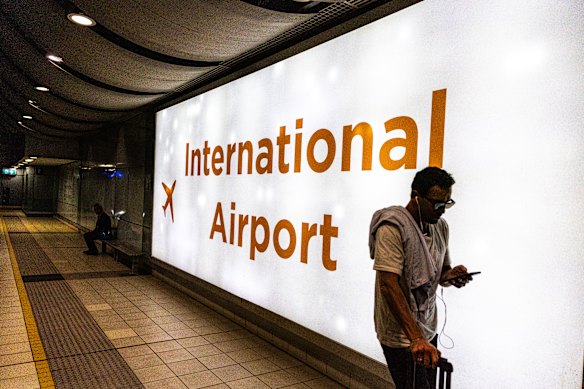
Net overseas migration has fallen to a three-year low but is still running above its long-term historical average.Credit: Sam Mooy
It’s a drop of 123,593 or 29 per cent on 2023-24 and 45 per cent down on the peak of 555,798 reached in the 12 months to September 2023.
At 305,600, net overseas migration – which tracks the number of people leaving or coming into the country that stay here for at least 12 of 16 months – is below what the government forecast in its mid-year budget update that was released on Wednesday. But it is well above the 260,000 that was expected when Jim Chalmers released the 2024-25 budget in May last year.
It is also in contrast to similar nations. Canada’s statistical agency overnight revealed that nation’s population fell by 0.2 per cent or 76,000 in the three months to October after a change in migration policy by the Carney government.
Net overseas migration to both NSW and Victoria dropped by 31 per cent in 2024-25, falling by 45,000 and 40,000 respectively. In the June quarter alone, Victoria’s net overseas migration intake of 12,753 was the lowest June result in a decade outside of COVID when the nation’s international border was closed.
Both states attract the largest share of international students that the government has sought to reduce through effective caps on universities and visa changes. This week’s mid-year budget update revealed the government expects to raise an extra $740 million from higher visa application charges for primary students and student guardians.
Despite the easing in migration, it is still driving up Australia’s overall population. Of the 82,189 increase in residents through the June quarter, 61 per cent were through net overseas migration.
Since the government’s election in 2022, of the 1.6 million increase in the nation’s population, 84 per cent has been due to migration.
The nation added 82,189 residents during the June quarter, a slight increase on the June quarter last year. The lift was due to strong natural population growth, with births up by 6 per cent to 77,607 while deaths fell by 5.6 per cent.
Western Australia continues to have the fastest-growing population, growing by 65,584 people or 2.2 per cent over the past year. It is now home to 3.04 million people.
The populations of Victoria and Queensland grew by 1.8 per cent over the past year, taking their respective populations to 7.07 million and 5.7 million, while NSW added 101,000 people to reach almost 8.6 million.
Tasmania’s population grew by just 0.2 per cent over the past year. In the June quarter, its population increased by a single person as 217 net migrants and 114 in natural population growth was almost completely offset by the departure of 330 residents to other parts of the country.
The government has forecast net overseas migration to fall to 260,000 this financial year and then 225,000 in 2026-27.
Despite the drop, the right-leaning Institute of Public Affairs said that over the past three years net overseas migration had added 1.27 million people to the population.
Institute senior fellow Kevin You said the large intake, which followed the combined loss of 94,000 during the pandemic, was adding to societal pressures.
“This is uncontrolled mass migration on steroids, pure and simple. It is causing social division, sectarian strife, and is making mainstream Australians poorer,” You said.
While the nation’s population is growing, it is not growing as fast as household wealth.
Separate figures from the bureau showed the net value of Australians’ assets lifted by 3.1 per cent or $551.3 billion in the September quarter to an all-time high of $18.4 trillion.
Over the past 12 months, household assets have climbed by $1.5 trillion or by more than 9 per cent.
The nation’s land and dwellings grew in value by $283 billion or 2.4 per cent to $12.2 trillion. Superannuation assets jumped by 3 per cent to $4.5 trillion.
Loading
The bureau’s head of finance statistics, Mish Tan, said the recent increase in the superannuation guarantee, higher house prices and the lift in global equity prices were adding to Australians’ wealth.
“’Global and domestic share markets performed strongly for the second consecutive quarter, increasing household superannuation balances,” she said.
Offsetting the value of assets are Australian debt holdings, which lifted marginally to $3.2 trillion.
Cut through the noise of federal politics with news, views and expert analysis. Subscribers can sign up to our weekly Inside Politics newsletter.
Most Viewed in Politics
Loading