3 months ago
27
3 months ago
27
Daniel De SimoneInvestigations correspondent

 Pacemaker Press
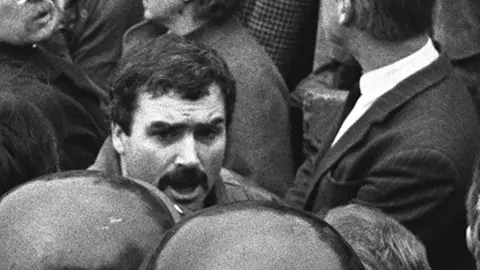
IRA spy Stakeknife was revealed to be west Belfast man Freddie Scappaticci, who died in 2023.
The major investigation into the state agent in the IRA known as Stakeknife has revealed MI5 had a bigger role in his handling than previously claimed.
The final report of Operation Kenova also said the belated discovery and disclosure of documents by MI5 to the investigation last year was "a serious organisational failure".
Stakeknife was Freddie Scappaticci, who died in 2023, but the Kenova remains gagged by the government from officially naming him.
He worked as a British agent from the late 1970s until the 1990s, and has been linked to 14 murders and 15 abductions. MI5 and the Army knew about his role in the IRA's feared internal security unit, and his involvement in torturing and killing people accused of being informers.
Operation Kenova's stark conclusions on MI5's candour is just the latest severe criticism of the security service by the courts and official inquiries in the past two years.
In 2023, the public inquiry into the Manchester Arena bombing – which killed 22 people – found that MI5's senior corporate witness had given inaccurate evidence about the key intelligence it held on the bomber before the attack.
Earlier this year, MI5 was forced to apologise after the BBC proved it gave false evidence to three courts in a case concerning a neo-Nazi state informant known as Agent X.
MI5 then tried to withhold further damning material from the High Court, and its third-in-command gave an inaccurate account of what had happened to senior judges, leading to the prime minister ordering a new investigation.
Jon Boutcher, Police Service of Northern Ireland chief constable, says he thinks that MI5 has an issue with its approach to legacy cases in Northern Ireland and that things must change.
But there is also wider question about whether MI5 can be trusted to provide truthful and full evidence to courts and investigations.
This poses a profound challenge to the government, which acts on behalf of MI5 in the courts and relies on its intelligence assessments to make big decisions.
MI5's evidence really matters. As with Operation Kenova, that evidence frequently relates to matters of life and death, but also cases concerning people whose British citizenship has been stripped or people whose liberties have been removed.
There are calls for MI5 to be subjected to increased scrutiny and be held more accountable under the law.
Campaigners behind the imminent Hillsborough Law are demanding that MI5, MI6 and GCHQ should be subjected to the same duty of candour as other public bodies and government agencies.
The law will create a new legal duty on public bodies and servants to act truthfully and fully support investigations into the state, ensuring wrongdoing is not concealed.
However, as things stand, the duty will not apply in the same way to MI5 and intelligence agencies, with individual MI5 officers not subjected to the duty, unlike people who work for organisations like the police.
Given Kenova's conclusions, how will ministers and lawmakers now react?
Another big issue for the government and MI5 is the refusal to allow Kenova to name the agent Stakeknife, despite repeated requests to do so, with the consequence that much of what was uncovered cannot be publicly described in case it identifies the agent.
As everyone knows, Stakeknife was Freddie Scappaticci, and Jon Boutcher on Tuesday said the ban on identifying Stakeknife was a "pantomime".
MI5 justifies the ban with reference to its core 'neither confirm nor deny' (NCND) secrecy policy, which has long been presented in a public as a monolithic principle that cannot be deviated from.
But in the neo-Nazi Agent X case, MI5 was forced to abandon NCND and confirm the man at the centre of the case was a state informant, after the BBC proved it had told me the man was an agent when it was trying to cover for him.
MI5 was also forced to accept it had misled a court by not revealing the existence of policies relating to departures from NCND – policies it had kept secret.
Last year, Kenova recommended that the government should review, codify and define the proper limits of the NCND policy as it relates to the identification of agents and its application in the context of Northern Ireland legacy cases.
On Tuesday, Kenova said no substantive progress has yet been made on the recommendation, and it is unclear whether and when this may change.
But the Stakeknife "pantomime", and MI5's lack of candour in other major cases, is now placing pressure on the government to act.
Email: [email protected]
Signal: @danields39.63
Click here to learn how to use SecureDrop, an anonymous whistleblowing tool that works only in the Tor browser and follow the advice to stay secure.