2 months ago
6
2 months ago
6
Essendon Airport are a band all about repetition.
“We sort of enjoy the persistence of playing something over and over again,” says co-founder and synth player David Chesworth. “We enjoy the hypnotic effect.”
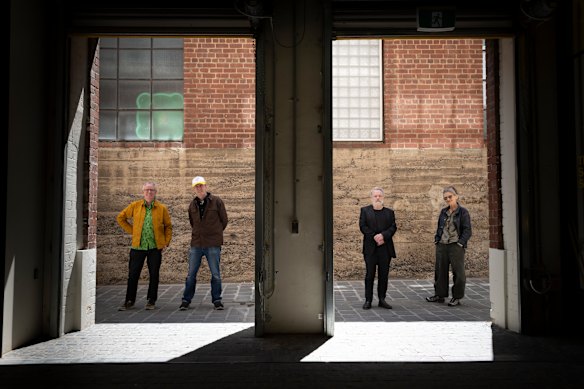
David Chesworth (left), Robert Goodge, Graham Lee and Barbara Hogarth of Essendon Airport.Credit: Jason South
In November, the Melbourne band launched their new album, MOR – their first since 1982 – to a crowd at the Northcote Social Club. That repetition was in full effect: there were the studied, hypnotic rhythms, the pulsing electronica overlaid with calm analogue warmth. Then there was the fact that the new record largely consists of material the band wrote nearly 50 years ago, and have been playing intermittently ever since.
And yet their audience keeps refreshing itself. The record was sold out after the show and is now being re-pressed.
“These days our musical peers will come up to us after a show and say, ‘How do you get young people?’” says guitarist Graham Lee. “Well, we really don’t know.”
“Audiences have changed in the way they approach music,” says bassist Barbara Hogarth. “Back then it was kind of tribal what music that you liked. Now audiences are so open.”
‘Back in the late ’90s, early 2000s, there was empty space where Australian music history should have been.’
Guy Blackman of indie record label Chapter MusicEssendon Airport, formed in 1978 by Chesworth and Robert Goodge, became a mainstay of Melbourne’s experimental music scene, centred on the Clifton Hill Community Music Centre. Over the next five years, they expanded to a five-piece and played wherever they could, including house parties, art galleries and the famed St Kilda punk venue the Crystal Ballroom.
For those whose interests lay outside the mainstream, 1970s Melbourne wasn’t an easy place to be. Imported records were rare, and the radio was almost all top 40.
“That was all we mainly had access to, and it was kind of exhausting,” says guitarist Goodge. “We tried to find something that would work for us, that we could fit together, that would give us pleasure.”
They came up with an esoteric blend of proto-electronica, with drum machines, organs and elements of experimental jazz.
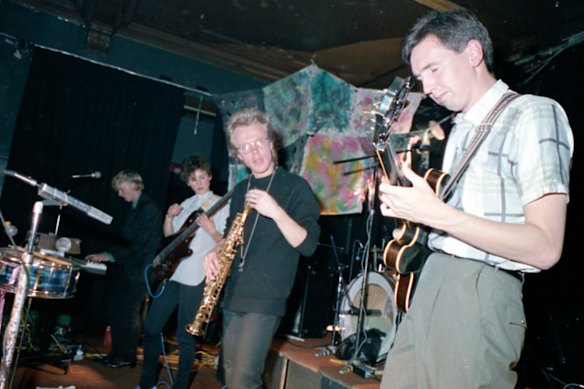
Essendon Airport perform at the Crystal Ballroom in 1982.Credit: Janis Lesinskis
The band found that when they played rock venues, their often abrasive sound “slightly annoyed people”, as Chesworth puts it.
“People weren’t ready for it,” he says. “They would be hanging around for Midnight Oil or the Boys Next Door or whatever. Yeah, it would aggravate them.”
But the varied audience at the album launch and the gig invitations they now receive – from indie festival Jerkfest to the very hip club Miscellania – tell a different story. It seems that audiences have caught up to Essendon Airport.
It was Guy Blackman of indie record label Chapter Music who kickstarted the band’s renaissance. As Chesworth remembers, he got a call from Blackman out of the blue in the early 2000s, asking “Are you the David Chesworth on this record I found in a bargain bin in Adelaide? I really like it. Can I come and see you?”
Loading
Blackman recalls picking up Essendon Airport’s EP Sonic Investigations of the Trivial in a secondhand store and hearing it for the first time. “I got it home and it blew me away,” he says. “It was so just different and kind of magical. That kind of quirky, ambient, oddball, investigative, inquisitive atmosphere of it.”
Blackman got the phonebook out and started calling every Chesworth until he found David. Soon after, Essendon Airport were included on Can’t Stop It!, Chapter’s compilation detailing Australia’s neglected post-punk history from 1978 to 1982 (reissued on vinyl earlier this year). After that, Chapter began re-issuing Essendon Airport’s recordings.
“Back in the late ’90s, early 2000s, there was empty space where Australian music history should have been,” says Blackman. “It’s been filled in a bit over the last few decades, and now everyone’s really proud of the stuff that that our artists achieved.”
In the intervening decades, Essendon Airport’s members have remained active in music and art. Chesworth has put out solo albums and created soundscapes and installations with his partner Sonia Leber, from Birrarung Marr to the Venice Biennale. Goodge and Hogarth went on to form I’m Talking with Kate Ceberano. Relative newcomer Lee is a former member of legendary ’80s band The Triffids. And Paul Fletcher has been an artist, horticulturalist and lecturer in animation at the Victorian College of the Arts.
But this weird little project from their youth has endured.
“They were so prescient in what they were doing,” says Blackman. “It takes aspects of kind of ambient music and electronica, and dance music culture that didn’t exist at the time. The minimalism, the easy listening aspects of it, all things that have been reappraised by younger people in successive generations.”
On the new album, some of the abrasiveness has worn away. That’s partly down to the band’s changing make-up, with Ian Cox’s saxophone being replaced by Lee’s slide guitar. But it’s also down to the gradual wear of repetition – the same tracks re-rendered and rerecorded across the decades.
“I think the music doesn’t really date,” says Chesworth. “It may become less relevant, and flow in and out, but it can’t be dated against what’s currently happening, because it doesn’t bear any resemblance to it.”
Loading
Meanwhile, they’ll continue to exist outside the mainstream, playing small venues to the growing audience for the eclectic.
“We’re sort of known about, just fizzing away in the background,” says Chesworth. “We’ve never peaked and we’re never going to.”
MOR by Essendon Airport is out now on Chapter Music.
Most Viewed in Culture
Loading