3 months ago
6
3 months ago
6
James Hunter re-learnt how to sail by crawling.
It had been a long time since the school holidays on Lake Burley Griffin where he’d first learned to sail in dinghies. A lot has happened to Hunter in his 61 years, not the least being that he is now completely blind.
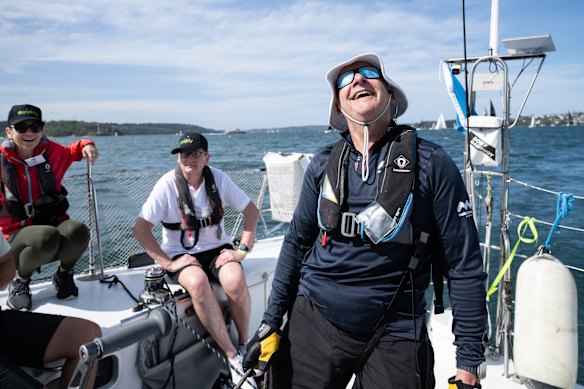
James Hunter on board MWF Kayle during the Making Waves Regatta.Credit: Louie Douvis
Inside a medical consulting room in 1995 with his parents to support him, Hunter was told there’d been a sad mistake. The degenerative eye disorder he’d been first diagnosed with at school, which was supposed to leave him blind after he’d retired, was wrong. Instead, aged 30, he was told he had two years of sight remaining.
“I was totally devastated,” he said. “It basically meant that my life goals, career aspirations, and my image were just dealt a blow – a savage blow, and I was left reeling with it.”
Hunter began training with a guide dog, learned how to use a cane and fixed up his office with audio technology at the University of New England where he worked as a lecturer. Then he waited. Two years went by and Hunter could still see.
It wouldn’t be until 18 years later, in 2015, that Hunter would wake up one morning on a work trip in Melbourne unable to navigate his way around a hotel room.
“That marked the end of a sighted life and the beginning of a non-sighted one,” he said. “I did not fully expect the emotional impact that had at the time and indeed, for quite a while after.
“Cognitively, I knew it was going to happen. I had done all the planning, the hard work and all that sort of stuff. But the emotional side of it, it’s a journey of reinventing your self-image.”
Hunter describes himself as innately competitive. He’d spent his earlier life playing tennis, cricket and hockey. His brother-in-law suggested he join the Making Waves Foundation, then known as Sailors with Disabilities. The organisation introduces people with disabilities, especially young people, to sailing.
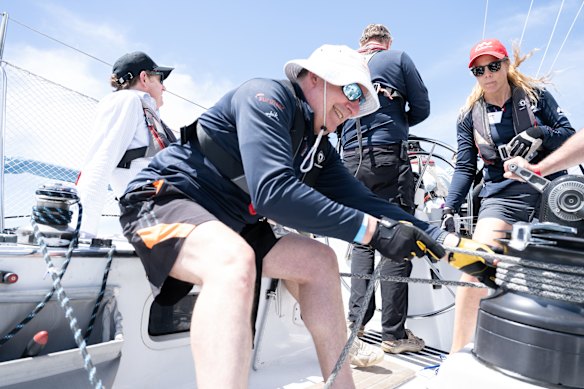
James Hunter uses lashings on the main sail rope to figure out how much to let out. Credit: Louie Douvis
Hunter’s first sail, later the same year, mostly involved sitting down.
“Close your eyes and that’s your reality,” he explains. “So, you need to map everything in your mind and your memory and you need to work on that concept of body and space. You need to be aware of where you’re at in relation to the rest of the boat in movement.”
With the help of volunteer Bridget Canham, Hunter progressed from sitting down, to crawling, to sailing, like he once had as a teenager on the lake. By the time he shows this reporter around the MWF Kayle, he has completed two Sydney to Hobarts and is preparing for his third next month. The boat, which is owned by the foundation, will be crewed by 13 sailors – half of them with disabilities.
On Sydney Harbour, Hunter uses gloves with holes in the thumb and forefinger to find lashings on the main sail rope which indicate how much he can let out. With my eyes closed and body kneeled over the way Hunter once had, I spend most of the race sick as the boat heeled from one side to another.
“I’ll tell you this, on a dark night in the middle of the Bass Straight, who’s blind?” Hunter calls out above the wind. “We all are,” he answers.
Loading
Before his first Sydney to Hobart in 2023, Hunter assumed the notoriously risky race would be too dangerous for him. But, being aware of his limitations, like any sailor, is what keeps him safe.
“I work here on the main [sail] because I can use other senses and I can do it well. There are other parts of the boat that I won’t be going to because it’s dangerous for me and dangerous for everyone else. So it’s that acknowledgment and being honest. Honest with myself and honest with those around you.”
It’s hard not to get sentimental about the opportunities the foundation has provided to those like Hunter, or how it feels to sail in the open ocean, heightening each remaining sense.
“For me, it’s the immenseness,” he said. “You are totally at the mercy of the waves … and the wind and the weather, and you realise just how insignificant you are in this world. And even that realisation is important because it allows you to recognise that you have to really bring your best step in life and never more important than out in the middle of the Bass Strait.
“But more importantly, you also acknowledge that you have to rely on others, they have to rely on you. It’s really – not to get too wah-wah about it – it’s a moment of deep reflection.”
Most Viewed in Sport
Loading