
 3 months ago
93
3 months ago
93
Sydney’s cutest harbourside residents need our help. Fairy penguins, now known more by the far more prosaic name of little penguins, once lived all over the city’s coastline. Today they only survive in and around Manly, and their future is far from secure.
There are just 15 breeding pairs returning to nest at Manly each year, and the population is stubbornly refusing to grow.
The number has been stable for the past few years, but the position of the colony is precarious, as Dr Benjamin Pitcher, penguin researcher and behavioural biologist at Taronga Conservation Society Australia, explains.
“Unfortunately, it only takes one fox to get in, and they can decimate the colony,” Pitcher says. “One of the big threats to declining populations of any species is they become more and more vulnerable to random events like predation.”
Wildlife under pressure from urbanisation can cling on in suburbia for a surprisingly long time. Take the eastern quoll, a small carnivorous marsupial once prevalent throughout forests in south-eastern Australia, but now only found in Tasmania. The last known sighting of an eastern quoll on the entire Australian mainland was in Nielsen Park, Vaucluse, in 1963, long after they died out elsewhere.
So, too, have little penguins persisted at Manly for decades. The first breeding pairs of the 2026 winter have already started to build their nests in the rocky crevasses in the cliffs under houses along Addison Road. It is a little earlier than usual – restrictions on construction during penguin breeding season do not start until the end of May.
When the little penguins come ashore to breed, from May to February the following year, and in March to moult, they are in danger of predation by foxes, dogs and cats. At sea, they are at risk of being struck by boats, and instability of food availability amid warming oceans. A further threat is when urban development removes the rocky nooks and crannies that form their habitat.
The little penguins forage all over the harbour and up and down the ocean coastline, and many Sydneysiders have experienced the delight of spotting one in the water. Manly residents who have the privilege of encountering them on land are often proud and protective.
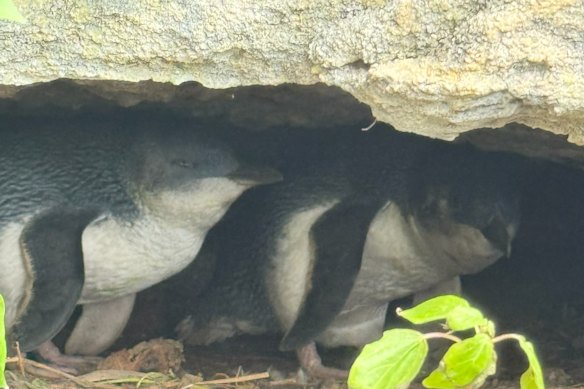
“One of the great things about Manly is there’s a lot of community support for the penguins,” Pitcher says. “The community really owns and values that penguin population.”
Is being beloved enough to save the Manly penguins? What would it really take and, if it involves sacrifices on urban development or pet ownership, are we prepared to do it?
Back in 2013-2014, there were 70 breeding pairs of penguins at Manly. They were breeding well, recruiting new members to the colony from birds that swam by, and the introduction of fledglings from other locations to Store Beach in Sydney Harbour National Park had been successful.
The translocation, outlined in a 2015 paper published in Marine Ornithology, detailed how 44 wild-bred fledglings from Lion Island in Broken Bay and 19 captive-bred fledglings from local zoos were taken to Store Beach in the three years to 2006-2007. By 2013-2014, at least some of the wild birds had returned to Store Beach and nearby places on the headland to breed and numbers were increasing.
Then in 2015, tragedy struck: a feral fox discovered the penguins and saw dinner. At least 27 penguins died in several attacks at multiple locations, including Store Beach.
National Parks and Wildlife Service has stepped up fox control, using daily camera checks and fox baiting with 1080 poison on North Head. Members of the public are requested to report any fox sightings in the Manly area on FoxScan.
However, earlier this year Northern Beaches Council voted to ban the use of 1080 on humane grounds, in favour of targeted shooting, trapping, den fumigation and fencing alone, which may make the fox control on council lands less effective. The Invasive Species Council has written to the council to express concerns, particularly for penguins at North Head. However, Northern Beaches Mayor Sue Heins says council has never undertaken 1080 baiting on council-controlled land in Manly because it would be too close to homes.
Pet dogs are also a problem for the penguins, particularly when they are off leash. Northern Beaches Council is under pressure from its community to increase the number of off-leash dog areas, which retired seabird scientist David Priddel warns could be catastrophic. “That would be the end of your penguins,” Priddel says. “Dogs and penguins don’t mix, and foxes and penguins don’t mix. People and penguins can mix, but you’ve got to have the right kind of people.”
Penguin wardens, local volunteers who operate under the auspices of NPWS, used to guard a pair of penguins that nested under Manly Wharf. Their task was to ensure dog walkers kept their pets on leash and did not get too close. However, the birds have not returned to this location for several years.
NPWS also list cats as a threat, and it is illegal to let pet cats roam within the parts of Manly marked as penguin habitat – known as the Area of Outstanding Biodiversity Value.
The Australian Registry of Wildlife Health at Taronga Zoo processed 11 dead little penguins last year, four of them from suspected dog bites, three with boat or propeller injuries, three that were young and emaciated, and one where the cause of death is yet to be determined.
The team can perform a necropsy on a penguin carcass to determine the cause of death, including being able to distinguish between fox and dog attacks based on the pattern of the puncture wounds and the DNA around the wound site.
Penguins are particularly vulnerable during their annual moult – a three-week period when the penguins sit still on a rocky outcrop for three weeks and do not eat, while they shed and replace all their feathers. The birds inadvertently broadcast their location because of all the droppings and feathers, making them easy prey for any predators.
Priddel says curbs on dog ownership in Manly would be “very helpful” but, based on his experience working for NPWS, unlikely to get public support.
Pitcher says the current approach of raising community awareness and education about responsible pet ownership is working well.
A spokesperson for the NSW Department of Climate Change, Energy, the Environment and Water says pets are already banned in the habitat area – residents in Addison Road can own pets, but must not allow them down to the foreshore.
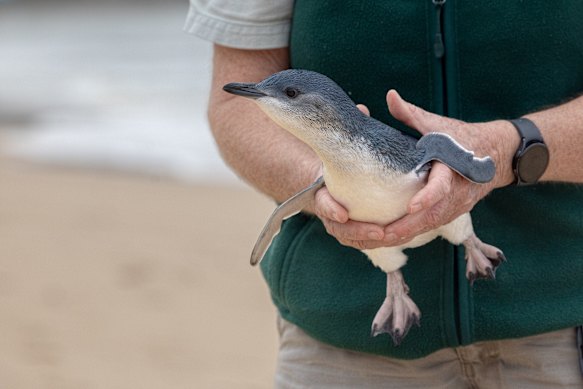
Taronga Zoo takes in penguins during moulting season and then releases them, as well as rehabilitating emaciated chicks or those with injuries from boat strikes. (The birds attacked by dogs and foxes are usually dead on arrival.)
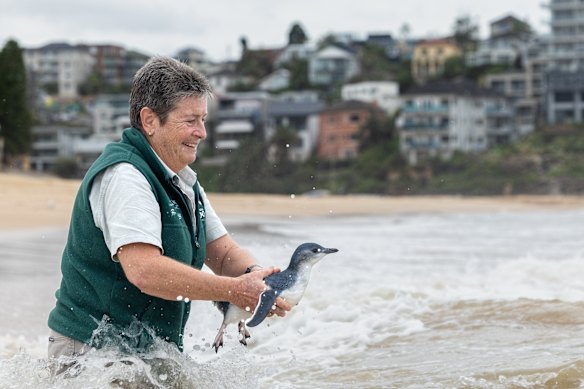
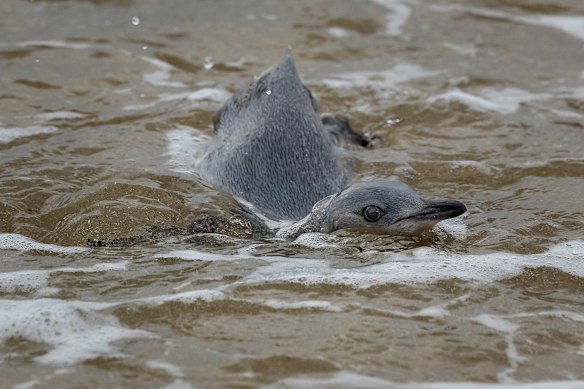
In March, the team released a rehabilitated juvenile penguin, which still had some of its baby fluff, at the north end of Manly Beach.
Sarah Joyce, executive director of the Sydney Coastal Councils Group, says the most recent monitoring report, yet to be released by the NSW government, shows that boat strike is still an issue, and that only one out of 10 chicks is surviving to breeding age. Chicks are often emaciated because of lack of food.
With NPWS and Northern Beaches Council focused on the penguins on land, Joyce’s organisation promotes the safety of the birds in the water. “We just saw that there was a gap there,” Joyce says. “And that no one was thinking about the penguins once they left the land and go into the water.”
Every September as the weather warms up, her group pushes an education video, reminding people about rules around anchoring and to reduce boat speed to avoid hitting penguins, especially at dawn and dusk when the birds band together and form rafts to get to shore.
Joyce says it is hard to judge the impact of urban development because a lot of the penguins currently preferred to nest in rocky crevasses underneath houses rather than in the national park.
“They are still breeding within urbanised areas and, for some reason, in the national parks where they have bred before, and you think it’d be nicer, much cosier habitat to go and breed in, they’re not,” Joyce says. “Is this population so used to urbanisation that they feel comfortable in a more lit area?”
The birds can also be contrary – in Eden on the South Coast, there is a fenced area for little penguins, but many have chosen to nest 500 metres away. Two new dead penguins were discovered in Eden on Friday, attacked by either a dog or a fox.
The Area of Outstanding Biodiversity Value designation means all development applications have a higher standard of assessment, and require an additional report on the impact on habitat. Whether this is sufficient is another question; Northern Beaches Council declined an interview request and the written response from the mayor did not directly address this question.
Decline across NSW
Priddel says penguin colonies grow through recruitment as well as breeding, and birds swimming by tend to be attracted to a “noisy colony” so success begets success.
The NSW environment department spokesperson says its science-driven management of the colony includes a sound machine that mimics the noises of a healthy penguin colony in the hope of attracting more penguins. However, penguins usually return to breed at the site where they hatch.
A source familiar with the program says NPWS has run the sound attraction system for the decade since the 2015 fox attack, and no new breeding has occurred as a result.
Part of the reason is that it is not just Manly’s little penguins at threat. Colonies in other parts of NSW are also declining, even on offshore islands without foxes and dogs.
The department spokesperson says the decline is most marked at the northern end of the penguins’ range, such as Lion Island, where the population decline has been similar to Manly. “Climate change and rising ocean temperatures in particular are limiting the food supply these birds need to thrive,” the department spokesperson says.
There is not much money available for researching little penguins, especially what happens to them at sea, scientists say.
Pitcher says the penguins can wear trackers for short periods of time, giving insight into their all-day foraging trips, but not the longer intervals between breeding seasons.
Taronga has a research program supported by the NSW government using eDNA analysis of penguin scat to see what the birds have been eating and how available that is in the surrounding ocean.
In Victoria, Phillip Island has 38,000 breeding pairs and St Kilda has a thriving colony that was successfully fenced off to protect the penguins. Manly, with its mix of land tenures and different geography, is harder to fence off, and Pitcher says it’s also already bearing the brunt of climate change.
“The Victorian colonies around Bass Strait are subject to different environmental conditions than our ones in NSW,” he says. “We’ve got the East Australian Current coming down past the coast, and that is one of the global hotspots for global warming.
“The NSW penguins, in a sense, are the canary in the coal mine for these impacts of climate change that we’re seeing in our marine ecosystems.”
Offering hope are some of the restoration projects in Sydney Harbour, such as Project Restore and the Living Seawalls program by the Sydney Institute of Marine Science.
“They’re small at the moment, but as they get bigger, they’re going to really support the whole food web in the harbour,” Pitcher says. “If we can build up that and restore more of the habitat in the harbour, then there’s going to be more resilience for the predators, like the penguins.”
Get to the heart of what’s happening with climate change and the environment. Sign up for our fortnightly Environment newsletter.

















































