
 3 months ago
74
3 months ago
74
Craning our necks beneath Bologna’s famous two towers, we can see what Dante was on about. The clouds passing over the looming, leaning medieval skyscrapers appear to make them lean all the more, just as they did in the 14th century, when Italy’s supreme poet compared one to a giant in his epic Divine Comedy.
Back then, Bologna bristled with about 100 towers. Today only two dozen remain and of those, Garisenda and her taller sister Asinelli are the northern Italian city’s most recognisable symbols. Climbing the 498 steps of the 97-metre-high Asinelli – the world’s tallest leaning medieval tower – was, until recently, a tourist rite of passage. But authorities became worried that Garisenda might topple over completely, and now both it and Asinelli have been fenced off while stabilisation works continue.
So we head to the Clock Tower instead and ascend the stairs for magnificent views over Piazza Maggiore, the grand central square, taking in the famous skyline of La Rossa (The Red City), so-called not just for its red-brick buildings and terracotta-tiled roofs but also for the tinge of its politics.
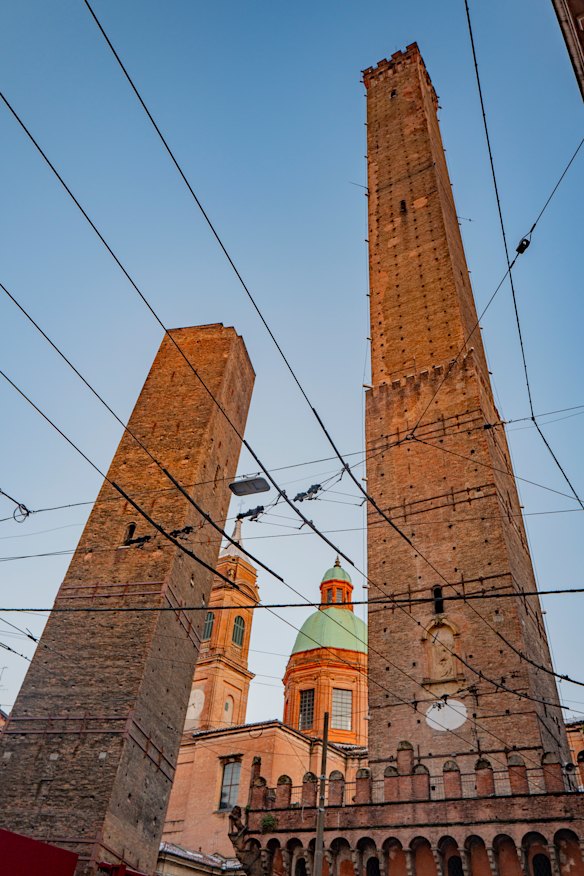
Bologna’s two famous towers were built in the 12th century by a pair of powerful families in a competitive display of wealth and status, and it was this spirit of capitalist rivalry that turned the city into a medieval Manhattan.
But the tall towers aren’t the city’s most enduring architectural legacies, we discover. That accolade goes to the porticoes – the handsome, covered colonnades that line the streets of the historical centre for more than 40 kilometres, and beyond the gates for 20 more. These grand pedestrian boulevards are the pulsing arteries of Bologna, spreading life to the city’s four corners and beckoning tourists and townspeople to explore its medieval and Renaissance marvels at a leisurely pace.
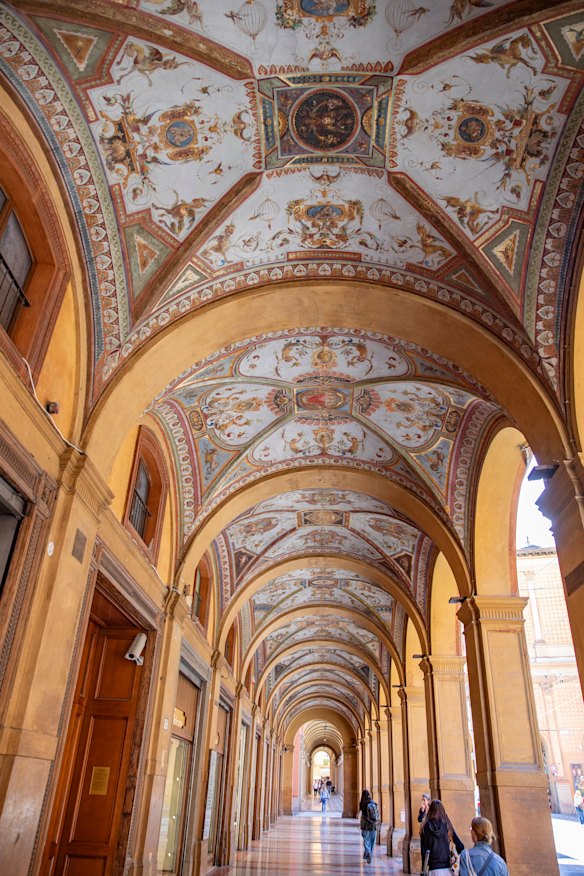
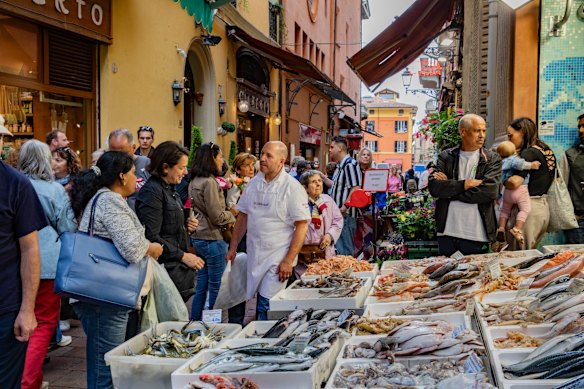
From Piazza Maggiore, where we visit the famously unfinished Basilica of San Petronio – partially clad in marble, like a biscuit dipped in tea, after public funds ran out in the 16th century and the pope refused to back it – we wend our way towards our accommodation on Via Santa Stefano. Striding beneath the porticoes’ grand, vaulted arches, we pass the ancient market area known as the Quadrilatero, boutiques and bakeries, students sipping Aperol and outdoor diners spilling from cafes, bars and restaurants.
Bologna is, of course, famous for its food and many of the people bustling along the arcades are likely to be heading out for one its famous dishes, whether it’s a panini stuffed with mortadella (the city’s signature cold cut), a steaming bowl of tortellini in brodo (broth) or a hearty plate of tagliatelle al ragu (don’t ask for spaghetti bolognese; it’s considered an immigrant offshoot of the real thing).
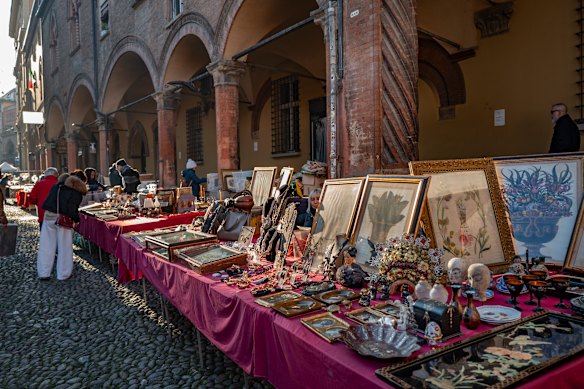
In front of the Basilica of Santo Stefano, known as the Seven Churches – an intriguing mix of ecclesiastical structures on the site of a pagan temple – we arrive at the piazza famous for its antique market and browse the stalls for ceramics, trinkets and vintage treasures.
It’s clear that the porticoes bind the community together and create the sense that the entire city is the attraction, rather than the usual set of disconnected and over-touristed sites. That they survive intact seems a miracle, but their story can be traced to the city’s reputation as a centre of scholarship, along with some far-sighted city planners.
Founded in 1088, the University of Bologna is considered the oldest university in the western world still in operation, predating Oxford by more than 160 years; Dante Alighieri, astronomer Nicolaus Copernicus, inventor Guglielmo Marconi and semiotician-novelist Umberto Eco are among the luminaries who have graced its halls.
The university’s origins lie chiefly in its famous law school, whose early scholars devoted themselves to extensively annotating rediscovered sixth-century Roman legal codes that were compiled under the emperor Justinian. The uni became Europe’s main centre for the study of medieval Roman law and its body of work would eventually form the basis of civil law systems around the western world.
By the end of the 11th century, the uni was bursting with students and scholars from around Italy, Europe and beyond, along with merchants, craftsmen and pilgrims, placing pressure on housing space in the increasingly crowded city. Today, the university still attracts exchange students from around the world (including our son, hence the reason for our visit).
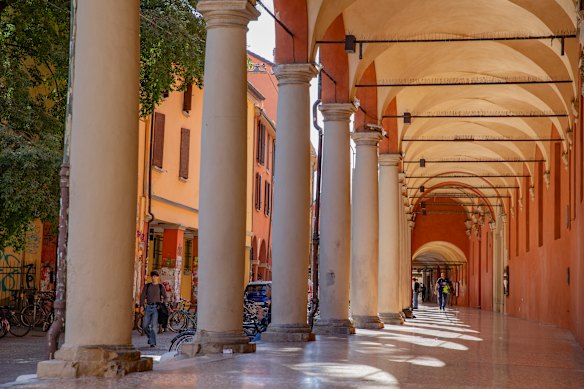
The solution the Bolognese came up with 10 centuries ago was to extend and enclose their streetside balconies so that extra rooms could be created for students and teachers to rent. This created not only more urban space without the need to create new buildings, but also a wide, sheltered area below that was accessible as a public thoroughfare.
In a masterstroke of urban planning, in 1288 the city decided to make the most of this burst of civic ingenuity and proclaimed that all new and existing buildings should have a portico, and that the minimum height should be 2.66 metres: high enough for a horseback rider wearing a hat, and broad enough for pedestrians, artisans and traders to comfortably pass by.
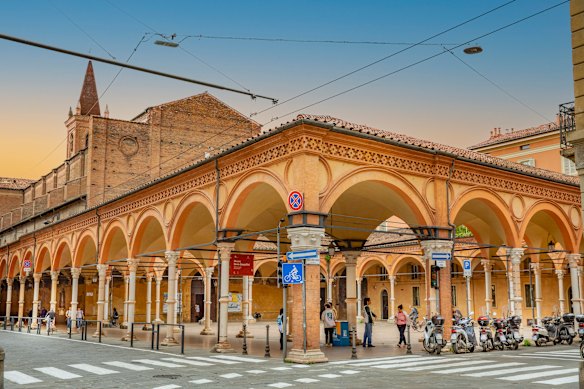
The lucrative influx of students from around Europe and beyond prompted the city elders to preserve the porticoes’ iconic form. Three centuries later, in 1568, it was decided that all the timber-supported structures would be upgraded to brick and stone (although a few examples of the old wooden porticoes remain). The result, achieved over the centuries since, is a network of connected, covered walkways unmatched in any city around the world.
In 2021, World Heritage status was bestowed on 12 sections of the city’s porticoes, ranging from the opulently decorated, vaulted arches along Piazza Cavour and Via Farini, to Via Zamboni, in the heart of the university district, to the longest, a 666-arch stretch leading pilgrims four kilometres uphill to the Sanctuary of the Madonna of San Luca, and the widest, at the Basilica of Santa Maria dei Servi, built to contain the overflow of worshippers barred from religious rites because they weren’t baptised.
The porticoes have increased housing while creating shelter, shade, a sense of pride in a shared community space and a desirable place for tourists and residents to amble. As we prepare to farewell the city and set off on a driving tour of central Italy, we wonder: could our own politicians and planners come up with such an elegant and long-lasting solution to today’s housing crisis? Or will they just leave behind empty towers doomed one day to topple?
Get the best of Good Weekend delivered to your inbox every Saturday morning. Sign up for our newsletter.
Read more from Good Weekend:

















































