3 months ago
7
3 months ago
7
Four decades ago, some kids are kicking a soccer ball around an Adelaide backyard. Fast-forward 20 years and one of those kids, Cos Cardone, is one of millions of Australians watching another of those kids, John Aloisi, stepping up in Sydney’s Olympic Stadium in 2005 to take a penalty that could put the Socceroos through to the World Cup Finals for the first time in a generation.
Fast-forward to last week, and Cardone, now the chief executive of JAM TV, one of Australia’s leading sports TV production houses, has realised a dream with the documentary The Kick that United a Nation, which celebrates that famous night.
“John and his brother Ross [who also played for Australia] were always together,” says Cardone. “We lived next door to their cousins and then they actually lived for a short time next door to us. Every time you picked up the local paper, one of them was on the back page.
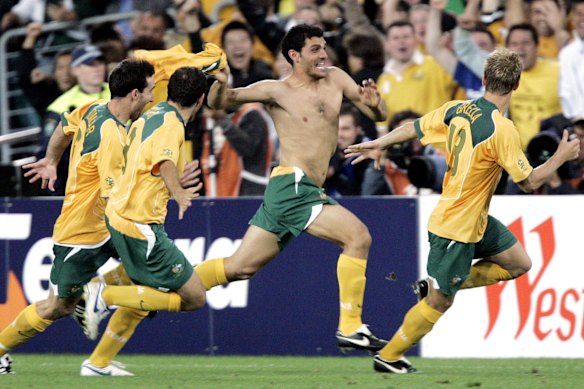
A shirtless John Aloisi celebrates scoring the penalty against Uruguay that put Australia into the 2006 World Cup.Credit: AP
“Then actually to get to that night [in 2005], it was John, who stood up and took the penalty, it was amazing. And now he’s forever etched in Australian sporting history.”
In the documentary, telling the story of that night, are key Socceroos Mark Bresciano, Mark Schwarzer, Tony Popovic, Archie Thompson, and Aloisi himself. Australia’s coach that night, the Dutch master Guus Hiddink (Chelsea, Real Madrid), describes how that campaign was one of his proudest achievements.
The then Prime Minister John Howard and billionaire soccer chief Frank Lowy are joined by soccer tragic Santo Cilauro, the former host of Santo, Sam and Ed’s Total Football, to explain the background. There’s even an interview with John Travolta, who popped up unexpectedly in the Socceroos’ dressing room to celebrate the triumph and trigger a spontaneous Grease singalong.
Loading
Cilauro says watching the documentary, and reliving the play-off, conjured up conflicting emotions. “I just realised how joyous that moment was because of the pain,” he says. “So it was strangely traumatic. Strangely traumatic, but incredibly uplifting. And also, you just get a real sense of what it takes to get something done. Yes, it was one kick, but, oh my god, there was so much that went into it.”
Across 32 years the footballing gods had found ever more fiendish ways to thwart the Socceroos’ quest to participate in the world’s most-watched sporting event. Scotland knocked us out at the final hurdle in 1985. Diego Maradona’s Argentina did the same in 1991. And, in 1997, it was Iran’s turn at the MCG after we were two goals in front.
In 2005, the screws were being turned again. A 1-1 draw on aggregate with the fifth-ranked South American nation, Uruguay, meant the Australians had to endure extra-time, and then a penalty shootout. Mark Viduka, arguably Australia’s best-ever player, failed to hit the target. But if Aloisi scored, progress to the finals in Germany would be secured.
For drama, history and sheer rip-your-shirt-off-and-celebrate excitement, it’s a sporting moment that ranks with the nation’s best – winning the America’s Cup and Cathy Freeman’s Olympic gold.
Two decades on, Aloisi is still constantly reminded of that kick. Just this week, coming out of a Melbourne gym, he heard a passing cyclist call his name. “The guy stopped on his bike and he goes, ‘John!’” recalls Aloisi. “I thought maybe I knew him, but I didn’t. And he goes, ‘Can I just thank you for what you’ve done for Australian football.’ And it’s because of that moment.”
Cardone organised a meeting with Aloisi last year to discuss making an anniversary documentary. “When we first met for coffee he told me about the night before the game at training, how he had stayed behind to practise penalties, and hit them all in the same spot,” says Cardone. “And then in the shootout, he put his hand up for the fifth penalty. That dedication, that’s what it’s about. I said, ‘Make sure you tell that story.’”
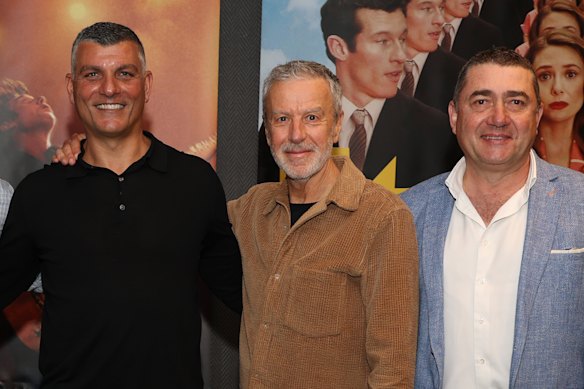
John Aloisi, Santo Cilauro and executive producer Cos Cardone at the documentary’s launch.Credit: Getty Images for Football Australia
Four years before the big Sydney game, the Socceroos had also faced Uruguay in the intercontinental play-off for a finals place. Aloisi, who played for top Spanish club Osasuna, was in the squad for those games as well, and found himself facing Osasuna teammates Richard Morales and Pablo Garcia in the Uruguayan side. The documentary shows the reception the Australian team received in Montevideo, being heckled and jostled as they battled through the terminal to their bus. Hostile crowds assembled outside their hotel to serenade them through the night.
Loading
“I remember being there [in 2001], we were beaten before the game,” says Aloisi. “And then after that, it wasn’t in the doco, but I copped it from my teammates over in Spain [at Osasuna]. So I copped it for three years from them.”
After that defeat, the players and authorities were determined they would get the preparation right next time. “That’s why in the doco, I said that when we got drawn with Uruguay, I was like, ‘Yes!’ Because I knew them so well,” says Aloisi. “So I could tell my teammates, ‘This is what it will be like. I know the way that they will try and intimidate us.’ All those things, you know, it just really helped.”
Hiddink emphasised the importance of the players being rested between the away leg in Montevideo and return game in Sydney. Fortuitously, Qantas sponsored the Socceroos, and a private jet was arranged that touched down mid-Pacific, so the players could stretch.
A genial figure now, Hiddink created a tense atmosphere at training, making it clear he wasn’t impressed by any of his players’ reputations. “Looking back now, I understand,” says Aloisi. “We had to be able to deal with the pressures and how intense it could be against Uruguay, in such a big moment, in front of 80,000 people. If you can do it in front of Guus, 80,000 people is not a worry!”
The Kick that United a Nation is now streaming on Paramount+.
Find out the next TV, streaming series and movies to add to your must-sees. Get The Watchlist delivered every Thursday.