3 months ago
37
3 months ago
37
The Danish toymaker that built a global empire on interlocking plastic bricks has unveiled what executives are calling the most significant evolution in its 93-year history: a tiny computer embedded inside a standard Lego brick.
Announced at the Consumer Electronics Show in Las Vegas, Lego Smart Play represents an eight-year, several-hundred-person development effort to add interactivity to physical toys without requiring screens, apps or complex set-up procedures.
“We introduced a step change to the Lego system of play,” Julia Goldin, Lego’s chief product and marketing officer, told this masthead. “We’re introducing a platform consisting of a smart brick, tags and interactive minifigures that fits seamlessly with the rest of the system, but provides an opportunity to bring a new dimension to play.”
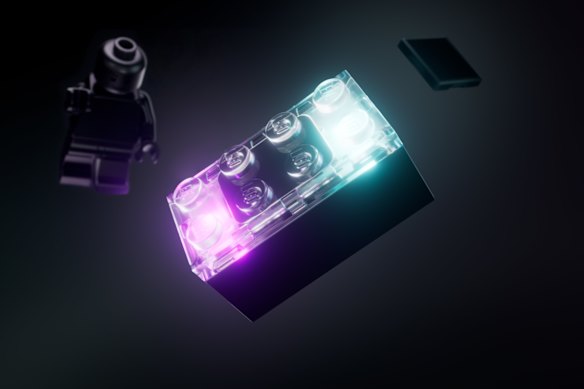
A Lego smart brick.
The technology centres on a custom-designed chip measuring 4.1 millimetres – smaller than a single Lego stud – packed with accelerometers, light sensors, a microphone, LED array and miniature speaker. When paired with NFC-equipped tiles and minifigures, the brick responds to children’s play with contextual sounds and light effects: lightsabers hum, engines roar, and spacecraft emit blaster fire.
Tom Donaldson, head of the Creative Play Lab at Lego, said the project required capabilities far beyond traditional toy manufacturing.
“It goes beyond just the technical department. It’s our supply chain, it’s our operations, it’s how we market things, it’s how we think about play and think about designing play,” Donaldson said. “Really substantial... Many hundreds of people involved in one form or another.”
The first products, three Star Wars-themed sets priced between $99.99 and $249.99 in Australia, will launch on March 1, with pre-orders opening January 9.
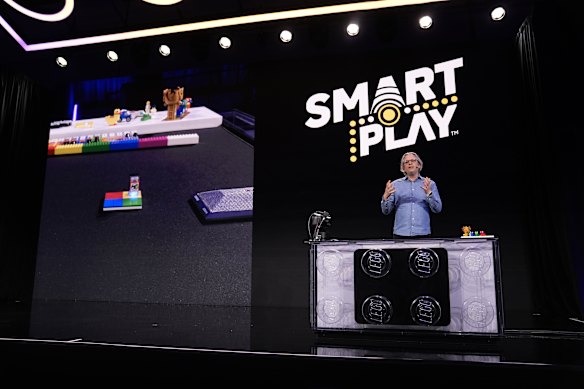
Tom Donaldson, head of Lego’s Creative Play Lab, at a news conference ahead of the CES tech show in Las Vegas.Credit: AP
The announcement carries particular weight given Lego’s history of near-death experiences and dramatic recoveries.
Founded in 1932 by Ole Kirk Christiansen in Billund, Denmark, the company began as a carpentry workshop making wooden toys during the Great Depression. The name derives from the Danish phrase “leg godt” – play well.
The modern Lego brick, with its distinctive hollow tubes enabling secure interlocking, was patented in 1958.
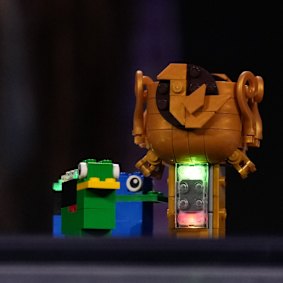
A Lego piece with a smart brick attached.Credit: AP
But the company’s defining moment came in August 1978 with the introduction of the minifigure: small poseable people with distinctive yellow heads and printed expressions that transformed Lego from a construction toy into a storytelling platform.
By 2004, Lego had nearly collapsed. Aggressive forays into theme parks, clothing and video games, combined with declining interest in traditional toys, pushed the company to the brink of bankruptcy. A dramatic turnaround under new leadership – including refocusing on core brick products and strategic licensing deals with franchises like Star Wars and Harry Potter – restored profitability.
The company now claims Lego Smart Play represents the most significant evolution since that 1978 minifigure introduction.
Critically, Lego has designed the system to operate without internet connectivity, artificial intelligence or cameras. Firmware updates and diagnostics are handled via a companion app, but the play experience itself requires no external technology.

“We’re just scratching the surface”: Lego chief product and marketing officer and executive vice president Julia Goldin at the Lego press conference.Credit: AP
Goldin said this was a deliberate choice to address parental concerns about screen time while extending physical play.
“There’s not one parent, I don’t think out there, that doesn’t want their child to have more physical play versus just screen time,” she said. “A small child can actually take it and play with it safely. They don’t need a screen, they don’t need a power button, they don’t need to know anything. They can just start playing.”
Donaldson said research showed children wanted play that was “more dynamic so that it changes over time,” and “more social” while remaining under their control.
“For those kids who like social, who like something that’s changing, that you can do stuff and stuff happens – but in an imaginative and creative way – we think it’s a great offering,” he said.
Independent toy researchers have raised both opportunities and concerns about the technology.
Katriina Heljakka, a play researcher at Finland’s University of Turku, told Wired magazine the system could help address criticism that Lego has increasingly targeted adult collectors with display-focused sets rather than children’s toys. However, she noted the “internet of toys” has historically raised security concerns about potential hacking vulnerabilities.
Lego says the system employs “enhanced encryption and privacy controls” and the microphone functions only as a sensor trigger – detecting sounds like blowing on a birthday cake – rather than recording audio.
Loading
The company declined to specify future product lines, though Donaldson hinted at significant expansion.
“We see a tremendous amount of opportunity and a huge breadth of opportunity,” he said. “We think the technology allows us to deliver a really broad range of play patterns. So it’s not just one thing that’s sort of endlessly repeated, but a real breadth hitting many different kids.”
Goldin said the launch was merely the beginning.
“Once our consumers get their hands on the bricks, once they get their hands on this new dimension, that’s when the magic really starts to happen,” she said. “We’re just scratching the surface.”
Whether Australian parents - and their children - agree that their Lego needs a chip inside it will become clear when the first sets hit shelves in March.
David Swan travelled to Las Vegas with support from Samsung, LG, Hisense and Lego.
Most Viewed in Technology
Loading