
 4 months ago
77
4 months ago
77
Within three weeks, the first of two giant boring machines pieced together beneath Sydney’s inner west is set to start burrowing its way under the harbour, leaving a tunnel large enough to fit three lanes of traffic in its wake.
The second machine will crank into gear about two months later, creating the other tunnel which will form the final stage of the $7.4 billion Western Harbour Tunnel motorway. It is designed to ease congestion on existing harbour crossings, allowing motorists to bypass the western side of the CBD.
Like any mega project, their journeys under the harbour come with risk. Critical to their success is a maze of pipes, filter presses and other equipment assembled over the last year within two giant caverns. They form what is known as the slurry treatment plant, part of which uses recycled equipment from Britain’s high-speed rail project and Paris’ suburban rail expansion.
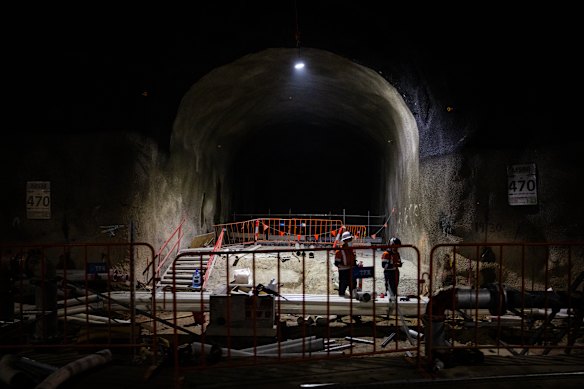
Clambering over the plant, Transport for NSW project director Simon Cooper likens it to the lungs of the entire project, ensuring slurry is circulated through the faces of the boring machines while removing rock and other spoil carved out to create the tunnels.
“If the lungs can’t breathe properly, the [boring machine] won’t move forward,” he said.
The fast-approaching launch of the boring machines, which are more than double the width of those used to dig tunnels for Sydney’s metro rail lines, is nerve-racking for workers on the project. When they worm their way northwards, the machines will reach depths of up to 47 metres below the harbour surface.
“The reduced sleepless nights for me will come once we’re through to the other side of the harbour,” Cooper said.
That is up to a year away, when the boring machines will break through into caverns dug especially for them under Waverton on the lower north shore.
Staggering the launch of the two giant borers is partly aimed at avoiding them hitting the riskiest zone of soft ground under the harbour at the same time. The zone, containing a mixture of clay, silt and sand spans several hundred metres in a paleo-channel – a historical riverbed below the harbour that has silted up over millennia.
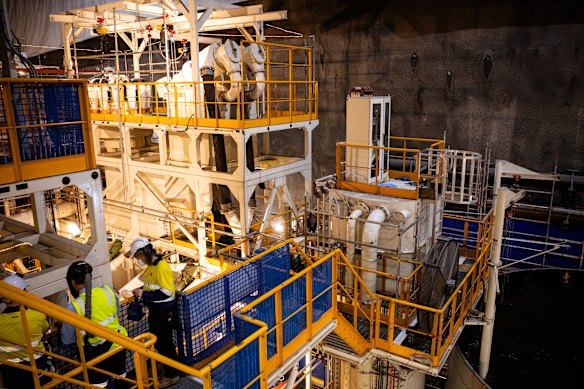
More than 50 kilometres of pipes bolted to tunnel walls connect the treatment plant to the boring machines, which have been assembled beneath Birchgrove. Once tunnelling starts, the plant will pump up to three million litres of bentonite slurry – a very fine clay – every hour to each boring machine. That will provide enough pressure to prevent ground at the front of the boring machines from caving in around them. In essence, it provides support until concrete segments can be lifted into place to line tunnel walls.
In most cases, slurry treatment plants are built above ground, and are spread over a much larger area. This time, it was pieced together underground to limit disruption to residents. It took more than a year due to the challenge of assembling pipework and small components in a constrained space. The boring machines took about five months to assemble.
The underground factory’s other main job will be to process the rock and other spoil churned out by the boring machines.
In one cavern, a centrifuge will spin at high speed, separating finer material from larger rocks. Mixed with water, the finer material will be pumped to a row of filter presses in the other cavern. Acting like giant French coffee presses, they will squeeze out water, leaving a dry, tile-like material which will be carried along more than 1.5 kilometres of conveyor belts to giant bins. From there, it will be loaded onto trucks and carted away.
“What we don’t want is wet material because that means it might flow out of the truck while we’re driving it on the road,” Cooper said.
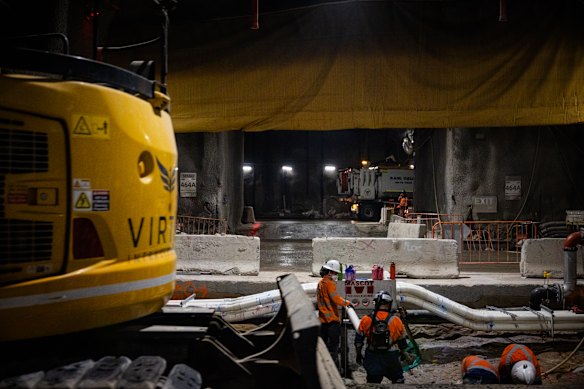
Once tunnelling is in full swing, an average of 250 truck and trailer loads of spoil will exit the underground site each day. At a peak, it will reach up to 400 truckloads a day, which will head out via the WestConnex motorway tunnels under Rozelle. Hundreds more trucks will enter and exit carrying concrete segments and other deliveries.
Ahead of the launch date for the first boring machine, contractors are working around the clock to put the finishing touches to the labyrinth of pipes, filters and other equipment that comprise the treatment system. As part of the commissioning, they are pumping water held in a giant storage tank through the plant to check for any leaks.
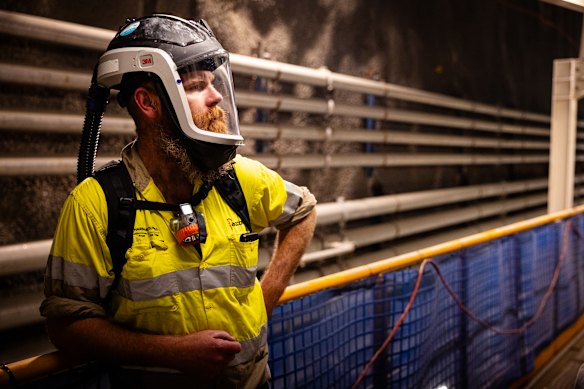
Slurry treatment plant senior supervisor Blake Matthews said the confined space in the caverns had made the job of assembling the plant a challenge. “A surface treatment plant could have multiple cranes going here, there and everywhere. It has had to be strategically built in a way where we weren’t going to box ourselves in,” he said.
Matthews has been involved in tunnelling for the past 15 years, and has worked on Sydney’s metro rail projects and the WestConnex motorway. He describes the under-harbour crossing as “the big one”, which will involve teams operating the plant around the clock, seven days a week.
“It’s going to be madness, but it’s going to be exciting,” he said. “Once all these motors are running, this is going to be a hot, humid area.”
Spanning 6.5 kilometres, the motorway he is helping to build is due to be completed in 2028, linking the Warringah Freeway on the north shore to WestConnex in the south.
After the boring machines finish their job next year, the treatment plant will be pulled apart and the two caverns housing it will be left largely empty. They will be walled off from the motorway tunnels, becoming another legacy of Sydney’s once-in-a-generation transport building boom.
Start the day with a summary of the day’s most important and interesting stories, analysis and insights. Sign up for our Morning Edition newsletter.

















































