3 months ago
14
3 months ago
14
Opinion
December 5, 2025 — 5.00am
December 5, 2025 — 5.00am
Apologies for my absence last week (or alternatively: you’re welcome). I’ve spent most of this fortnight far away from the news cycle, in the sacred cities of Mecca and Medina. Around the time Pauline Hanson strolled into the Senate chamber wearing a burqa, I was strolling into the Prophet’s Mosque, and I can’t tell you how small, how powerless Hanson’s stunt suddenly seemed. I’d seen its like before in 2017, and even in 2014 when Bronwyn Bishop tried to ban anyone wearing a face veil from entering Parliament House – even if only to watch their representatives from the gallery. Such things are designed to dominate the political imagination. To view them from somewhere like Medina is to recognise just how tiny that imagination can be.
That’s because politics imagines nothing beyond power. It imagines a world of total human sovereignty, where people impose their will on others, and on events. When, inevitably, it turns out we have no such control, when the economy won’t behave, or a conflict erupts in an unforeseen way, or a pandemic arrives, politics retreats to anxiety, anger and fear. No one wins office by acknowledging that most things are beyond their control. Many lose it once this becomes apparent.
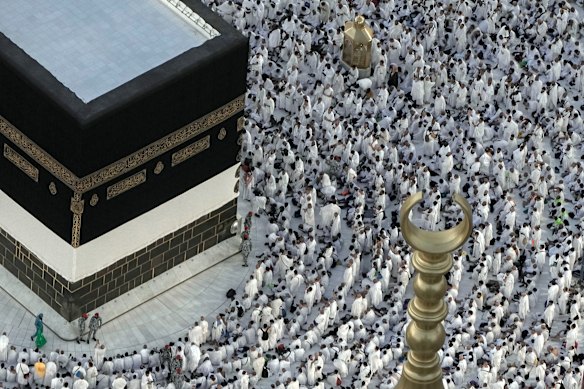
Muslim pilgrims pray in front of the Kaaba, the cubic building at the Grand Mosque, during the annual hajj pilgrimage, in Mecca, Saudi Arabia, in 2023.Credit: AP
But sacred places exist on a different plane, where you’re overwhelmed by your own powerlessness, and where our daily obsessions with power look positively juvenile. That’s why Medina, which is astonishingly serene, and Mecca, which is hot and harsh and trying, both inspire tranquillity. The point is that each, in quite opposite ways, dethrones the ego.
Men, especially, have so much to learn from that. In saying this, no doubt I’m influenced by our culture’s current fretting over masculinity. It’s not a lens I would normally use. But it turns out to be an instructive one in this case because of the sheer possibilities of how badly it could go wrong.
The day we arrived in Mecca, a record half a million people performed the lesser pilgrimage, known as ’umrah. My guess is hundreds of thousands more were also there, having performed it earlier. All converge on a single site, from all corners of the world. Men, women, old, young, big, small, strong, frail, wealthy, poor, blind, in wheelchairs, thrown together into the crush. A little impatience, a little self-importance, a little aggression, and the whole thing would become a mass of injuries. In short, you’d see the worst possibilities of what, in our time, some would call toxic masculinity. But with rare exceptions, that’s not what you see.
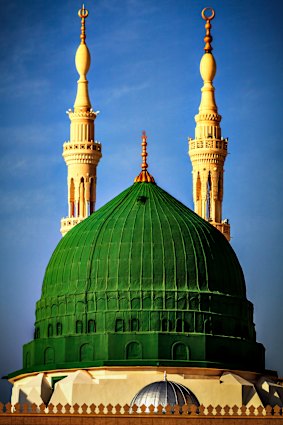
The dome of al-Masjid al-Nabawi (the Prophet’s Mosque) that sits above the Prophet’s burial site, Medina, Saudi Arabia.Credit: Getty Images/iStockphoto
Instead, you see the Indonesians in their colourful matching shirts, joining arms and walking through the crowds in formation. You see the even more colourful West Africans and the formidable Turks chart their course, and the swarms of people move around them like liquid. You see the South Asians, from Afghanistan through to Bangladesh, many elderly and frail, nimbly adjust to the human traffic. You see the Gulf Arabs saunter, the Americans strut, pilgrims from Kyrgyzstan shuffle along with their magnificent hats. No common language, few common customs, not even a shared culture of queueing. But it works because you constantly see deference: people gently bouncing off one another, giving way to each other, communicating with a smile or a glance.
Men play their role in this. Holding the line to create space for their female companions. Standing as a buffer between them and the oncoming throng. Forging a path for their group, allowing a path for others. In short, and again with exceptions, putting others first. But, especially during the formal rituals of the pilgrimage, they are forced to do so without any trappings of status or power. The men, no matter how rich or poor, dress in the same dishevelled way: wearing two white unstitched sheets, akin to a burial shroud. They wear sandals at most, but no shoes. They leave their hair uncovered, and at the end are encouraged to shave it off (my friends are in for a shock). Even that source of vanity, gone in an instant.
And they cry. Quietly and intimately, but obviously. They cry while visiting the Prophet’s grave in Medina, or circling the Ka’bah in Mecca. Some of these are hard men from hard lands, but they’re not ashamed to do this. Their prophet cried often. The real loser is the one who can’t. Such vulnerability ceases to be emasculating because in places like these, invulnerability has already been shown to be a lie.
The masculinity of the manosphere doesn’t survive contact with this. Whatever its online appeal, the preoccupation with wealth, dominance and womanising becomes immediately ridiculous here. It looks more like the masculinity of a puffer fish: a show of size to conceal something much smaller. Against the backdrop of Mecca’s forbidding mountains, all that seems not just out of place, but out of puff.
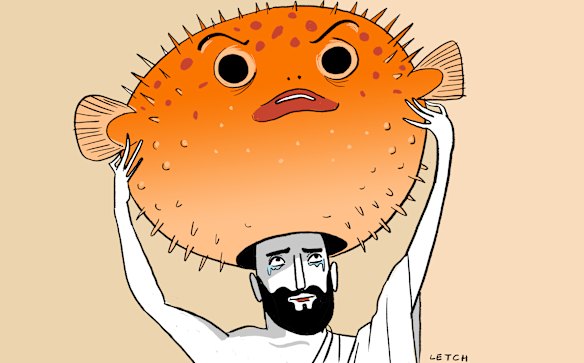
Illustration by Simon Letch
But it’s not enough just to deflate that. The problem with the discourse of toxic masculinity is that it doesn’t sit alongside anything affirmative. It points to genuine problems in male behaviour, but is less eager to say anything about masculine virtue. The result is something of a void: a process of endless deconstruction, leaving the spoils to whoever is willing to construct an alternative. Into that void steps YouTube’s range of masculinity entrepreneurs, whose main advantage is that at least they’re affirming something.
What if, instead, masculinity centred on service, on sacrifice, on self-effacement? What if it didn’t shy away from its archetypes of strength and firmness, but understood that they tip over into oppression when combined with ego, and shorn of patience and soft-heartedness? I don’t pretend I saw a carnival of perfection this past fortnight in Mecca and Medina. I’m not blind to all the problems that beset the Muslim world, misogyny included. But in that time and that place I got the glimpse of this potential, and can see the challenge it issues. That the test of masculinity – or for that matter, a senator – isn’t in how much power you claim to wield. It’s about whether you’re anything without it.
Waleed Aly is a broadcaster, author, academic and regular columnist.
The Opinion newsletter is a weekly wrap of views that will challenge, champion and inform your own. Sign up here.
Most Viewed in National
Loading