3 months ago
22
3 months ago
22
Police also submitted to NCAT that “the Firearms Registry should not have to investigate to determine the accuracy of the information provided,” the written decision said.
O’Rourke’s version of events was different. He said he gave his original name on his application, which, he said, “was more than enough considering the ridiculous amount of media coverage he had received”, the NCAT decision said. “His licence was not suspended after 15 days. It was valid on the Firearms Registry for over a year without incident.”
NCAT upheld the police decision, despite O’Rourke’s protestations that he deeply regretted the mistakes of his past and was now a hard-working, happily married man. The tribunal said it was not in the public interest for someone with O’Rourke’s background to have access to firearms.
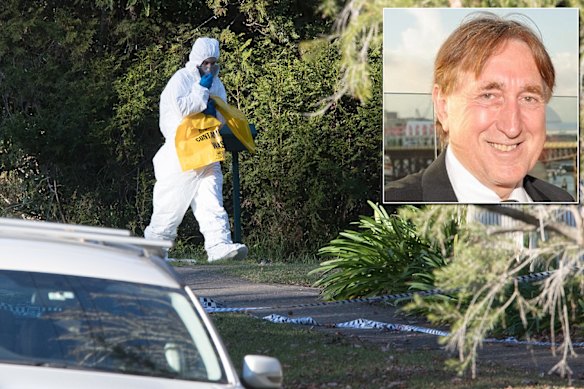
The scene of a 2018 shooting in West Pennant Hills and John Edwards, inset. Credit: Janie Barrett/LinkedIn
Jihad Jack’s licence approval came after another catastrophic and widely criticised decision by the NSW Firearms Registry. In January 2017, it had approved a man called John Edwards for a permit to shoot at sporting ranges. There were 18 previous incidents involving Edwards on the police database, 15 of which related to AVOs, stalking, assault allegations or so-called adverse interactions in relationships.
The following year, Edwards shot and killed his two children. A surviving daughter told how he’d spent “50 years traumatising the women and children in his life without remorse”. In 2021, coroner Teresa O’Sullivan found that Edwards should have been refused a licence if the material available to police had been properly analysed.
She also found that systemic problems in the registry “are highly likely to have adversely affected the adjudication of a very significant number of recreational licence applications”.
Another killer who held a NSW gun permit was Nathaniel Train, who legally owned four rifles and a shotgun. His licence was suspended in August 2022, many months after he unlawfully crossed into Queensland during the 2021 COVID lockdowns amid what an inquest showed appeared to be an unravelling of his mental health. He still had some of the guns when he and his brother shot and killed three people.

Gareth, Nathaniel and Stacey Train, who were killed in a shootout that left two police officers and a neighbour dead, have been labelled Christian extremists.
Train did not have a concerning record, but the case raised issues about how information flows across borders. The data held by Queensland police was out of date. At the time, many jurisdictions – including NSW – had not yet digitised its firearm registries. A 2019 auditor-general’s report had also criticised the NSW registry for leaving key decisions about licence revocations to junior staff, failing to validate data, using outdated technology and being heavily reliant on manual data entry, which could be prone to errors.
Sajid Akram applied for a NSW gun permit in 2020. Three years later, it was granted, even though he lived with his son, Naveed, who had been investigated by ASIO for his links to terrorist sympathisers in 2019 (he was not found to pose a risk). Naveed joined his father on their killing spree in Bondi on December 14, in which 15 people died and about 40 were injured.
Serious questions will be asked about whether the NSW Firearms Registry investigated Akram’s history; whether it had access to information from federal agencies such as ASIO – which told NSW Police that Naveed had been put on a known entity management list; whether notoriously bad relationships between NSW Police and their federal counterparts, or jurisdictional issues, had interfered with the exchange of information.
Loading
The three-year delay for the approval of the licence wasn’t because the registry had raised flags, but rather because it was “a shambles”, said Police Minister Yasmin Catley. There had been serious backlogs between 2020 and 2023. “It appears that it was quite normal for a licence to be issued between two to three years. That’s unacceptable. However, their systems were upgraded significantly in 2023. Since then it hasn’t been my experience that we’ve experienced those delays.”
Catley has previously said that the registry had not been fully digitised until 2023. The ammunition reports remained paper-based, said one person (who works in a gun shop) on the condition of anonymity because they did not have permission to speak. At present, ammunition is registered on a paper log that can be inspected by police.
Australians have prided themselves on world-leading gun laws instituted after the Port Arthur massacre, which banned semi-automatic weapons, tightened licensing rules and introduced a national firearms register. But many did not realise that the laws meant there were still millions of guns in circulation.
A report by The Australia Institute in January this year raised the alarm. It found that while there are fewer gun owners than after the National Firearm Agreement after the Port Arthur massacre, those who have guns have more of them. NSW has the most, 1.23 million. There are two people in NSW who own more than 300 each, although they are most likely collectors whose guns have to be disabled (some collections, says Robert Linnegar from the Antique Arms Collectors Society of Australia, can be worth millions; a single Holland and Holland rifle, the type used by kings, costs upwards of $340,000).
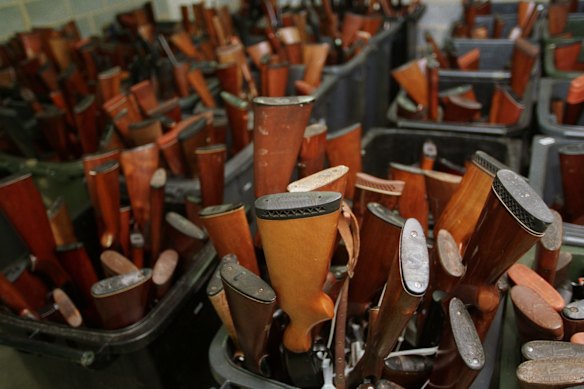
Guns collected during a previous amnesty schemeCredit: Craig Sillitoe
The same report also showed support for West Australian laws introduced in 2023 to limit the number of guns owned by recreational shooters to five. The state’s number of firearms has been cut by a quarter. A poll showed 78 per cent support among the public. Despite this, no other government acted. Earlier this year, the Minns government in NSW was supporting a plan to enshrine a right to hunt in law and to allow silencers, before backing away.
Now, after 15 people died when two gunmen who legally owned six guns allegedly opened fire on a Jewish religious festival, there will be action. The NSW government will tighten gun laws and provide more resources to the registry. The new laws will ban someone from owning a gun if they or someone they live with has been investigated for terrorism offences, and most licence holders will be able to own only four guns rather than an unlimited number.
The new laws will prevent non-citizens from owning guns, and licence terms will be reduced from five to two years to increase the frequency of reviews. Gun owners will no longer be able to appeal against the revocation of their licence in NCAT. Those with more than four guns will be able to hand them back under a firearms buyback next year. “These are measures that gun safety advocates and experts have been calling for over years,” says Greens MP Sue Higginson.
The public seems to agree. A Herald/Age Resolve Political Monitor poll found three-quarters of Australians believed laws had to be toughened. “Many thought machete crime was the worst thing we could face because guns were assumed to be rare,” said pollster Jim Reed. “The simple question many Australians are asking is why people in our cities need a gun at all.”
Get alerts on breaking news as it happens. Sign up for our Breaking News Alert.