3 months ago
25
3 months ago
25
It was a paddock – nothing but grass and trees as far as the eye could see. But plans for this land at Luddenham in western Sydney envisioned a very different future: Sydney’s version of Silicon Valley.
Located just three kilometres north of the new Western Sydney Airport, the $5 billion mixed-use city known as Sydney Science Park would provide more than 12,000 jobs, 3400 homes, a STEM school, laboratories, research facilities and more than 80 hectares of open space.
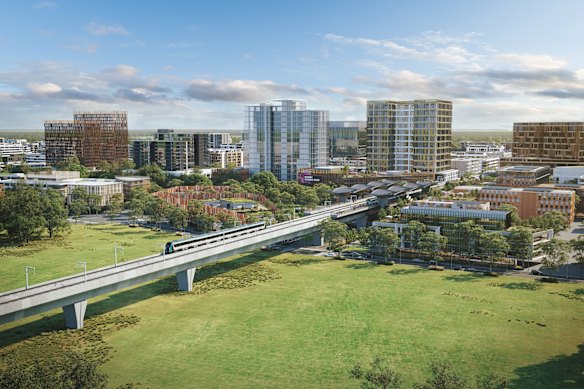
An artist’s impression of the planned Sydney Science Park at Luddenham.Credit: Celestino
The plans were approved in 2016, a sod-turning ceremony took place in 2018, and another in 2021, yet the rest of the land remains almost exactly as it appeared when planning began in 2011: a paddock, except for the addition of a water recycling hub.
By 2027, a sparkling new Luddenham metro station will sit on the edge of this land. It was back in 2020 that locations were announced for the new Western Sydney Airport metro line stations. But plans lodged with Penrith City Council as early as 2014 show a train line running through the area, with a station in almost exactly the same position as the coming Luddenham station.
How did it end up there? After months of investigating the precinct, a NSW parliamentary inquiry could not provide an answer.
“Having considered the balance of evidence, the committee still has unanswered questions about the probity and integrity of these decisions,” the final report of the inquiry, chaired by Greens MLC Abigail Boyd, said.
During the inquiry, developer Celestino denied lobbying the former state government as early as 2011 for the metro station, saying the plans weren’t “predicated on a train station being on the site”.
The committee then asked John Camilleri, chairman of the company that owns Celestino, what passengers can expect to see at Science Park when the Luddenham station opens, to which he responded: “in our opinion, not a great deal”.
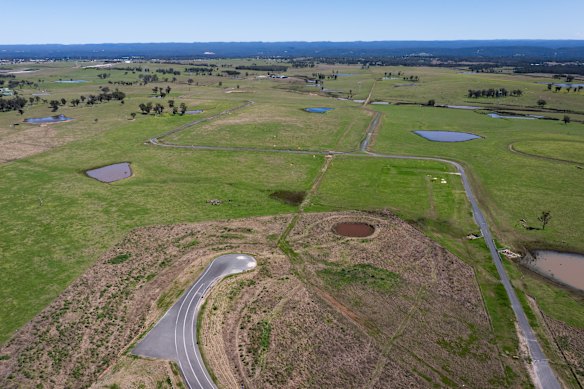
Land in Luddenham where it is planned that Sydney Science Park will be built.Credit: Wolter Peeters
From jobs hub to homes hub
When the Science Park plans were approved, Celestino – the property development arm of Baiada Poultry, which also owns poultry brands Steggles and Lilydale – touted it as a jobs boon for western Sydney.
The project was forecast to generate 12,200 scientific and research-based jobs. But Penrith City Council always had its doubts about the project.
“We did not want it to become a Trojan horse for residential development,” Andrew Jackson, the council’s planning director, told the parliamentary committee. Before the planning proposal was approved in 2016, the council added two conditions: a dwelling cap of 3400, and that 10,000 square metres of jobs-generating floor space would be delivered before any dwellings could be built.
However, in 2018 Celestino had a meeting with state government planning officials, during which the developer made submissions to increase the cap on dwellings to 30,000, across a larger curtilage: the 287 hectares of Sydney Science Park plus additional connecting landholdings. The NSW government did not act on the request.
In the inquiry’s final report, Celestino dismissed suggestions the development would become a housing estate that would never deliver on its jobs promises.
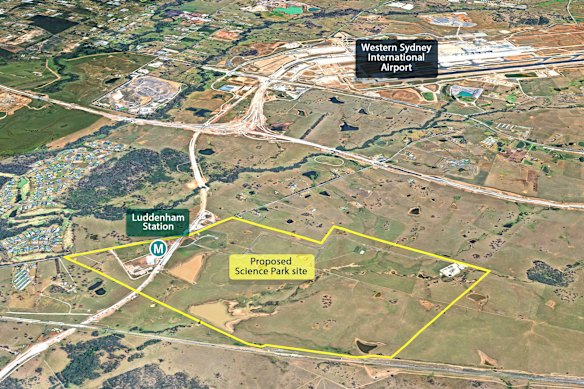
The Sydney Science Park will be located just 3km north of the new Western Sydney Airport.Credit: Matt Willis
The committee recommended that the state government legislate current approvals to ensure the development’s main objective remained the delivery of jobs. It was supported in principle, with the NSW government saying it was “currently satisfied” that retaining the provisions in the Western Parkland City state environmental planning policy provided sufficient safeguarding of the dwelling cap.
In an interview, Celestino chief executive Matthew Scard was asked how many jobs the project would provide. He said that “it would be hard for me to say” as plans for the surrounding Aerotropolis land had changed significantly since the first Science Park proposal was approved.
He was also unable to share the total number of dwellings that the development would deliver, but said that “it would be more than 3400” – the number under the current cap.
Developer cites ‘competition’
Scard said the project had faced many challenges, resulting in delays to construction. Among them have been soaring development costs and the state government’s competing vision for Bradfield city centre, which was announced after Celestino’s plans were approved.
Bradfield, the first master-planned Australian city in 100 years, will become a “world-class research and education ecosystem”, the city’s website says – and it’s just down the road from Sydney Science Park.
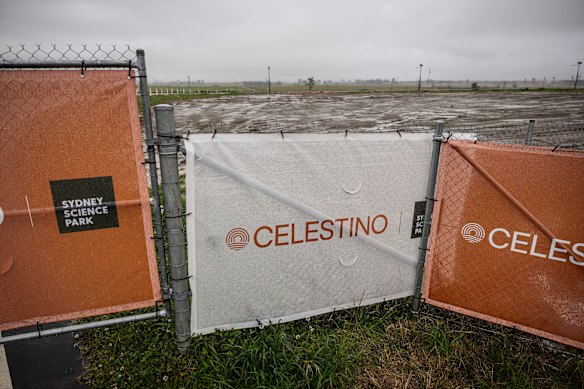
The Luddenham site remains fenced off.Credit: Wolter Peeters
“Now we’ve got competition, let’s call it, that makes it a bit harder because we’re potentially trying to aim and get the same thing in our sites,” Scard said. “It’s a bit harder for us to compete with government as well.”
Scard said he believed the almost decade-old approved plan for the site needed to be reviewed to set it apart from Bradfield.
Ross Grove, the western Sydney regional director for Property Council Australia, of which Celestino is a member, said that “it’s very difficult to compare” the privately owned Science Park with the other sites where Western Sydney Airport line metro stations are being built.
“It’s got a different set of drivers to the other metro stops in the Aerotropolis,” he said.
Partner fallout
As the development has floundered, so have its partners. Organisations that partnered with Sydney Science Park at the outset of the development – including CSIRO, the University of Sydney and the Catholic Education Diocese of Parramatta – are no longer involved.
Loading
Now, there are two: Mamre Anglican School, a local school that plans to move to the Science Park by 2029, and Sydney Water, which delivered the water recycling hub – a project the inquiry’s report said was “at odds with the fact that some homes and other areas in the Aerotropolis simply lack basic water or sewer connections”.
In the original vision, the first stage of the development also included relocating Baiada Poultry Group’s head office to the Science Park, which would have created “many new jobs”, Celestino said.
It’s yet to be built, with Camilleri of Baiada Group claiming the broader state government Aerotropolis planning processes led to the proposal being “frozen” from 2018 to 2022. “[We] haven’t been able to build anything on [the] Science Park until the Aerotropolis planning was finished,” he said in the inquiry.
The NSW Planning Department said that planning controls to develop Sydney Science Park had been in place since October 2016, and it was the developer’s responsibility to deliver it.
Despite the delays, Scard said Celestino is still committed to the project. A state significant development application was initiated at the end of 2024 for the first precinct, with work anticipated to begin in 2027, pending approval.
“We’re not walking away from it,” he said.
The Sydney Morning Herald has opened a bureau in the heart of Parramatta. Email [email protected] with news tips.
Most Viewed in National
Loading