3 months ago
51
3 months ago
51
Opinion
January 17, 2026 — 9.30am
January 17, 2026 — 9.30am
It’s a good thing William Shakespeare wasn’t on the guest list of Adelaide Writers’ Week.
A community theatre performance of the Bard’s The Merchant of Venice, scheduled for this month in Sydney, has been postponed in the wake of the mass shooting in Bondi. The play’s key figure, Shylock, is a Jewish moneylender, represented with the antisemitic dramedy typical of Shakespeare’s England. Notwithstanding decades of contortions and reinterpretations to turn Merchant into a satire or a critique of antisemitism, Shylock can’t climb out from under his own history, and nor can old Bill.
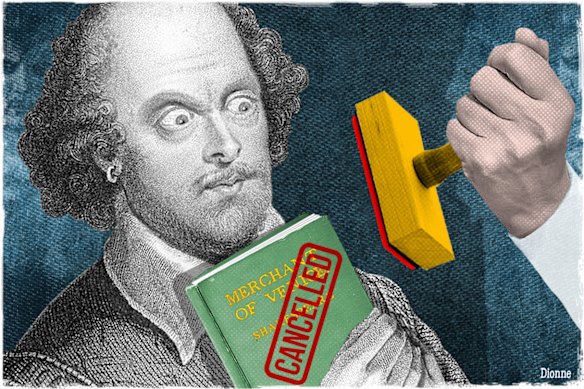
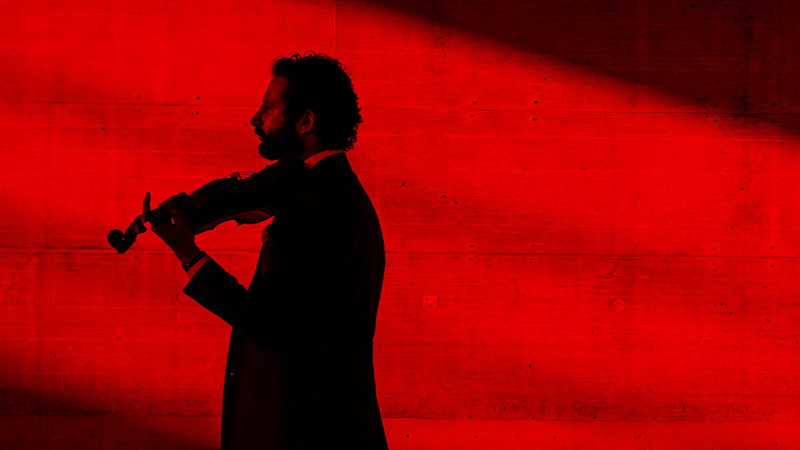
Illustration by Dionne GainCredit:
If the former Adelaide Festival board had disinvited him for failing the “social cohesion” test, it’s hard to imagine any participants, let alone nearly all, boycotting Writers’ Week in solidarity with his right to free speech. (It’s also hard to imagine what the theatre group Such Stuff was thinking in putting on Merchant even before Bondi, but without being able to see their presentation of Shylock it would be unfair to speculate.)
The cancellation of Shakespeare is an overdue reminder that neither antisemitism nor its mirror-image, anti-antisemitism, were invented in October 2023. Antisemitism from the far right has older and deeper roots in Australia than any version coming from the far left. Whether in the thickets of Canberra law-making or South Australian Premier Peter Malinauskas’ rubber sword chopping a writer out of the Adelaide program “from a place of compassion”, it defies over-simplification and opportunism while holding an irresistible appeal to the over- simplifiers and opportunists. “The devil can cite Scripture for his purpose”, says Shakespeare’s merchant Antonio, the antisemitic creation of an antisemitic playwright speaking a truth in the 1500s that the Australian government is struggling to disentangle in 2025.
Old-school white Australian antisemitism lived in comfortable and relaxed ignorance on Sydney’s north shore in the 1980s. Playing the title role, Antonio, in our second-form production of the play was the high watermark, indeed the swansong, of my Thespian career. We had no girls at our school, so Matthew W was the star turn as Portia. We had precious few Jewish students, either, or if we did in our English class they weren’t putting up their hands to play Shylock, so my best friend John F landed the role. With the black hair and olive features of his dubh Scottish ancestry, he could pass. At 14, he needed a Shylockian beard, though. (It actually fell off mid-show while he was accusing me of voiding my rheum upon it many a time and oft in the Rialto.)
Loading
Our teacher Mr Wood must have been stricken by the unserious poverty of our acting. Aside from Matthew W, who really was very good, as actors we lived up to our teacher’s name more than his energetic directing.
Antisemitic? Of course. John F’s Shylock was a bad dude, not just greedy but malicious when he offered me an interest-free loan with just one catch. I think we learnt lessons about what a pound of flesh equated to in kilograms; mostly we enjoyed our rank incompetence but about antisemitism I’m afraid we learnt next to nothing until we read The Diary of Anne Frank a year later. We were blissfully unaware that our parents’ generation, just like their parents and grandparents before them, were manipulating rules to keep Jews out of their sporting and social clubs. Were there Jews on the upper north shore? It didn’t matter: our Australian forefathers had all read their Shakespeare.
“If you prick us, do we not bleed? If you tickle us, do we not laugh? If you poison us, do we not die? And if you wrong us, shall we not revenge?” asks Shylock. These words have been taken to mitigate Shakespeare, showing that he gave Shylock agency and a sympathetic point of view, but did white Australia learn anything from his pain? Or was their guilt such that they needed to wait until the arrival of new scapegoats?
I very much doubt there were Palestinians, Muslims or leftist class warriors keeping Jewish people out of Sydney’s clubs, private schools and social institutions, and laughing at stage Shylocks with unsteady beards. I very much hope, however, that the coming royal commission doesn’t overlook those Australians who, wrapped in their ensigns and Southern Crosses, make the strangest of bedfellows with their enemies’ enemies. The varieties of Australian antisemitism are multiform and, in coming months, bound to be politically inconvenient if they can be coaxed out of hiding.
Loading
South Australians, meanwhile, can rest safely knowing that their premier would have overstepped his authority to place a call to a festival chair to disinvite Shakespeare, and he wouldn’t have attempted to hide the fact. Even a person as out of his depth as Malinauskas is when grappling with artistic expression would have been on safe ground cancelling that writer for such an invention as Shylock.
Modern inventions of antisemitism are, alas for Mr Malinauskas, harder to pin down. On Tuesday he was saying he hadn’t given the festival a direction to disinvite the writer Randa Abdel-Fattah but it was his opinion that her absence from Writers’ Week would be better for “social cohesion”. By Wednesday, with nearly every guest boycotting the event, the director resigning, the Adelaide Festival board either out the door or on their way, Writers’ Week itself gone this year and the broader festival under threat, the premier of “The Festival State” was still none the wiser, likening Abdel-Fattah to a direct inciter of terrorist acts and earning himself a defamation action.
Even by Thursday, when the new festival board had apologised to Abdel-Fattah and issued the earliest of early invitations to her to come to Adelaide in 2027 – putting her in the invidious position of having to say yes to help save the festival that had excluded her – the premier still didn’t have a clue. He said he knew of no defamation action. He said his description of Abdel-Fattah was uttered “from a place of compassion”. He gave no directions to such a place. But the South Australian election was one week closer. He wanted dearly to put all of this behind him.
Behind him is a further battering for cultural festivals that were already on their knees. The new Adelaide Festival board is doing its best to repair the damage, but no artistic director of a cultural festival in their right mind anywhere in Australia will let things go as far as they went in Adelaide. Writers deemed to threaten “social cohesion” and “cultural safety” won’t be disinvited; their fast-diminishing hopes of being invited in the first place will recede into the shadows of “risk management”. Artistic directors who lose their autonomy to frightened authoritarian boards will quit, and more festivals will be lost to boycotts because no collection of writers or artists can escape the dragnet of “social cohesion” enforcement.
Loading
Or, to put it another way, any collection of writers or artists who universally meet a “social cohesion” code of conduct wouldn’t be worth listening to. In Adelaide, to save a festival, the writers had to destroy it. In future, to destroy their festivals, organisers will try to save them pre-emptively.
Adelaide’s festival, in the end, was saved by money: artists with financial muscle. The British band Pulp threatened to cancel their free concert unless Abdel-Fattah received her apology. With disaster beckoning – forget Writers’ Week, the Pulp concert might not happen! – the festival apologised. Malinauskas, still in that place of compassion, refused mercy.
“The quality of mercy is not strained/It droppeth as the gentle rain from heaven/Upon the place beneath. It is twice blest/It blesseth him that gives and him that takes.”
I can still see Matthew W, in his Portia make-up, saying those words, some of Shakespeare’s wisest and most beautiful. They contain grains of whatever hope we can find. Shame they were written by a cancelled antisemite. But few things are what they seem when escalated out of shape by smiling politicians and other escalation-seekers who think history started 28 months ago. Oh, what a goodly outside falsehood hath.
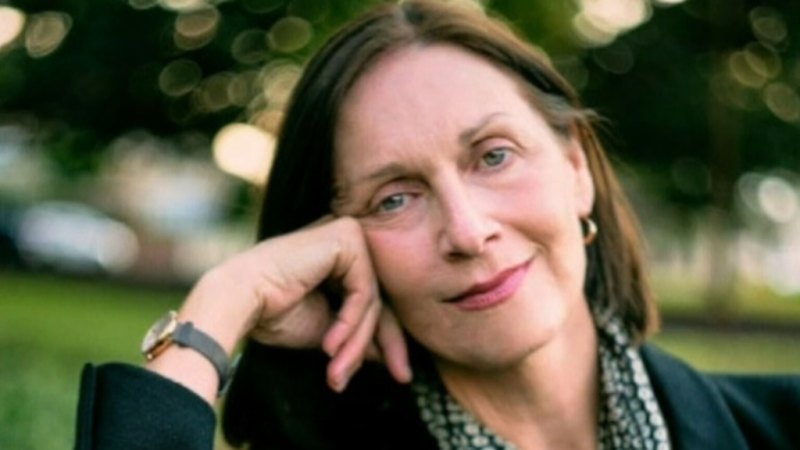
Malcolm Knox is a journalist, author and regular columnist for The Sydney Morning Herald.
Get a weekly wrap of views that will challenge, champion and inform your own. Sign up for our Opinion newsletter.
Most Viewed in Culture
Loading