3 months ago
53
3 months ago
53
18 minutes ago
Yolande Knell,Middle East correspondent, Jerusalemand Alys Davies

 AFP via Getty Images
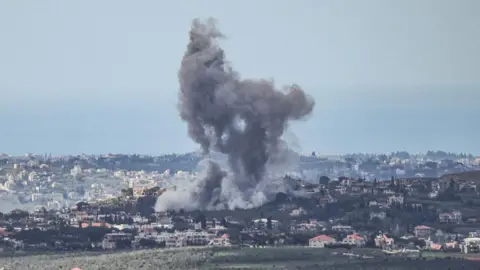
Israel's defence minister has said a buffer zone will be set up inside southern Lebanon and that Israel will keep security control over a swathe of the territory even after the end of the current war against the armed group Hezbollah.
Israel Katz said the area to be occupied would go up to the Litani River in southern Lebanon - about 30km (18.6 miles) from the border with Israel.
He also said all houses in Lebanese villages near the Israeli border would be demolished.
Lebanon's Defence Minister Maj Gen Michel Menassa said Katz's remarks reflected "a clear intention to impose a new occupation of Lebanese territory". European nations, Canada and the UN also criticised Israel's announcement.
Israel sent ground troops into southern Lebanon on 2 March and has also been launching broad strikes across the country.
Israel was also carrying out near-daily strikes on Hezbollah before that despite a ceasefire that was agreed in 2024.
Since early March, at least 1,238 people have been killed in Lebanon, according to the Lebanese health ministry, including at least 124 children. The UN's humanitarian affairs office says 52 health workers have also been killed.
In the same period, 10 Israeli soldiers and two Israeli civilians have been killed by Hezbollah attacks, Israeli authorities say.
Others killed in the south in recent days include three Indonesian peacekeepers, and three Lebanese journalists, according to the UN and the Lebanese health ministry.
The Israel Defense Forces (IDF) confirmed it killed two of the journalists, describing them as "terrorists" without providing evidence to back up its claims. It also said it was aware of reports a female journalist was killed.
It has not yet been established who killed the peacekeepers.
More than a million people - roughly one in every six in the country - have also been displaced, worsening an existing humanitarian crisis in Lebanon.
Israeli officials say the aim is to protect communities in northern Israel from Hezbollah attacks.
Speaking in a video statement published by the defence ministry on Tuesday, Katz gave further details on Israel's military intentions in southern Lebanon.
"At the end of the operation, the IDF will establish itself in a security zone inside Lebanon, on a defensive line against anti-tank missiles, and will maintain security control over the entire area up to the Litani."
"In addition, the return of more than 600,000 residents of southern Lebanon who evacuated northward will be completely prohibited south of the Litani until the safety and security of northern residents are ensured," he added.
"All houses in villages near the border in Lebanon will be destroyed - according to the model of Rafah and Beit Hanoun in Gaza - to remove, once and for all, the threats near the border to northern residents," he said.
Katz had already announced the intention to create a buffer zone in the south of Lebanon earlier in the month. He had also already said displaced residents would not be allowed back until northern Israel was safe and that houses would be demolished.
But his latest statement goes a step further than his last, as he said Israeli troops would stay in the region after Israel's war with Hezbollah ends.
Lebanon's defence minister said Katz's remarks were "no longer mere threats", but reflected "a clear intention to impose a new occupation of Lebanese territory, forcibly displace hundreds of thousands of citizens, and systematically destroy villages and towns in the south".
'Our home is gone, everything is gone': BBC speaks to displaced Lebanese families
Addressing the UN Security Council from Beirut on Tuesday, UN aid chief Tom Fletcher said "the current escalation is compounding a situation that is already critical".
He said 51 primary healthcare centres and four hospitals had closed due to hostilities, with others damaged or operating at reduced capacities.
"Given the intensity of the coercive displacement that we are seeing, how should we prepare, collectively as the international community, for a new addition to the list of occupied territories?" Fletcher asked the council.
Canadian Prime Minister Mark Carney called Israel's deployment of ground troops in Lebanon an "illegal invasion", which violates its "integrity and sovereignty".
"The government of Lebanon has banned Hezbollah, is taking action, is trying to take action against Hezbollah and their terrorist activities and their threats to Israel, and that is the purported justification for this invasion," Carney said.
A joint statement signed by the foreign ministers of 10 European countries, including the UK, France and Italy, as well as EU foreign policy chief Kaja Kallas, urged Israel to avoid widening its military operations in Lebanon and to respect the country's territorial integrity.
They expressed their "full support to the government and the people of Lebanon, who are once again suffering the dramatic consequences of a war that is not theirs".
The ministers added that "the responsibility for the situation lies with Hezbollah", and called for the group to stop its attacks in support of Iran against Israel.
Southern Lebanon is the heartland of Lebanon's Shia Muslim community, Hezbollah's main support base. But it is also home to other communities, including Christians.
The latest Israeli ground invasion has already caused widespread alarm among the Lebanese.
Under the ceasefire agreement that ended the war in 2024, Hezbollah was meant to disarm and leave its positions in the south. This was to be supervised by the Lebanese government and army.
Progress was made, but it was partial. Israel also maintained several military posts in the south and continued to carry out regular attacks on what it said were Hezbollah targets.
The will may have been there for the Lebanese government to disarm Hezbollah, but it has always lacked the ability to do so. The prospect of a major confrontation between the Lebanese state and Hezbollah has also long been a major concern, reawakening fears of a descent back into civil war.
Katz previously said that Israel was taking action because the Lebanese government had done "nothing".
Lebanon's President Joseph Aoun has described the Israeli plans as a "collective punishment against civilians", and that they could be part of "suspicious schemes" to pursue an expansion of Israel's presence in Lebanese territory.
Moment missile hits building in Beirut