
 4 months ago
78
4 months ago
78
In his classic book On Strategy, Vietnam-era American colonel Harry Summers recounts a conversation he had with a North Vietnamese counterpart days before the fall of Saigon in April 1975.
“You know you never defeated us on the battlefield,” Summers said. To which Colonel Tu responded: “That may be so, but it is also irrelevant.”
It has become an oft-cited reflection on the duality of tactical victory and strategic defeat. Retired US diplomat Alan Eyre brings up this exchange when asked about the Trump administration’s military successes in Iran.
Yes, Iran’s navy and air force have been annihilated (they were “pretty pathetic to begin with”, he says). Yes, much of their missile stocks and defence industrial base have been destroyed. But such accomplishments are only a means to an end.
“[Donald Trump] makes the mistake of assuming that because we have military superiority – which is not hard – that that translates into strategic success,” Eyre says. “Yes, we have won militarily, but that has not translated into getting what we want out of this war.”
Eyre is an expert on Iran, the focus of his 40-year career at the US defence and state departments. A fluent Persian speaker, he was part of the team that negotiated with Iran for five years, culminating in the 2015 nuclear deal known as the Joint Comprehensive Plan of Action (JCPOA). He later worked on sanctions policy and is now a distinguished diplomatic fellow at the Middle East Institute.
He is scathing about the “unnecessary and ruinous” war, and deeply unimpressed by the “incompetent” Trump administration. And yet, he also thinks the US president may still be able to salvage some kind of deal that turns back the clock on Iran’s nuclear enrichment program.
At the time of our interview, the situation was very much in flux. US Vice President JD Vance had cancelled a trip to Islamabad for talks; Trump envoys Steve Witkoff and Jared Kushner (Trump’s son-in-law) were going to go, but were then stopped by the president, who said it was pointless to fly back and forth for little tangible progress.
Trump now seems content to let the “genius” US naval blockade choke Iran’s economy, and wait for it to fly the white flag. He is also keeping open the option of further military strikes, likely in a short but strong burst.
“They [Iran] have come a long way, the question is whether or not they’re going to go far enough,” he said this week. “There will never be a deal unless they agree that there will be no nuclear weapons.”
Who’s in charge?
One of the earliest military successes of the United States and Israel was to kill Iran’s supreme leader, Ali Khamenei, who had ruled since 1989. Air strikes took out a whole layer of Iranian leadership, including Ali Larijani, the head of the Supreme National Security Council, and other top clerics.
Trump claims this constituted regime change. The country’s new leaders were smarter and sharper, he said, and more moderate – without saying exactly who he was talking about.
But instead of accelerating that change, the US-Israeli war set it back. Khamenei’s death disrupted Iran’s evolution and provided the regime with an opportunity to consolidate. Paradoxically, the external pressure meant to topple the Iranian regime has helped preserve it.
Lately, as the prospects of a deal have faded, Trump has acknowledged the situation is more complex, alluding to a power struggle between moderates and “crazies”.
Eyre says the idea that there has been regime change in Tehran is “nonsense”, and that Trump, Witkoff and Kushner do not understand the dynamics at all.
“The reason negotiations are going slowly is not because there’s internal division in Iran. It’s because the Iranian government is saying you have to lift the blockade before we negotiate,” he says.
“There’s not a power struggle, there’s politics. That has been … worsened by the fact that because of our decapitation strikes, the guy who was at the top of the pyramid since 1989 was killed. That did shake things up.”
The new supreme leader, Ali’s son Mojtaba Khamenei, has not been seen since he was selected by clerics to replace his father, but he has issued written statements. A deeply sourced report in The New York Times by Farnaz Fassihi, who has covered Iran for three decades, said he was in hiding and gravely wounded by the air strikes that killed his family, but “mentally sharp and engaged”.
Eyre says there are two institutions in Iran that matter right now: the Islamic Revolutionary Guard Corps (IRGC) – the elite paramilitary group that formed in the aftermath of the 1979 revolution – and the Beit-e Rahbari, literally “house of the leader”, which is the administrative structure around Mojtaba.
But that institution is weakened by his relative lack of standing. “Even if he were not injured, he would not be as powerful as his dad,” Eyre says. “Because the type of power that position gives is accumulated over time. So right now, Mojtaba is not that powerful.”
In his place are the generals: IRGC commander-in-chief Ahmad Vahidi, Supreme National Security Council secretary Mohammad Bagher Zolghadr and senior military adviser Yahya Rahim Safavi. They are close with Mohammad Bagher Ghalibaf, the Iranian parliamentary Speaker and former IRGC brigadier general who has attended negotiations, when they occur, along with Foreign Minister Abbas Araghchi.
Fassihi reported it was the IRGC that came up with Iran’s strategy for attacking the Gulf states and closing the Strait of Hormuz, approved back-channel diplomacy with the US and participated in the Iranian delegation for the first round of Islamabad talks.
Eyre says it is wrong to think the talks would be more successful if they involved particular people, such as Araghchi, a more moderate political figure, or Vance, who was more sceptical about the war to begin with.
“It’s not a question of personalities, it’s a question of institutions,” he says. “They are servants of the system. Ghalibaf is very close to the supreme leader. Araghchi served in the IRGC. Neither of those guys are purely civilian – they are IRGC.”
Writing in the Foreign Affairs journal this week, Danny Citrinowicz, a researcher at the Institute for National Security Studies and a former analyst for the Israel Defence Forces’ intelligence unit, said the weak Iranian regime had in some ways been thrown a lifeline by the war.
Not only had the regime endured and proven resilient, he argued, but Tehran and Washington were engaged in high-level discussions about sanctions relief that previously would have been unthinkable.
“In other words, the conflict is not only hardening the regime’s resolve but also affording it new forms of recognition that could materially change its economic outlook,” Citrinowicz wrote.
He, too, believes Trump, Vance and co have misunderstood the people they are attempting to negotiate with.
“These leaders, including Ghalibaf, are deeply invested in the Islamic Republic’s core revolutionary principles and motivated to avenge past confrontations,” he wrote. “The notion that even Ghalibaf could be a partner in transforming Iran’s strategic orientation is unrealistic.”
Having negotiated with them for many years, Eyre is also effusive about the efficacy of Iran’s foreign ministry. Their negotiators know their portfolios, the history of the issues, international law and the details of sanctions applied against Iran.
“They are incredibly competent diplomats who fulfil the instructions given to them,” he says. “The Iranians on that side of the table are representing their country, and they do a very good job of it.”
He does not extend the same praise to Trump’s team.
‘Expertise in foreign affairs is not transferable to expertise in a real estate deal or in finance.’
Retired US diplomat Alan Eyre“President Trump and this administration have never negotiated. What they do is they issue demands, and then [enact] either military action or tariffs until the other side capitulates,” Eyre says.
“This side does not have the skill set for a series of sustained negotiations … because expertise in foreign affairs is not transferable to expertise in a real estate deal or in finance. That’s the problem.”
The secret sauce
As a product of the 1970s, Trump has had a lifelong obsession with Iran. One of the major acts of his first term was to withdraw from the JCPOA that Eyre helped negotiate, labelling it one of the worst deals of all time (mostly because it was signed by former president Barack Obama).
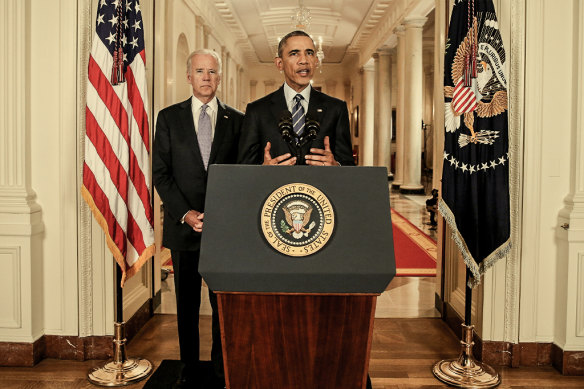
The agreement was criticised at the time. After 20 months of negotiations and years of talks before that, it did not require Iran to suspend its uranium enrichment. Rather, it limited the regime to low-grade, civilian-level enrichment, limited the number and types of centrifuges it could use, and submitted it to monitoring by the International Atomic Energy Agency (IAEA).
Eyre says that whatever deal, or framework of a deal, Trump eventually does with Iran, it will involve the same dynamics as the JCPOA – the US eases sanctions in return for Tehran accepting limits on its nuclear program.
“That’s the spinal cord of the JCPOA, and that will be the spinal cord of any realistic or any possible agreement between the two sides, if there is one,” he says.
He believes there is still scope for Trump to get the Iranians to suspend nuclear enrichment, possibly for up to five years. “We have never gotten [that],” Eyre says. “The JCPOA did not have anything in it about suspending enrichment. So, that would be good.”
He says Iran could also agree to down-blend its existing stockpiles of highly enriched uranium – most of which is believed to be buried under bombed nuclear facilities at Isfahan. It is even conceivable that it could surrender its stockpiles entirely.
“Anything in Iran is a [bargaining] chip,” Eyre says. “But the more you ask from Iran, the more you have to give them. The most important aspect of it is verification by the IAEA. Whatever Iran agrees to, you can’t take them at their word. You have to let the IAEA inspect. Any deal, if it doesn’t have the most vigorous means of verification and inspection, is worthless … That’s the secret sauce.”
Overlooked in some analysis of the war, says Eyre, is how Iran has realised the power of the Strait of Hormuz as a weapon of strategic deterrence, along with the damage that can be wreaked on neighbours by their cheap drones.
It has already created the greatest energy supply disruption of modern times, he says – Brent crude oil briefly hit a four-year high of $US126 a barrel on Wednesday (US time). If a deal were struck tomorrow, the consequences, especially for Asian countries, would still take years or months to resolve.
“President Trump and the US admin have taken a complex system and broken it,” Eyre says. “We are not going to be able to go back to the way it was on February 26. The new normal will be more expensive and less stable.”
Get a note directly from our foreign correspondents on what’s making headlines around the world. Sign up for our weekly What in the World newsletter.

















































