2 months ago
22
2 months ago
22
Before competing at a recent tournament, Australian curling stars Dean Hewitt and Tahli Gill spotted something in the corner of their eyes that ... well, let’s just say they don’t see every day.
“We were like, ‘Oh wow, there’s like a massive goat in the window of the office,’” Gill laughs.
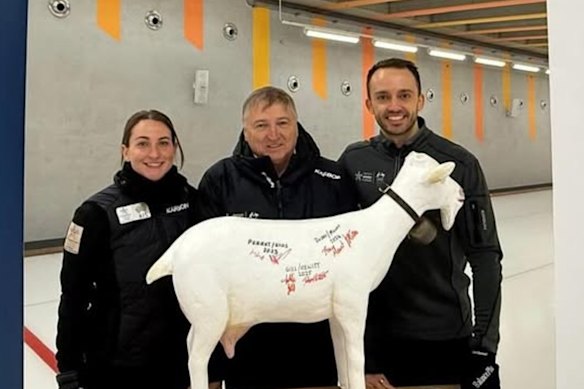
Tahli Gill and Dean Hewitt with the spoils of victory in Gstaad, Switzerland, in October.Credit: Instagram
World sport dishes up some bizarre trophies. There’s the tiny Ashes urn, containing the remains of a cricket bail burnt almost 150 years ago. The silverware for the now-defunct National Rugby Championship looked like a toaster rack.
The winners of the A-League proudly hold aloft a glorified toilet seat, while the spoils of the F3 Derby between the Newcastle Jets and the Central Coast Mariners are a cross-section of road taken from the eponymous highway for the men, and a guard rail for the women. Stage winners of cycling’s Tour of Turkey receive an enormous bunch of bananas, while the top golfer at the Italian Open – in addition to an enormous cheque – takes home their weight in Parmesan cheese.
Now we can add the mixed doubles curling event in Gstaad, an upmarket mountain resort town in the Swiss alps, where the victors are presented with a goat.
Not a live one, we should clarify, but a life-sized statue. And the winners get to sign it.
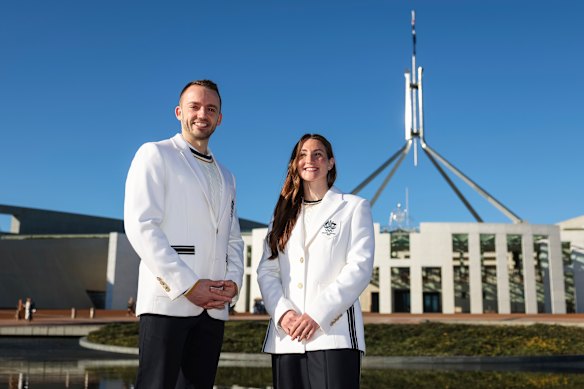
Dean Hewitt and Tahli Gill in the Australian Winter Olympic team uniforms.Credit: Alex Ellinghausen
It’s not a play on words in the sense of sporting GOATs (greatest of all time), but a proud symbol of the region: the Saanen goat is a traditional Swiss breed, known for its high dairy production and for the bells affixed to their collars, which provide the soundtrack to go with the local scenery.
“You walk into Gstaad, and everything is just ringing,” Hewitt said.
“There’s bells everywhere from the goats and the cows, and they made that as their trophy, and we happened to sign it – and we’re happy that we did.”
Welcome to the weird, wonderful world of curling – which, for the uninitiated, is essentially lawn bowls on ice, with brooms, infused with intricate chess-level tactical nuance.
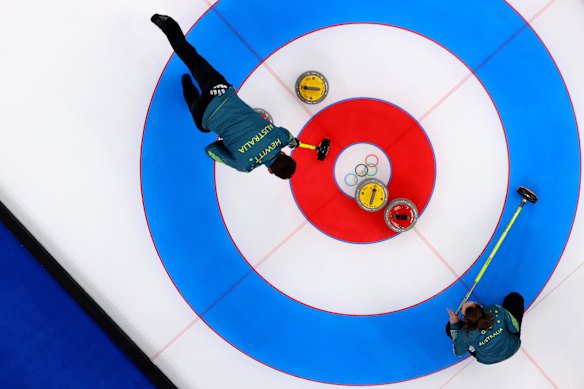
Dean Hewitt and Tahli Gill in action at Beijing 2022.Credit: Getty Images
Signing a goat was an experience Hewitt and Gill won’t forget. But they are keen to create further memories, in pursuit of a far more orthodox sporting prize: an Olympic medal.
Hewitt, 31, and Gill, 26, have been on a roll. Last season, they finished top five in every event they competed in bar one. This season, the Australian duo claimed gold at another competition in Bern, won silver medals at both the Colorado Cup and Stirling International, while in May, they collected bronze at the world championships in Canada – the first by any Australian curler in history at that level, although they did fall agonisingly short of direct Olympic qualification.
Their run of results was enough to boost them to the world No.1 ranking in mixed doubles curling last month; they’ve since slid to No.9, but should they clinch an Olympic berth at the final qualification event in Kelowna, Canada, which runs between December 13-18, they are expected to be in the mix for a medal at Milano-Cortina 2026.
That’s some feat, given their chosen sport – the origins of which can be traced to a frozen pond in Scotland in 1511 – barely exists where they’re from. They estimate there are under 200 regular curlers in Australia, whereas a single club in North America or Europe can boast over 1000.
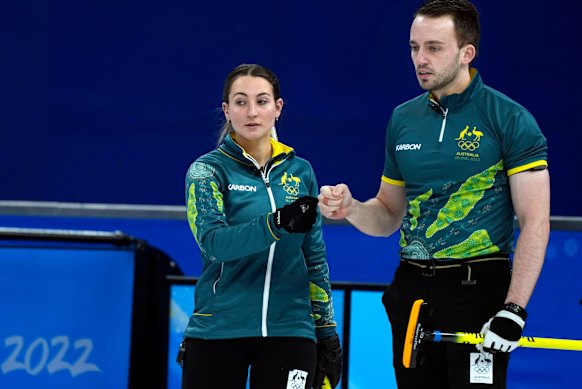
Tahli Gill and Dean Hewitt.Credit: AP
Modest as their community is back home, they are the faces of it.
There are no curling facilities in Australia. It is played on hockey ice, which would be like asking Olympic swimmers to practice in a backyard pool.
“The ice is bumpy,” Hewitt explained.
“It’s got hills and valleys and things like that – it doesn’t look like it, it looks very flat, but for curling, it has to be so, so, so flat. And for us to get those conditions, we have to be overseas.”
So they spend up to eight months every year abroad, pursuing their dreams, racking up expenses that Hewitt reckons would comfortably sit in the six-figure zone. They’re fortunate they have flexible employment situations: he’s an exercise physiologist who can pick up work in Australia and in Canada, where he is a dual citizen, while Gill is a teacher who does relief work at a school which is very accommodating and understanding of her schedule.
“It’s just what you’ve got to do to be at the top,” Hewitt said.
Milano-Cortina wouldn’t be their first Olympic appearance, should they make it. Hewitt and Gill also qualified for Beijing 2022, becoming the first curlers to represent Australia on that stage, but their experience was coloured by the pandemic; they couldn’t mingle with other athletes like at a typical Games, while their efforts to stay COVID-free were so mentally exhausting they say it affected their preparations.
Plus, whatever they tried didn’t work: Gill tested positive while in Beijing, and was only able to compete thanks to a late reprieve from Chinese health officials, which allowed her mere minutes to grab her things and get to the curling venue.
Loading
Since, and partly thanks to the friendly timezone and television exposure in Australia from the last Olympics, they say general interest in curling has skyrocketed – and will grow, should hopes for a dedicated rink come to pass.
“Instead of people saying, ‘I don’t really know what that is,’ it’s like, ‘Oh, yeah! I saw that on TV, we had a team,’” Gill said.
“We always see a massive influx of people coming and trying curling and wanting to get into [it]. But the biggest challenge that we have is that … we don’t have capacity.”
Adds Hewitt: “Australians would really love the concept of the sport. It’s very friendly, it’s a very social sport that can be played by pretty much anyone of any age and ability. Hopefully sooner rather than later, we can get that rink.”
Most Viewed in Sport
Loading