2 months ago
17
2 months ago
17
Opinion
December 26, 2025 — 3.45pm
December 26, 2025 — 3.45pm
One thing I will never forget on the one occasion I met Donald Trump, when he was running for president in 2016 and trying to convince The New York Times to endorse him, was the way he started one sentence: “The beauty of me is …”
I can’t remember how the sentence ended, as I was so impressed by the audacity of the way it began. Australians would never speak that way, in earnest. On one level, I admire the chutzpah. He was large and bombastic, but shrewd. Maybe we should all be aware of the beauty of ourselves, trumpet it and trumpet the beauty of others, too.
This may be a struggle for the humble.

Illustration by Simon LetchCredit:
But lately I’ve been pondering the opposite of this phrase – not the beauty of me, but the mediocrity of me. All the things I am generally pretty terrible at, but enjoy anyway. Or the things I was once bad at but have improved with time. When I spoke at a girls’ school speech night recently I found myself wanting to tell them to embrace being average, in a world of AI mimicry and filtered avatars.
The rise of the robotic mind is going to make it increasingly important that we embrace messy, chaotic, human creativity. And so many kids feel the pressure to arrive in the world polished, fully formed, even perfected.
Loading
So, as we puff and pant towards the end of 2025, hands on knees, sucking in air, it might be time to remind ourselves that the great Australian tradition of “having a crack” is a fine one to nurture and encourage. Not because you will win or excel or even be noticed, but because joy can be found even when floating on the sea of mediocrity. Or just when starting somewhere, anywhere.
Let me give you a couple of examples from my own life.
A few weeks ago, I went back to my school diaries to see what I was writing about then. Turns out it was mainly boys, my friends, books, more boys and, occasionally, politics. Unfortunately, I also seemed to write a lot of poetry. I love poetry – and at the time I was particularly devoted to Judith Wright, Kenneth Slessor and Alfred Tennyson – but my own was shudderingly bad.
There were many mentions of crystals for some reason. It was dramatic, often melancholic and also boring. A great reminder that it’s better to train your eyes outwards and observe the world than devote yourself primarily to analysing your own – in hindsight, quite dull – emotions. I even started feeling sorry for the boyfriends I must have tormented then.
Here are a couple of fragments, to give you a taste. One poem, called Spiritual Rattle, began:
Crystallised melancholy gleam/Dreams of beams/Isolate screaming feelings/Then all is silent .../Empty … grey
Cheerful eh? It is actually painful, typing this out.
Another gem, written when I was obsessed with William Lane’s failed attempt to set up a “New Australia” utopia in Paraguay, was called Written on the Phone:
Crystallised visions/A utopian future/Always beyond the reach of man’s grimy fingers/A mirage perhaps/Or maybe we don’t reach far enough/Our arms are too short.
Loading
It’s diabolical stuff. And don’t I sound like an absolute hoot? A joy bomb. When I sat down to write in my teen years I was earnest, way too serious and my work was overwritten.
Still, despite the dodgy output I had always wanted to be a writer and I pressed on. I was not writing for me – or a judgmental future self that would shame me as I am doing now – I was writing for myself coz I was trying to figure stuff out.
And I wrote and wrote and wrote and wrote, not because it was good but because I had to and I wanted to – diaries and letters and essays and theses, and eventually, I got better. I wrote articles then books and got them published. This happened because I started somewhere, enjoyed it and just kept going.
A second example: I swim all the time, in the ocean. I go with different groups, on my own, with my mermaid friends, and this has become a practice which has sustained me during the roughest times. It has trained me to slow my breath, to pay close attention to the sea floor, to watch the tides and swells and moods of the waves, and taught me that daily rituals like these can make you calm and strong. I see it as part of a personal pursuit of awe, of the feeling of smallness in a vast and wondrous universe.
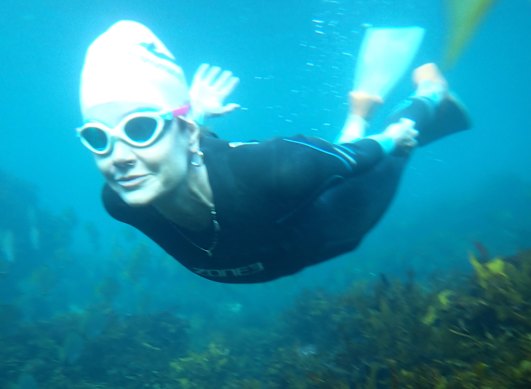
Julia Baird: “My kick doesn’t seem to add much to my speed.”
I have written columns and books about it, made documentaries, bored people senseless with it. Everywhere I go around Australia, on the NSW South Coast and Margaret River, in Hobart, Portsea and Adelaide, people invite me to go swimming in wild and beautiful places and I never regret it when I do.
But I’m not a good swimmer. As with many things, my enthusiasm far outweighs my ability. I’ve never won a swimming race, nor do I think I have even been placed in a final. I’m pretty slow, my kick doesn’t seem to add much to my speed, and while I’ve worked on it, I’ll never swim at the front of a pack. But I love it! It brings me infinite joy and pleasure, and I do it any chance I get.
In short: who cares?
Some have lamented that a pursuit of excellence has degraded the world of pleasure. People tend to avoid taking up hobbies, in other words, because they worry that they will be bad at them.
Loading
So let me sound the trumpet for mediocrity this year. The worse you are at something, the better you might make others around you feel! You could even become better yourself? And if all else fails, and indeed you fail, at least you’ve had a thumpingly good time.
Julia Baird is a journalist, author and regular columnist. Her latest book is Bright Shining: how grace changes everything.
Get a weekly wrap of views that will challenge, champion and inform your own. Sign up for our Opinion newsletter.
Most Viewed in Lifestyle
Loading