2 months ago
26
2 months ago
26
Opinion
December 18, 2025 — 3.58pm
December 18, 2025 — 3.58pm
We know Alex Carey is “clearly not” a walker. But let’s pretend Australia’s wicketkeeper-batsman does, occasionally, enjoy a walk.
Just for a minute (or the English press will start to get ideas), and just because sometimes a complex DRS drama can be better viewed through a more basic prism: like urban infrastructure.
Let’s say Carey takes a stroll, not from the Adelaide Oval crease to the dressing room, but along a footpath in the city. It’s pretty pleasant and, even though he briefly loses his balance on a crack, recovers adequately to avoid a fall.
Let’s say he goes for another walk in 2027, this time in Birmingham. He’s touring Edgbaston by foot, and it’s been a successful outing until he happens upon an uneven slab in the pavement that trips him up. It might not have got him, but the footpaths are different there. It’s a different type of concrete, and there are different tradies employing a different method of laying it.
Carey knows the footpaths are different again in Barbados; he spent some time there earlier this year skipping over potholes that caught some others off guard.
It’s annoying but also understandable that footpaths fluctuate across countries. But what if there was a global governing body of footpaths? One with broad reach and lots of money, set up to ensure a consistent experience for all the world’s walkers?
Because although Carey didn’t walk on day one of the third Test in Adelaide, even he conceded he thought he’d feathered a caught-behind appeal when he was on 72, and thus only made his century thanks to a bungle with the DRS “Snicko” technology.
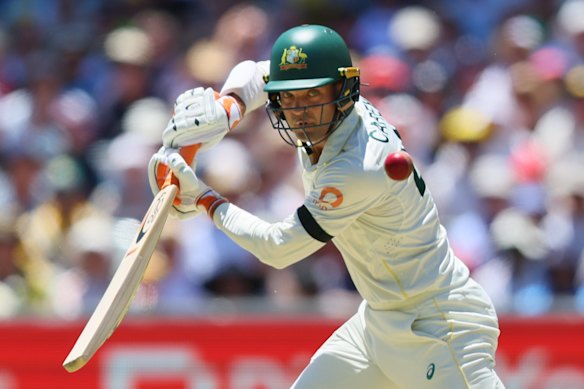
Alex Carey in action against England in Adelaide.Credit: AP
The collective reaction has been dismay, but it’s tough to hear Ricky Ponting’s comments that the “Snicko” technology is inferior to the Ultra Edge product used in England without wondering why two separate products are being utilised to adjudicate an identical game.
We know the answer. It’s a similar answer to the query about why some countries use rival ball-tracking companies Hawk-Eye and others Virtual Eye, why some use varying combinations - with or without Hot Spot - and why some use only partial or none. Money, of course, is the answer to many things, and it is critical to the set-up and staffing of DRS for a Test match.
For home-and-away bilateral series such as the Ashes, the cost is worn by the hosting board or shared with broadcasters. For wealthy organisations like Cricket Australia (CA) and the England and Wales Cricket Board (ECB), the whole shebang can get very pricey. Nobody needs to worry about the Board of Control for Cricket in India (BCCI), with its overwhelming riches, once its initially staunch opposition to DRS softened.
In Australia, Foxtel pays for the whole box and dice. Seven also pays for their own tech aids but the Foxtel tech is what the umpires get. In the UK, the ECB cuts a deal with Sky where the board helps pay for the tech aids, so Sky doesn’t just choose the cheapest operators.
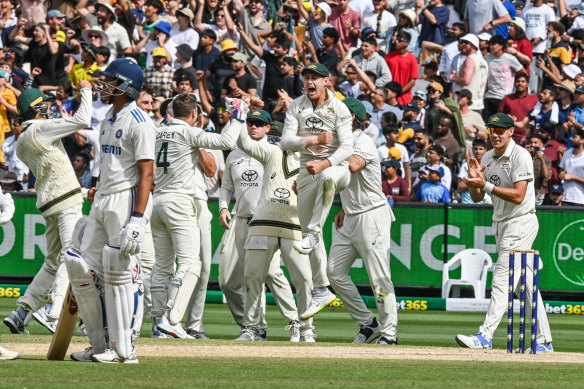
Yashasvi Jaiswal is dismissed by Australia after a contentious DRS decision in the 2024 Boxing Day Test against India.Credit: Justin McManus
CA are going to sit down with broadcasters and tech operators at the end of the season to review processes and decide if they need to look at having stricter regulations (that go beyond ICC minimums).
For poorer nations - think Zimbabwe and West Indies - the cost can be too prohibitive for anything less than a major home series, and those Tests produce in-game calls that may well not fly in Adelaide this week. But then, Snicko (also used in New Zealand) could not get it right, either.
In essence, the sport of cricket operates on one DRS framework using multiple technology packages with varying levels of accuracy. So where does that leave everything? Ideally, with the global governing body for footpaths.
The International Cricket Council (ICC) funds and mandates the use of full DRS technology at its flagship tournaments, including the World Cup (men’s and women’s), T20 World Cup (men’s and women’s), Champions Trophy, the World Test Championship Finals and the Under-19 World Cup, along with some higher-tier World Cup qualifiers.
After that, nothing is uniform, because the ICC does not pay for it. The international and domestic scenes are replete with hypothetical controversies and edge cases primed for exploitation. At risk is fairness for all teams and players, trust in umpires, the credibility of broadcasts and even player development.
During the 2018 Ashes, Jonny Bairstow lamented DRS inconsistencies were “messing with careers and livelihoods”. England had been on the wrong end of the DRS on a disheartening day for the tourists in Sydney, but his remarks about the disparities between Snicko and Ultra Edge around matching vision with sound were, well, sound.
Loading
“We are aware there are two different systems in place around the world, and it’s about making sure there is clarity on how those systems work for us as players out in the middle,” Bairstow said.
“When you see the spike on the graph and one system is allowed one frame before, but the other system has one frame after, and you don’t know which system is in place, that can be very frustrating - especially when you are toiling very hard for a long period of time.
“The technology is there to be used but we need to make sure it’s of the highest standard, because it’s people’s careers and livelihoods you are messing with. It is a frustration not knowing the exact rulings and how it’s used.”
Cricket is firmly in the age of technology, and there’s no going back. The ICC’s revenue is swelling every year, pulling in hundreds of millions. With the money to fund the best technology available, and the means to implement it all over the world, it should do both.
Most Viewed in Sport
Loading