3 months ago
11
3 months ago
11
I was 19 and had planned to hitch my way from Victoria to Far North Queensland, taking my time going up along the coast. Some time the previous night, a truckie had offered me a lift at a truck stop near West Wyalong, an old NSW town on a crossroads a couple of hours north of Wagga Wagga.
Truth to tell, I didn’t quite know where West Wyalong was.
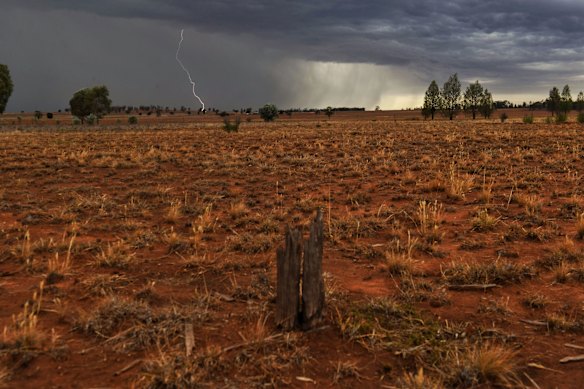
Storms roll through the parched landscape near West Wyalong in 2020.Credit: Nick Moir
There were no mobile phones those days, and I had no map.
I was travelling blind, occasionally finding a phone box and placing a call (reverse charges, naturally) to reassure my long-suffering parents I was having an excellent journey. Safe as houses.
So there I was, dozing at a truck stop cafe in the middle of NSW somewhere, when this bloke in a blue singlet woke me and said the waitress had told him I wanted a lift.
I hoisted my rucksack into his truck’s cabin and we bellowed off, hauling a great load of steel.

This story is part of an opinion summer series from our writers and reporters about the year that changed them.Credit: Aresna Villanueva
I probably should have taken the trouble to figure out those crossroads. One highway stretched towards Sydney and the other, the Newell, to Brisbane.
So, a few hours into the trip, I learnt I wasn’t going to Sydney. Wrong highway.
More than six weeks of travelling stretched before me. It was my first holiday as a cadet journalist at The Portland Observer.
It was July 1971. I didn’t have much money. But I had a thumb.
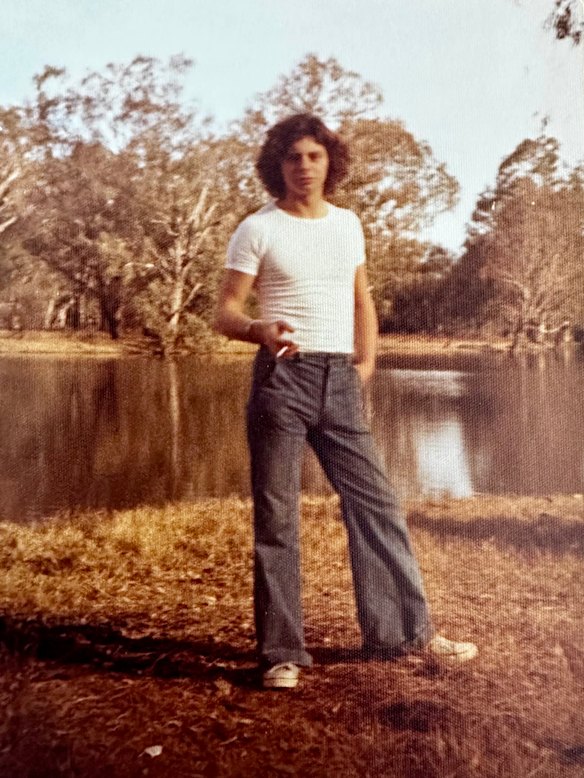
Wright around the time of his road trip.
A song by Bobby and Laurie had become my anthem since it was released in 1966.
Hitch-Hiker, it was called. “Like a restless tiger,” went the lyrics. “You can’t stand still/And you never will”.
And so, I stuck out my thumb with a hazy plan to hitchhike the length of the east coast of Australia, from Victoria to Far North Queensland and back.
And if I was going to get to Queensland quicker than I’d expected, so be it. I could see Sydney on the way back. And did. Which is another story altogether.
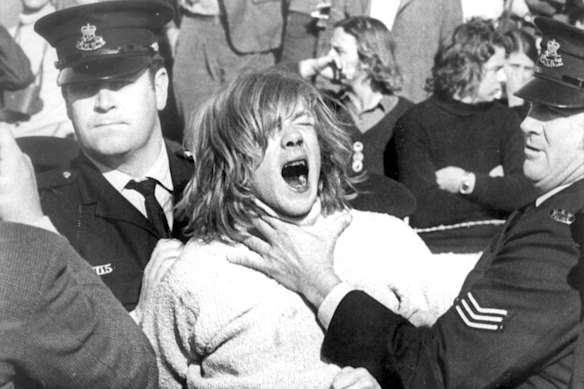
An anti-Apartheid protester is restrained during the Springboks’ 1971 tour of Australia.Credit: Fairfax
The truckie was a taciturn character gobbling amphetamine pills.
His back-up plan in case the pills weren’t sufficient was that I had to stay awake to prod him in the ribs if he started nodding off. He wouldn’t share his amphetamine, and if my head started to descend towards my chest, he’d give me a swipe across the ear.
Loading
He wanted to get to Brisbane without stopping because he had a girlfriend there, he told me. Lucky girl, I thought.
He didn’t make it.
His load was overweight, we’d taken dodgy back roads to avoid weigh-stations and we’d thundered down the eastern edge of the Great Dividing Range on a precipitous, winding hell-road called Cunningham’s Gap, the truckie letting his machine have its head and cackling mightily at my terror.
We pulled in to a layby at the bottom of the gap, less than two hours from Brisbane.
The truckie laid back his head and started snoring. The amphetamines had performed their last hurrah.
The girlfriend would have to wait. Very lucky girl.
I retrieved my rucksack and stuck out my thumb. An old Holden pulled up.
Two young blokes and two young women were aboard. They made room for me. We rocked off, the cassette player cranked up to 11.
“Where are you staying?” one of them shouted.
I thought I might stay on the beach, I said. Gently, they explained Brisbane didn’t have a beach, unless I enjoyed mudflats.
“Better come home with us,” they said.
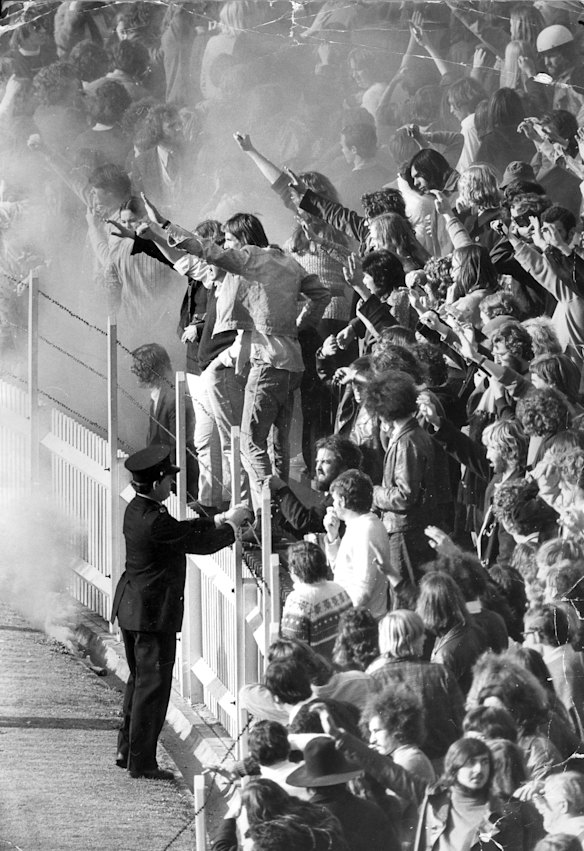
Anti-apartheid protesters flash mock-Nazi salutes during a match between the Springboks and Wallabies in July 1971.Credit: Fairfax Photo Archive
They were teachers, they lived in a lovely old Queenslander and they were planning to attend a protest that night against something called the Springboks. I didn’t know what a Springbok was, but didn’t feel brave enough to ask after the humiliation concerning the non-existent Brisbane beach.
And so, I tagged along. And got a charging bull of a cop’s truncheon over the shoulder for my trouble, bringing me to my knees and paralysing my arm. Others fared worse, particularly those herded over a cliff at the end of the park on to a roadway below.
Loading
I got briefly radicalised by that indignity, and occupied the University of Queensland for the night amid quite a lot of genuine wild-eyed radicals.
Next morning, I picked up my bag from the lovely old Queenslander I hadn’t got the chance to stay in, and hitched to a real beach – Surfers Paradise.
My travelling holiday had begun.
Adventures of all manner lay in wait on the long, long road ahead.
I’m not sure even now how I survived.
“Like a restless tiger, you can’t stand still, and you never will,” I sang to myself.
I wouldn’t take back a day of it.
Tony Wright is an associate editor and special writer for The Age and The Sydney Morning Herald.
The Opinion newsletter is a weekly wrap of views that will challenge, champion and inform your own. Sign up here.