2 months ago
7
2 months ago
7
There is a scene in Rental Family in which American actor Phillip Vanderploeg, living in Japan to capitalise on the fleeting fame of a toothpaste commercial, is confronted with the reality of working for an agency that hires him out to play relatives and friends of clients. “We sell emotions,” he is told. “That’s how this business works. There’s always someone new.”
As much as it is an examination of the prideful nuances of Japanese culture, it is also at times a deeply affecting exploration of the modern world as some kind of elaborate rental model: a cheaper, less substantial and perhaps less authentic world than the one we inherited. To quote Jonathan Larson’s Pulitzer and Tony Award-winning rock musical Rent: “Leave your conscience at the tone.”

Brendan Fraser says he is an “open book”.Credit: Jason Bell
“What is the price of authenticity and what is performative and reality?” asks actor Brendan Fraser, who plays Vanderploeg in the film. “Losing face, saving face, is of paramount importance in Japanese culture, which just boils down to us being unfailingly polite to one another no matter what. We don’t always see that in the world of today. We certainly don’t see it in what is beamed at us from this screen in the palm of our hand, [and that is] even more reason why I’m sure this is a film we need right now, more than ever.”
At 6′ 3″ (190 centimetres) tall, Fraser cuts an imposing figure as he lopes into a London hotel room. He’s on the promotional trail for the film, but rather than conduct the interview inside the junket’s heavily lit, crowded framework, we have been ushered into a nearby room and offered a couple of armchairs to talk. As the human machinery dissipates and we are left to talk, he relaxes into the moment, somehow both larger than life, but also softly spoken.
“The director, Hikari, came to this with the notion of how we contend with isolation,” Fraser says. “She wrote it during pandemic – we are all living with these pieces of black [screen] glass in front of our faces, and it has a temporal quality, short attention spans, form over substance. This man, he arrived in the beehive of activity that is Tokyo, and still managed to feel absolutely isolated and terribly lonely. It’s something we collectively feel. You’re not alone in being alone.”

Shannon Gorman and Fraser in Rental Family.Credit: SEARCHLIGHT PICTURES
Rental Family explores a real microindustry in Japanese culture, in which people are hired from an agency to play roles as substitute family members or friends for specific events. Sometimes the purpose is practical - the inability to find a plus one to accompany you to a wedding, for example - but there are also complex societal layers the film explores: mourners at a funeral, a replacement for a missing parent, and so on.
“These are people who can convincingly stand in for those absent from people’s lives, and when the fantasy construct of that abuts the reality, the blurry area in the overlap is where this movie lives,” Fraser says. “We find out what really happens when you do this. When you ask the understandably, prickly moral and ethical questions that surround participating in something that could genuinely change the trajectory of a person’s life.”
The result is genuinely stunning. Unassuming to start, the film quickly unpacks a complex emotional tail, exploring both the profound melancholy of Vanderploeg’s life, but also the sometimes bleak worlds of his clients, yearning to create meaningful emotions private, inner worlds often devoid of them. How real is it to him? And what happens when the contract ends and real people have to disconnect performed emotions?

Mari Yamamoto and Brendan Fraser in Rental Family.Credit: SEARCHLIGHT PICTURES
“People seem to see this film as almost a catharsis, and we’re not performing a public service in making a movie, it’s entertainment, of course, but it does resonate,” Fraser says. “We’ve all felt like we have our nose pressed up against the glass and you want to belong, but you’re kept away, you don’t know what you need to do to get in. Phillip certainly feels like that, and he is reminded pretty regularly of that.”
Born in Indianapolis, Indiana, to Canadian parents, Fraser’s early career cast him as something of a matinee idol. School Ties (1991), Encino Man (1992), The Mummy trilogy (1999–2008) and George of the Jungle (1997) confirmed him as a box office quadruple threat: dramatic actor, comedic actor, man of action and pin-up boy.
But if Fraser’s career is composed of three acts, the middle act was something of an interregnum which took him out of the spotlight for the better part of a decade. A combination of factors were in play, including being sexually assaulted by a journalist (amplified by the industry’s reticence to take it seriously) as well as recovery from the physical demands of filming his own movie stunts, which required surgery and recovery.
His return to the spotlight, amusingly referred to as the “Brenaissance” by his fans, began with a handful of smaller parts, including the prison guard Gunther in the television series The Affair, and Robotman in two other television series, Titans and Doom Patrol, and then accelerated rapidly with roles as a gangster in Steven Soderbergh’s period crime film No Sudden Move (2021) and as morbidly obese recluse Charlie in Darren Aronofsky’s film The Whale (2022).
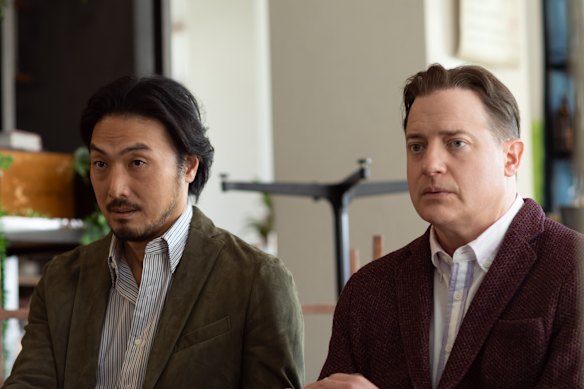
Takehiro Hira and Brendan Fraser in Rental Family.Credit: SEARCHLIGHT PICTURES
The creative, commercial and personal impact of The Whale was transformational for Fraser, drawing wide acclaim for breathing into Charlie a rare and very moving humanity that audiences connected with as he struggled to reconnect with his estranged daughter. Richard Roeper, writing in The Chicago Sun-Times, called it an “empathetic, haunting, beautiful, heartbreakingly moving story of a broken man”.
Fraser would go on to win the Oscar for best actor. In his acceptance speech, Fraser thanked Aronofsky for “throwing me a creative lifeline and hauling me aboard the good ship”. But more significantly, perhaps, the role offered Fraser the opportunity to rewrite his own life story and created an opening for what now looks to be an even more extraordinary third act.
“I’ve got nothing left to hide; I’m an open book,” Fraser says, candidly. “I don’t want you reading my book necessarily – who does? But not too big to admit that, sure, I struggle with confidence all the time or insecurity, or what you want to name it, and it’s liberating to acknowledge that and think, well, what’s the worst thing that could happen if I do that, if I make that reveal? And you don’t know it until you do it, and the surprise is you’re not alone. It’s one place you’re not going to be alone.”
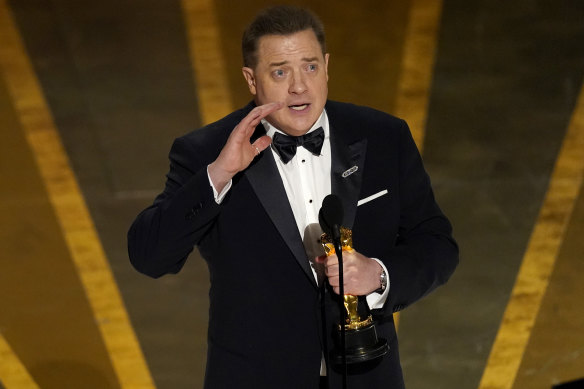
Brendan Fraser accepts the award for best performance by an actor in a leading role for The Whale in 2023.Credit: AP
Speaking to him face to face reveals the curious juxtaposition of Fraser’s emotional self. He’s all movie star: statuesque, commanding and the centre of the room the moment he walks into it. But he also wears all of his emotion on the outside. And he has a kind of raw, unmanufactured ease that leaves little room for disguise or artifice.
To be honest, Fraser’s return to the screen was on the radar for some time. When The Whale was in production, long before the critics roared with praise and the Oscar spotlight swung powerfully back onto Fraser’s face, the director Steven Soderbergh and I were speaking. Soderbergh had had an opportunity to see the film, and assured me it would be transformational for Fraser.
Soderbergh should know. He cast the then 26-year-old actor in the noir anthology series Fallen Angels. In the episode The Professional Man, Fraser played Johnny Lamb, an elevator operator who sidelines as an assassin and becomes entangled between his boss, a jealous, unhinged mobster, and his latest contract: to assassinate a target who happens to be his boyfriend.
Reflecting on Fraser’s work at the time, Soderbergh told me: “He has absolute fearlessness, a complete disinterest in how it will look. All he cares about is that guy, being that guy.”
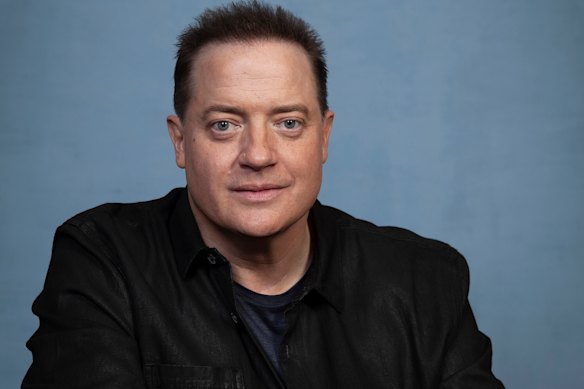
Brendan Fraser wears his heart on his sleeve. Credit: AP
Fraser takes the compliment when I repeat Soderberg’s words, but with a touch of self-effacing awkwardness. “That means a lot to me,” he says. “He gave me that job back in the day because he loved the twist on the pulp fiction trope: a guy called Johnny and a boss and a dame, only the dame’s a dude. That’s the surprise at the end, which is fantastic.”
Fraser’s career is composed of collaborations with a who’s who of the directing world, from Stephen Sommers (The Mummy, 1999) who turned him into an Indiana Jones-style action hero, to Phillip Noyce (The Quiet American, 2002), Paul Haggis (Crash, 2004), Steven Soderbergh (No Sudden Move, 2021) and Martin Scorsese (Killers of the Flower Moon, 2023).
“The ones who I think mean the most to me are the ones who just get out of your way, hire the right people to do what you do well and let them do it,” Fraser says. “Those that micromanage, it becomes more laborious, and the ones you mention are not those individuals who micromanage. In a word, confidence. That’s what I’d say.”
And the boy on the billboard, while he is plainly Brendan Fraser, is also somebody else. He is Clayton Boone from Gods and Monsters. And he is Rick O’Connell from The Mummy. “He’s an assembly of so many parts,” Fraser says. “That’s an image that doesn’t grow old or get hungry or bleed or have an opinion, and this one does. I look at him sometimes, and I think, wow, that guy was trying little too [hard] ... he needs to lighten up, he’s trying too hard, he needs someone to tell him, it’s going to be okay. I needed a Rental Family member to go and coach me through it.”
Those men are also men from a place and time, but perhaps the one who endures the most is Rick O’Connell, dashing hero of The Mummy. I loved the movie, and I loved that character, I tell Fraser. “I was there with you,” he says, smiling that Rick O’Connell smile. (He and co-star Rachel Weisz will reprise their roles in a recently announced sequel.) It was a performance that ought to have put Fraser at the top of the list for an Indiana Jones recast, if only Hollywood understood then how recasting was so instrumental in the long shelf life of franchises such as Doctor Who and James Bond.
Loading
“Place and time ... they make an impression on you, and it becomes part of our mythology or our personal narrative,” he says. “I have those moments, too. I do. I remember the first time I saw Saturday Night Live. Star Wars was right here at the Odeon in Leicester Square. 1977 with my brother. Transfixed, it rewires your brain somehow, right? When films are affected, that’s what they do. And you walk out feeling changed.
“It’s such a mercurial process ... what you conceive of, what you write, what you prep and cast, shoot, edit, deliver – that it’s so far removed from what it was at the beginning that you wonder, how did this giraffe get born into this family of zebras? But it belongs and that’s what you get. And will all of that, whatever it is, resonate with the audience? That’s the hope, I suppose, right? Sentiment doesn’t live in a vacuum.”
Rental Family opens on December 26.
Must-see movies, interviews and all the latest from the world of film delivered to your inbox. Sign up for our Screening Room newsletter.