3 months ago
26
3 months ago
26
Opinion
December 27, 2025 — 5.00am
December 27, 2025 — 5.00am
If you believe Australia needs Asia capability, then you must believe the Australian government and the wider workforce need Australians who have spent time living, studying and working in Asia.
I am an Australian, with Mandarin language skills, studying a PhD in Hong Kong, researching the impact of nationalism on public perspectives of the Australia-China relationship. I was in Canberra recently to have conversations with ANU professors, think-tankers and government staff about my research. It took all of two seconds for someone to accuse me of being a spy.
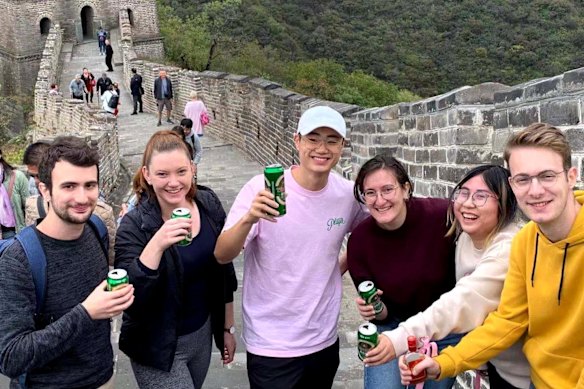
Ciara Morris, second from left, with Peking University classmates on the Great Wall of China in 2019.
A senior political staffer, at a dinner among friends, who was meeting me for the first time, thought it was appropriate to openly question my national loyalty after learning I was interested in China. Joke or not, these all-too-frequent comments are a symptom of a wider problem: undue suspicion of Australians with China capability.
I preface this by saying this feeling can be so much worse for Chinese Australians, for whom these ‘jokes’ also take on a racial frame.
I first moved to Asia in 2019 after completing my undergraduate degree in government and international relations in Sydney. I went to Beijing for my masters to learn more about China.
Loading
Arriving back in Australia a year later, I was told by ASIO officers, waiting outside my home, that I would be unlikely to ever pass a security clearance to work in the Australian government given my time in China, and if I was smart, I wouldn’t return. Unfortunately, this is not a unique story.
Despite the threat atmosphere, I wasn’t done with China. It didn’t make sense to me, as an Australian, not to learn more about this massive and growing superpower to our north, our most important trading partner, a country of great social importance to our multicultural nation and also just because I found it interesting.
A House of Representatives Standing Committee on Education is currently leading an inquiry into building Asia capability in Australia. This is a proposal of mammoth importance.
As committee chair Tim Watts said: “Australia’s future prosperity and security relies on the Asia capability of our people – the mix of cultural understanding, language facilities and regional experiences that are needed to be effective in Asia.”
After co-authoring the Australian Academy of Humanities’ 2023 report on Australia’s China Knowledge Capability, I assisted the academy in its submission to the inquiry. We wrote: “For the last 20 years, Australia’s collective knowledge of Asia has developed without a co-ordinated strategy. Efforts to broaden Asia literacy and capability have been ad hoc, and initiatives have stalled as political tides have changed. A refreshed government discourse on the importance of Australian Asian capability is sorely needed.”
In the past month, I have attended two academic conferences, one in Shanghai and one in Melbourne, filled with established academics who have deep knowledge of China.
Australian Asia capability does exist and can be found in university classrooms and think-tank offices around the country. But it is disconnected, often unacknowledged and it is untapped as a nationally strategic resource. It is also not actively cultivated, measured or nurtured to meet future expanding needs.
Early-career researchers are struggling for funding and to find jobs in and outside of academia. Young Australians with Asia capability are leaving for jobs overseas.
As a trading nation, Australia’s entire prosperity depends on our engagement with the world and, in particular, Asia. If we keep making cheap jokes about our own students being spies, we’re self-sabotaging our future.
Loading
Of course, national security is important and we absolutely need Australians legitimately protecting our nation from foreign interference. What we don’t need is a culture where Australians distrust their fellow citizens purely because of time spent out of the country. We are a nation of migrants, and our collective knowledge of the world makes us stronger, not weaker.
Every few years, the same story comes out: we need more Australians who have formal training in Asia.
There are fantastic programs that exist to help Australians learn more about Asia, such as the National Colombo Plan for undergraduate students, and the Foundation for Australian Studies in China for postgraduate scholarships. But higher education is only one part of the story. We need a pipeline before university, and afterwards.
We need to support our students so they want to study Asia, and we need to value professionals with Asia capability.
We need to decide as a nation that we will value these Australians. We will vet everyone who applies for a government job, of course. But we will not judge people as un-Australian just for having an interest in other places.
Ciara Morris is an Australian PhD candidate at the City University of Hong Kong.
Most Viewed in National
Loading