2 months ago
18
2 months ago
18
Inside the Huntington Botanical Gardens, a leafy oasis amid the concrete sprawl of Los Angeles County, a hawk snatched a baby squirrel from its nest, much to the horror of onlookers. On a commercial flight, a wayward bee buzzed through the cabin, causing mayhem among the passengers. In both instances, Robert Irwin happened to be nearby. “Wherever I go, whenever there’s anything animal-related, it’s like when Clark Kent takes his little glasses off,” he said. “It’s like, ‘OK, I can step in and handle it.’ ”
Not all heroes wear capes. Sometimes, they wear khaki. Irwin caught the bee, but the squirrel could not be saved. “I felt really bad. But, I mean, that’s nature, isn’t it?” he said. “Best day ever for the hawk, worst day ever for the squirrel.”
The son of Steve Irwin, the beloved “Crocodile Hunter” conservationist who died in 2006, Irwin has continued his father’s work, promoting wildlife at home in Australia and around the world, while also doing things his own way. As a contestant on Dancing With the Stars in the US, Irwin, who turned 22 this month, became a fan favourite from his very first jungle-themed jive. And that carried through right up until the end, as he and his partner, Witney Carson, were crowned the champions of season 34 during the show’s season finale.
It was not a surprise. His older sister, Bindi Irwin, won the reality show’s Mirrorball Trophy in 2015, and it was clear that, like his sister, the endlessly upbeat Irwin had also inherited his father’s ability to connect with people: the judges, fans, children, celebrities. Even Prince William called in to the show to offer Irwin his support.
“Robert is like living sunshine,” Bindi Irwin, 27, said. “Wherever he goes, he makes people feel better.” Or, as his mother, Terri Irwin, put it, “He’s kind of what Tom Cruise aspires to be.”
When I first met Robert Irwin inside his Dancing with the Stars trailer in Los Angeles in mid-November, his khaki workout pants were peppered with jagged rips, not from a wayward animal encounter but from aggressive knee-sliding across the dance floor.
“I’m held together with tape and a prayer at this point,” he said. “I feel like I am at my limit, and I wouldn’t want it any other way.”
Though athletic, Irwin had zero dance experience before joining the hit series. He approached the competition with a dogged determination that carried him to the finale.
Since September, the finalists – a group that also includes Olympic gymnast Jordan Chiles, actress Elaine Hendrix, and content creators Alix Earle and Dylan Efron – spent 24 to 36 hours a week in rehearsals with their professional dance partners. Irwin was paired with Carson, a professional dancer who in 2014 won the competition with Alfonso Ribeiro, who is now one of the show’s hosts.
On a recent Monday evening, I watched Irwin practise his foxtrot inside the Dancing with the Stars ballroom – technically, a cavernous soundstage – near Hollywood. His mother and sister sat a few rows back. The family, along with his sister’s husband and four-year-old daughter, decamped to Los Angeles for the show’s entire season to support Irwin, at his request. As cameras prepared for the blocking session and producers conferred, Irwin twirled across the polished floor, his arms wrapped around an imaginary partner, his patent loafers following a silent beat.
“I just want to get this right,” he told Carson as she slipped into position and they retraced the movements yet again.
At the next night’s live show, while the other contestants chatted and stretched, Irwin was back at it, furiously dancing parts of his routine until a crew member shooed him into place.
“He puts so much pressure on himself,” Carson said inside her trailer. “He’s a perfectionist. He just puts his heart and soul into everything and makes you want to be better.”
Throughout the season, the two have leaned into Irwin’s budding status as a heartthrob, outfitting him in torso-baring ensembles and integrating the occasional body roll and hip thrust into his choreography.
Yet there’s a softer side to his appeal. Irwin isn’t afraid of raw emotion and he has broken down multiple times during the season. One night, he cried during a dance dedicated to his mother, who raised him and his sister alone after his father was fatally stung by a stingray. Another time he fell to the floor, overcome with emotion, when videos of him and his father were shown.
Loading
Fans – and there are many – have praised Irwin as a beacon of positive masculinity for his vulnerability. He makes no attempt to appear cool or aloof. He often throws his head back in full-throated laughter, and he gleefully celebrates everyone around him. He has also expressed his support of the LGBTQ+ community and women’s health issues. (He said he was inspired by his sister’s endometriosis diagnosis.) “I strongly believe that life is too short not to wear your heart on your sleeve,” he said. “When you lose someone important early on, it reaffirms the fact that life is so fleeting. You owe it to yourself to find your passion and to pursue it.”
For Irwin, that sensitivity is a strength he first saw in his father, who died when Irwin was two, and to whom he bears a striking resemblance, both in exuberant mannerisms and blond, rugged physicality. “He was about as traditionally masculine as you can get, and then, at the same time, he was the most vulnerable, emotional, family-oriented, kind human being,” he said. “That, to me, is the epitome.”
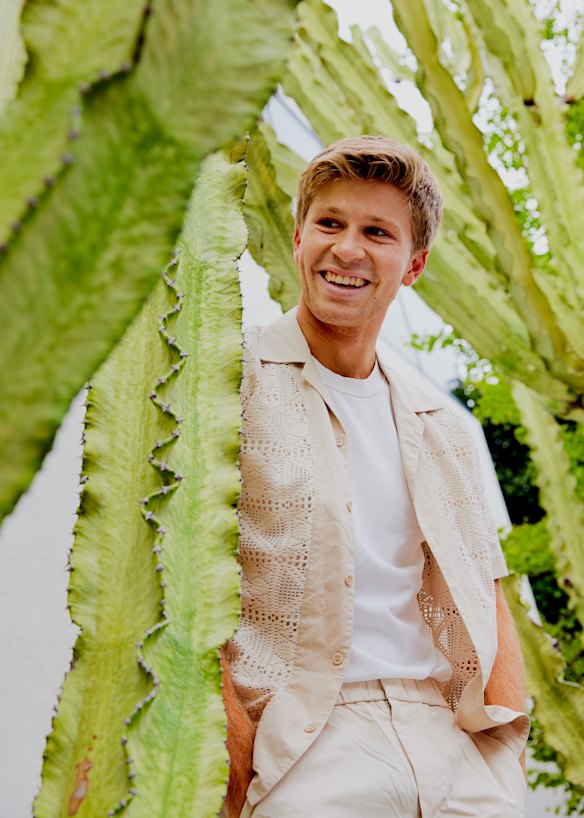
“When you lose someone important early on, it reaffirms the fact that life is so fleeting. You owe it to yourself to find your passion and to pursue it.”Credit: NYT
Actor Russell Crowe, who has been a close friend of the Irwins since the 1990s, said Steve would be “so impressed” with the man his son had become and how he had succeeded on his ballroom journey.
“Although Steve could read the rhythms of the seasons and every living creature, he was absolutely not gifted with a sense of musical rhythm,” Crowe said in an email. “In his hands, a tambourine became a deadly weapon.” He added, “I think he would watch Robert dancing and how he uses his body, the strength and poise, and he would be in awe of his son.”
Australia does not have its own homegrown royal family, but the Irwins could be considered the closest thing. In lieu of a palace, Irwin was raised in a zoo.
In 1970, the elder Irwin’s parents founded a small reptile park that evolved into Australia Zoo in Beerwah, Queensland. After he began managing the park and married his wife, who is American, in the early 1990s, they settled in a home on the site as they expanded the zoo and collaborated on The Crocodile Hunter, their wildlife documentary TV series.
When he died, his wife made sure he remained ever-present in their children’s lives through his extensive work catalogue. The children watched episodes of The Crocodile Hunter and other documentaries featuring their father every morning with breakfast. “We had thousands upon thousands of hours of footage, so I never felt like I was missing the picture of who my dad was,” Robert said. “Put it this way, I learnt how to feed crocodiles from my dad,” he added, explaining that he first tried it eight years after his father’s death, with guidance from the videos and other zookeepers who his father had personally trained. “He is still teaching me every day.”
While growing up, the privately tutored Irwin children made time for typical 2000s kid things. Their mother said Bindi had a Tamagotchi and Robert had a Game Boy, but they were mostly “free-range kids” who climbed trees and traipsed around the zoo.
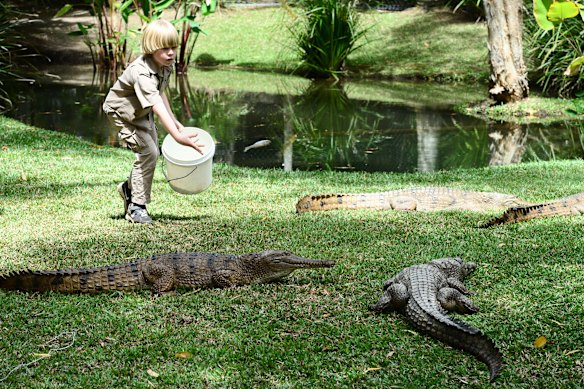
Irwin at age 8 at Australia Zoo.Credit: AAPIMAGE
Terri Irwin is now the zoo’s sole owner, and she, her son and her daughter’s family all live on the 285-hectare property. They regularly appear there to promote their conservation and animal rehabilitation work, and have found other promotional avenues such as reality TV, merchandise, luxury lodgings and non-profit efforts.
“It’s like I was born into a Disney movie,” Robert Irwin said. “I wake up every morning to the sound of the lemurs and tigers calling. I’m surrounded by animals, and I’m surrounded by all of this love from my family and this drive to want to make the world a better place.”
Loading
At a backlot photo shoot the morning after Irwin earned a perfect score for his foxtrot, he vibrated with pent-up energy as he made small talk about the merits of monotremes (egg-laying mammals such as the platypus). When he had to pose for a few serious shots, his lips quivered as he tried to suppress his signature toothy grin. “It’s my default,” he said as his smile won the battle.
Irwin’s overarching message, like that of the rest of his family, is simple: treat others – whether they be humans or animals – with kindness.
“Someone once said, ‘Steve’s like the Gandhi of wildlife,’ ” Terri Irwin said, adding that her husband’s mantra was, “You’ve got to love crocodiles and koalas, vultures and eagles.” As in, the prickly or overlooked animals deserve adoration, too. “Once you’re accepting like that, it just kind of cuts through your whole life,” she said. “More love.”
Over the course of the three days I spent intermittently trailing and observing Robert Irwin at various Dancing with the Stars activities, his puppy-like excitement for anyone and anything that crossed his path never appeared to waver. But no one can really be that enthusiastic all the time, right?
“I used to think that,” said Luke Reavley, the general manager of Australia Zoo, who has known Irwin since he was a toddler. “But it’s him. On and off camera, he’s like that 24/7.
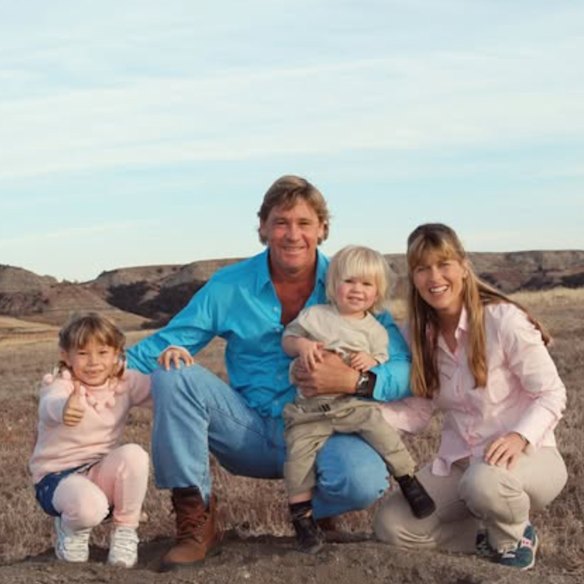
A very young Robert Irwin with older sister Bindi, dad Steve and mum Terri in a picture Irwin posted on Instagram.Credit: @robertirwinphotography/Instagram
Perhaps because Irwin has been in the spotlight since birth – a camera crew filmed him as a newborn in the delivery room, and four weeks later he was at the centre of an international uproar when his father cradled him in one arm while feeding a crocodile – he doesn’t see any distinction between his public persona and his private self.
“I never change what I say, what I do, who I am one bit, wherever I am,” he said as we sat on a couch in an empty green room before a fresh round of rehearsals. “It’s just me, and I stand by who I am.” The challenge with that, he conceded, is “you’ve got no persona to hide behind”.
Instead, he has become an expert at revealing just enough. No matter his audience, Irwin is disarmingly friendly and welcoming. But every word is spoken with intention. Every answer bounces in exactly the direction he wishes to take it. He is a publicist’s dream.
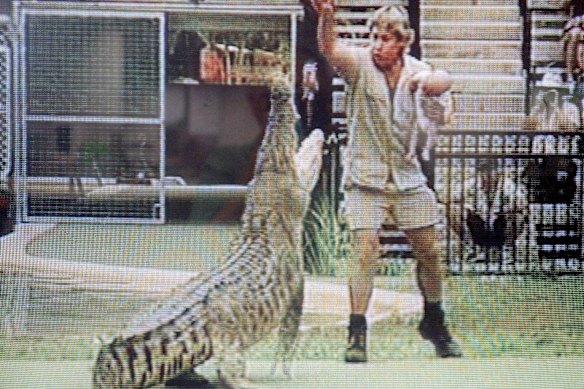
Steve created uproar when he cradled baby Robert while feeding a croc at Australia Zoo.Credit: Chanel 7
Topics like his struggles with fame and his dating life are spoken about in broad terms, his cheerful tone belying the wall of privacy he has delicately constructed. “Holy moly, that’s so challenging to navigate,” he said of trying to date in an era where “anything you do will be on TikTok the next day.” (He was previously in a relationship with the niece of Heath Ledger, and Dancing fans love to speculate about various dating rumours.)
When I asked his family if Irwin had ever rebelled, Bindi quipped, “His paleontology phase was pretty wild.”
In Australia, he unwinds by surfing in the Pacific most mornings. He considers himself a spiritual person, and he finds the most solace from being in nature. “That is my meditation,” he said. “It’s my church. It’s my everything.”
Loading
Now, Irwin’s at a crossroads. After Dancing with the Stars, he will head to South Africa, where he hosts the Australian version of I’m a Celebrity ... Get Me Out of Here, a gig he committed to only after the series agreed to stop serving native wildlife in its eating challenges.
But his stint as a dancing star has opened up a new world, he said, one in which he sees a future more rooted in the arts and working, at least part-time, in the United States. To that end, he has a cameo in Disney’s Zootopia 2 as a koala named Robert Furwin. And he dreams of one day starring in action movies.
“Mate, 100 per cent,” he said, his eyes lighting up at the thought of doing stunts. “Oh my gosh, that would be an absolute dream.”
He’ll never move away from wildlife conservation or the zoo, he explained carefully, but he is hoping to evolve the ways in which he spreads his message.
“What I represent is still so deeply connected to anything I do,” he said. “Even if I’m not in there catching crocodiles, the khaki is still in my heart. It’s always me.”
This is an edited version of a story that originally appeared in The New York Times.
Get the best of Good Weekend delivered to your inbox every Saturday morning. Sign up for our newsletter.