3 months ago
18
3 months ago
18
If they are not already, the AFL leadership should be asking themselves how they became embroiled in an acrimonious marriage split that originated with a grainy photograph of male genitals posted on the internet more than 12 months ago.
The legal stoush between the estranged couple, former Carlton president Luke Sayers and his wife Cate, went up a few notches over the past week when Cate filed a defamation suit against her husband in the Supreme Court of Victoria, prompting a public intervention from two of the couple’s daughters, Bronte and Claudia, on behalf of their father.
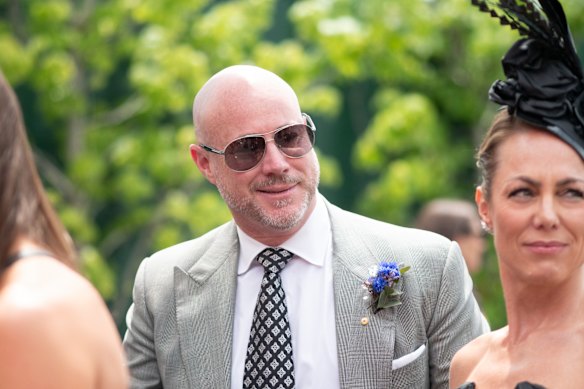
Ex-Carlton president Luke Sayers.Credit: Elke Meitzel
Where is the AFL exposed, so to speak?
At the centre of Cate Sayers’ case is the statement, said to be a statutory declaration, made by her husband to the AFL’s integrity unit. In the statement – which this masthead has not seen – Sayers clearly asserted that he did not upload the offending image on his social media (X) account and provided some detail of his version of these events. A female executive, who worked for a club sponsor, had been tagged into the X post.
The AFL found that Luke Sayers had not breached AFL rules, and that his account had been compromised.
Cate Sayers is taking legal action, on the basis that she has been injured by her husband’s explanation to the AFL, and is seeking some form of redress.
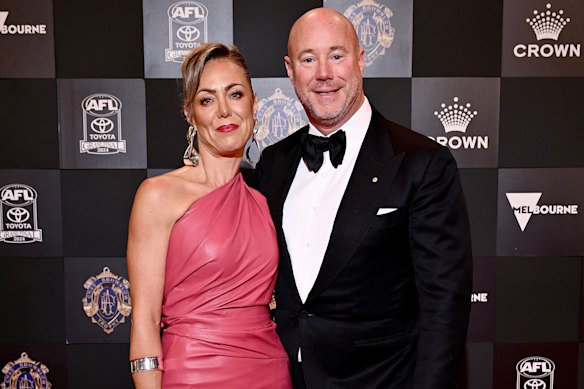
Cate and Luke Sayers at the Brownlow in September 2024.Credit: Getty
The Cate camp is saying that she has some knowledge of what Luke put in the statement and is willing to subpoena it. The inference is that she has not necessarily seen the document, in full.
The AFL, thus, could face the prospect of having this document bared – I won’t strain the metaphor much further – to the public via the court action. Cate Sayers’ statement of claim to the court could be available shortly, even if Luke’s statement is withheld.
Luke Sayers’ camp says he is standing firm behind what he told the AFL, that there’s been no backtracking on his version.
If this was merely a spat between a wealthy couple, one of whom was the immediate past Carlton president, amid a hostile break-up, the AFL could wash their hands of it entirely.
But the Supreme Court filing creates the possibility of some further embarrassment, and the fact that the league’s newish communications and government relations supremo, well-connected ex-ALP staffer Sharon McCrohan, advised Sayers during the scandal is another awkward wrinkle for the league.
Whatever happens in court action or in mediation managed by costly lawyers, the AFL might not merely consider how it fell into this mud but also ponder the role – and remit – of its integrity unit.
The league might also ask itself this plain question: how far should we go in policing or probing the private behaviours of individuals who happen to be either players or officials at clubs?
The integrity unit, as first conceived, investigated matters pertaining to the running of a clean football competition – drugs, gambling, cheating and tanking (see Melbourne, 2012). Over time, it expanded into the social realm to include racial and/or homophobic incidents.
Loading
Why was the integrity unit investigating the dick pic posting? Sayers was then Carlton president, and it was seeing if he had breached the AFL rules, including the convenient catch-all of “bringing the game into disrepute”.
But did the league really need to activate the integrity unit here? Naturally, the party line back when the scandal surfaced was that it had to investigate because Luke Sayers, the ex PwC chief executive, was at the helm of the Blues.
The league had been pressured, implicitly, by persistent complaints from the AFL Players Association that officials – often coaches, but sometimes maverick presidents – had been treated leniently, ie not investigated or suspended/fined, for offending comments or remonstrations.
The AFL has a Respect and Responsibility policy to deal with offensive behaviours towards women, which, irrespective of whether it provides justice for mistreated women, at least has a clear process.
Loading
Respect and Responsibility (very Jane Austen-sounding, yes), more than a decade old now, is triggered by complaints. If there is no complaint, there is no investigation. And the league is naturally bound to inform the police if there is say, an allegation of sexual assault or another criminal action.
In this Sayers case, there was no complaint that we know about, from any party.
One of the problems the AFL faced early in 2025 when the pic and story became last summer’s answer to Lachie Neale’s more current marital travails on footy’s gossip-meter was this: how would it have handled a player in this position?
I would venture, however, that if Bailey Smith can evade AFL and club sanction for sexist remarks or postings on social media (such as to my colleague Caroline Wilson), the league did not necessarily need to jump into the Sayers pit, which, if not bottomless, has not yet reached its bottom.
Luke Sayers might have wished to defend himself, and to cauterise the wound to his reputation by telling his version to the AFL.
But he could also make statements as a private citizen, without any AFL involvement.
The AFL’s integrity unit, helmed by a highly capable ex-cop in Tony Keane, is often viewed as a quasi-judicial body, when it really is only an internal organ of a sporting competition and events management business. It has no legal standing, although players and officials are bound to cooperate with it while they’re in the system.
Did the AFL learn about its limitations, that it is not the United Nations of Australian sport, during the Hawthorn racism saga?
Loading
There, the AFL erected a costly edifice to investigate the allegations from First Nations ex-players and officials, only to end up in another, more appropriate domain, the Human Rights Commission, after finding no case against the former Hawk officials and leaving all parties – accused, accusers and club – without a happy outcome.
Sayers might have spared himself the current grief had he quit the Carlton presidency swiftly, not long after the pic was posted (and taken down). Granted, resigning immediately might not look good, given he’d already been in the dock, before the Senate hearing, during the PwC scandal.
But quitting then, and averting a Supreme Court writ from his estranged wife, would have spared all parties, not least the AFL, of more unwelcome exposure.
Keep up to date with the best AFL coverage in the country. Sign up for the Real Footy newsletter.
Most Viewed in Sport
Loading