2 months ago
15
2 months ago
15
Sustained price hikes charged by companies controlling Australia’s largest ports inflate everyday costs for consumers and business, the competition watchdog says, as it recommends government intervention to address “apparent market failures” in the sector.
In a searing assessment of stevedoring companies, who are contracted by container ports to operate their terminals where they load cargo on and off ships, the Australian Competition and Consumer Commission (ACCC) has blasted the companies for putting up costs they charge their freight transporter clients despite having “significant spare capacity” while their operating costs remained stable.
Almost all consumer goods, including electronics, cars, furniture, clothing and medicines, as well as many raw materials used for construction imported to Australia are loaded into standardised containers and onto cargo ships to make their way to ports around the nation.
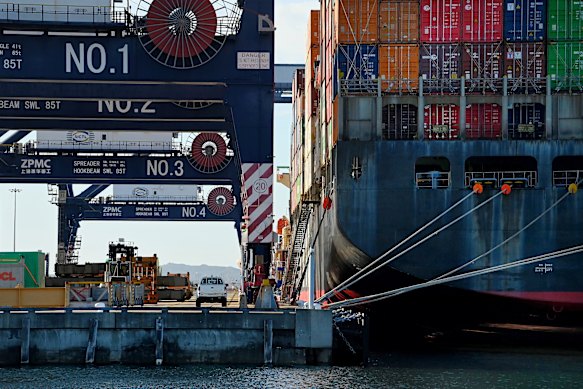
A cargo ship docked at Port Botany, NSW. Credit: KATE GERAGHTY
Only a handful of major stevedoring companies, including the UAE government-owned DP World, Hong Kong-based Hutchison and Australian operator Patrick, control access to the nation’s shipping container terminals. The ACCC warns the prices charged by the intermediaries flow through the supply chain to businesses and households.
Stevedoring companies’ profits rose for the fifth year in a row in the financial year 2024-25, the ACCC’s annual container stevedoring monitoring report, to be released on Friday, showed.
Loading
“Stevedores are now charging a higher total price per container, in real terms, than at any time since the ACCC began monitoring the container stevedoring industry 27 years ago,” the watchdog said in its report which covers prices, costs and profits at the country’s five largest container ports – Adelaide, Brisbane, Fremantle, Melbourne and Sydney.
“The report concludes that a Government policy or regulatory response is likely required to address apparent market failures and improve Australia’s container freight supply chain to the benefit of households and businesses,” the ACCC warned.
Over the past five years, stevedoring companies’ profit margins increased by 14.5 per cent to a historical high of 34.8 per cent in 2024-25, according to the ACCC.
The analysis found the industry’s profit margins last year were higher than other players in the transportation sector across all metrics the watchdog used.
ACCC Commissioner Anna Brakey said the profits posted by the stevedoring companies were “very high short run returns for an industry with significant spare capacity at ports, stable costs and stable productivity”. Typically, spare capacity should place downward pressure on prices, she said.
Loading
Brakey said that the fact stevedores are performing better financially now than they were before the entry of Hutchison to the market in 2013 – “an era when the industry was operating as a capacity constrained duopoly – raises serious concern about how this market is operating”.
While stevedoring companies’ clients include shipping lines docking at their terminals, the ACCC has specifically raised the alarm over the price hikes on what they charge transport companies, mostly trucking businesses, to collect or drop off containers, known as landside charges.
Brakey said that over the years, “landside charges have gone from a relatively small part of revenue to a major driver of profit for the industry”, collecting 49.5 per cent ($1.15 billion) of its total revenue from these charges.
She said the ACCC was concerned that stevedores can increase charges, and thereby their profitability, without being tied to underlying market conditions.
“These unavoidable costs land first on trucking companies, who then pass them on to importers and exporters, who have no real way to avoid or negotiate them. With similar charges across terminals and lack of ability or incentives for most importers and exporters to switch stevedores, they cannot influence these costs through competition,” Brakey said.
“Targeted reform is likely needed to ensure there are effective competitive constraints on stevedores to support the supply chain. Without it, Australian businesses and households will ultimately pay the price through higher costs.”
In comments provided to this masthead before seeing the report, Patrick Terminals’ CEO, Michael Jovicic, said the company was “proud of the market leading services we provide to our customers in a highly complex, interconnected global supply chain”.
A Hutchison spokesperson said: “Hutchison Ports supports practical, evidence-based reforms that strengthen efficiency and ensure fair outcomes for businesses and consumers across the container supply chain.”
DP World was also contacted for comment.
The Market Recap newsletter is a wrap of the day’s trading. Get it each weekday afternoon.
Most Viewed in Business
Loading