2 months ago
6
2 months ago
6
High-profile former politicians Zoe Daniel and Rex Patrick will launch a High Court challenge to overturn part of the Albanese government’s campaign finance regime, arguing it entrenches the dominance of major parties.
In court documents to be filed on Monday, the former independent politicians argue sweeping changes to the Electoral Act — pushed through parliament at the start of the year with bipartisan support — tilt the playing field against independents and new political entrants, and may breach the Constitution’s implied freedom of political communication.
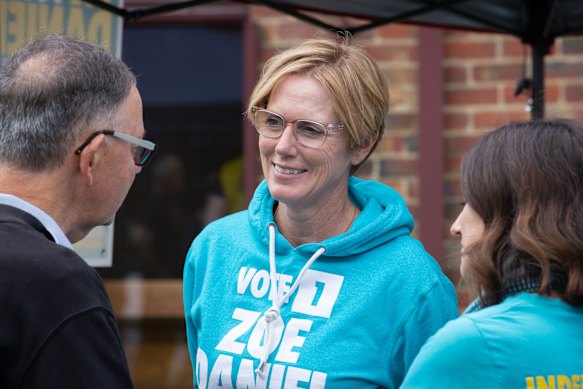
Zoe Daniel on the campaign trail earlier this year.Credit: Simon Schluter
Former solicitor-general Justin Gleeson, SC, has been briefed to argue the independents’ case.
Daniel, former independent member for Goldstein, said Labor and the Liberals had conspired to try to ensure that politics remained a “cosy table for two”.
“They could get better, or they could rig the rules. What a surprise that they’ve chosen the latter. It’s a rort, not reform,” she said.
The High Court challenge comes after the Albanese government, in February, pushed through the biggest shake-up of political-donation rules in decades, designed to curb the influence of big money in politics. The government promised tighter caps on spending and real-time disclosure of most donations, after agreeing to several late concessions to lock in Coalition support.
At the time, Special Minister of State Don Farrell said the regime levelled the playing field.
“It also increases the transparency of that system so that all participants in the electoral process are treated equally,” he said.
Daniel and Patrick will ask the High Court to strike down three parts of the new electoral finance regime, which they say distorts competition by allowing the major parties to draw on far greater funding streams and campaign resources than are available to independents and new entrants.
The first claim centres on new expenditure-cap rules that put a limit of $800,000 per lower house electorate on candidate-specific advertising. But Labor and the Coalition are still permitted to run large national and state “brand” campaigns through multimillion-dollar national advertising budgets.
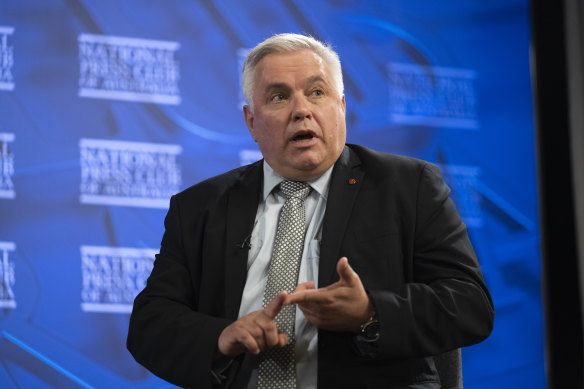
Former independent senator Rex Patrick.Credit: Rohan Thomson
The second claim relates to the design of the new donation-cap system aimed at limiting self-financing candidates such as Clive Palmer and Malcolm Turnbull.
The new laws increase the donation cap to $50,000 per donor to a single party branch or candidate – but the federated structure of the major parties means a single donor would still be able to contribute to multiple state branches, amounting to as much as $450,000 a year.
The plaintiffs will argue this arrangement gives the major parties access to far larger streams of private funding than their competitors.
The pair will also challenge a new rule that prevents any donor from contributing to more than five candidates in a state or territory, a measure they say is explicitly aimed at community independents who are backed by fundraising groups like Climate 200 and who rely on shared donor support across electorates.
Their submission argues that the rule disproportionately constrains independents while leaving the major parties’ fundraising capacity largely intact.
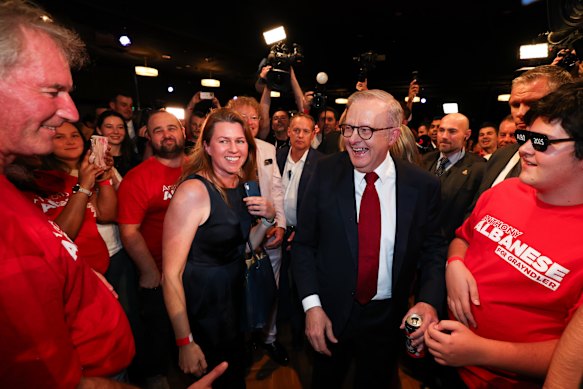
Prime Minister Anthony Albanese walks through a crowd of Labor supporters on election night in May after claiming victory.Credit: Alex Ellinghausen
While not challenged in their case, the two independents say the new donation laws, which come into effect in 2026, also unfairly hand the major parties millions more public money. In their statement of claim, the plaintiffs argue public funding for the two major parties would have jumped 47 per cent if applied at the 2025 election.
According to figures in Daniel and Patrick’s claim, Labor would have received $54.6 million and the Liberals $41.7 million had the laws applied at the May election. Incumbent independents, they argue, would have gained only about $108,000 each — a fraction of their $800,000 spending cap.
“Far from banning big money in politics, this simply ensures that taxpayers foot a massive bill for the major parties rather than getting it from donors,” Daniel told this masthead.
Loading
The legal challenge to federal donation laws comes just weeks after the Victorian government was forced to walk back its own campaign finance laws ahead of a separate High Court case.
Last month, The Age revealed the Allan government had conceded in its defence that a pre-2020 deadline that locked out new parties from setting up financial structures similar to the major parties was discriminatory and must be “severed”.
Former Federal Court judge Ron Merkel, SC, has been briefed to argue that case, which is scheduled to be heard in early February.
Former South Australian senator Rex Patrick, who lost his seat in 2022, described the challenge to federal laws as necessary to ensure independent candidates are not left election campaigning with one hand tied behind their back.
“Importantly, it will ensure there is real competition and choice for voters at polling booths.”
Loading
Melbourne Law School professor Joo-Cheong Tham, a director of the Centre for Public Integrity, said while the Albanese government’s changes went some way towards improving democracy, there were significant gaps that favoured established parties.
Tham said the new regime still gave major parties a spending advantage, largely because seat-level caps were too narrow and only applied when a communication explicitly named a candidate or electorate — leaving plenty of room for targeted campaigning that avoids the limits. He said the government could fix this by expanding the definition to capture “spending that can be reasonably regarded as promoting a specific candidate”.
Tham said the changes would be toughest on political newcomers, not necessarily community independents such as those backed by Climate 200.
“The teal MPs are now incumbents but the new-entrant problems [remain],” he said.
While supporting a system that was more “robust”, Tham warned that the looming High Court challenge could potentially unravel key safeguards.
“This High Court challenge puts a spotlight on whether the political funding laws unconstitutionally favour the major parties,” he said. “It also risks throwing the baby with the bathwater: if expenditure caps are struck down, it will be a return to a free-for-all for big-money election campaigns.”
The government has been contacted for comment.
Most Viewed in Politics
Loading