3 months ago
17
3 months ago
17
Heatwaves could grip large swaths of the country from the Pilbara to Sydney this weekend, while hot, dry and windy conditions are fuelling extreme fire danger in south-eastern Australia.
At the start of what is forecast to be a hot, dry summer, despite the declaration of a La Niña, the Bureau of Meteorology has issued warnings of low-severity heatwaves in NSW, Queensland, South Australia, Western Australia and the Northern Territory.
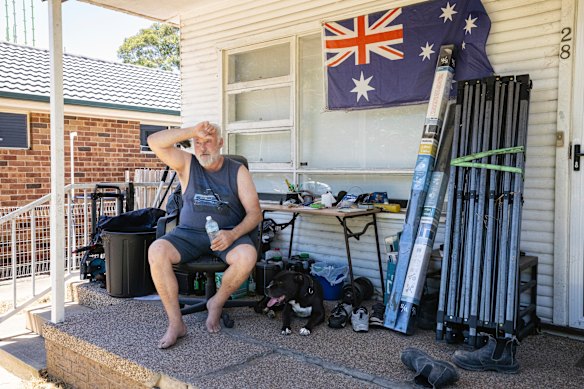
Keith Greenbank swelters outside his house in Penrith in 40-degree heat on Friday.Credit: Sitthixay Ditthavong
Minimum and maximum temperatures must remain unusually high for at least three days before the bureau formally declares a heatwave.
Extreme conditions are forecast in the Pilbara region in WA on Sunday, where the region is set to hit the high 30s to the mid-40s.
Sydney reached 29.4 degrees on Thursday at Observatory Hill, before soaring to 37.3 degrees on Friday. The forecast on Saturday is for 37 degrees, before a cool change in the evening.
As usual, it was hotter out west, hitting 40 degrees in Penrith, and 39 degrees in Liverpool and Castle Hill on Friday.
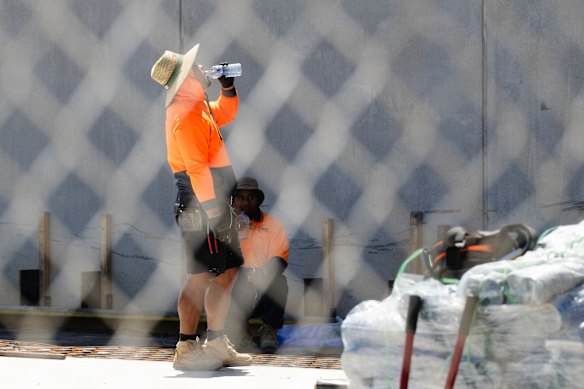
A worker stops for a break on Friday, a scorching day in Gregory Hills, Sydney.Credit: Janie Barrett
Temperatures in Melbourne reached 34 degrees on Thursday, before cooling to a predicted maximum of 26 on Friday.
Fire danger conditions in Victoria are expected to ease late on Friday, while dangerous conditions will remain in NSW until Sunday. Fire danger will be extreme in Sydney, the Illawarra and Shoalhaven.
Bureau meteorologist Sarah Scully said any fires would be difficult to control because the heat was combined with gusty wind expected to push north from Victoria into eastern, inland and parts of northern NSW.
“On top of it, [on Saturday] we’re also expecting there to be thunderstorms across a really broad area of northern Victoria and much of NSW, and not a lot of rainfall,” Scully said.
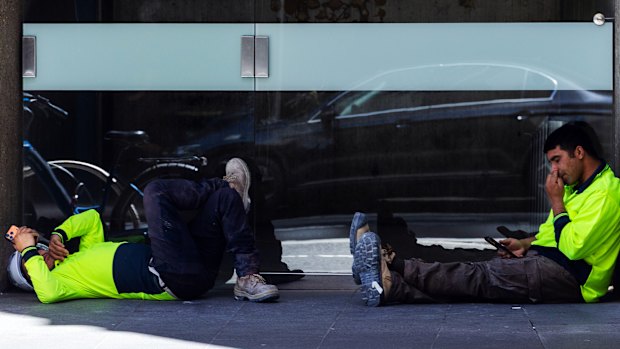
Workers get some respite in the shade in Sydney’s CBD on Thursday.Credit: Sam Mooy
“The thunderstorms through the southern half of NSW will overlap with the extreme fire danger. So there’s the potential for dry lightning as well.”
Weatherzone meteorologist Ben Domensino said the burst of heat, wind and elevated fire danger ratings would be most notable in South Australia, Victoria and NSW.
“The atmosphere is too dry for widespread storms and heavy rain, so storms are likely to be scattered and fast-moving,” Domensino said.
“The biggest threats from these storms will be damaging and possibly destructive winds, and dry lightning, which could ignite bush or grass fires.”
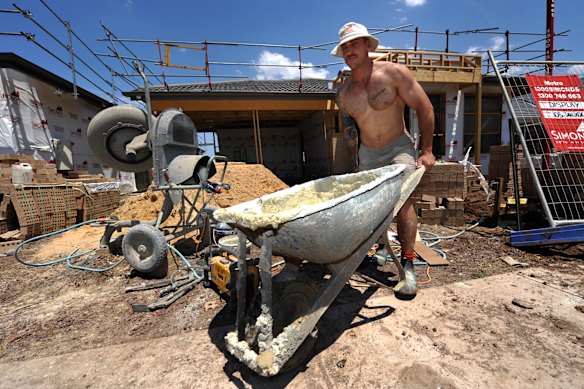
From the archives: Bricklayer Nathan George on the wheelbarrow on a hot day in Melbourne.Credit: Fairfax Media
Scully said heatwave conditions in summer were not unusual. The cold front passing through south-eastern Australia on Saturday would drop the temperature to six to eight degrees below average, she said, and it could snow in Victorian alpine areas.
Heatwaves in a warming climate
The National Climate Risk Assessment recently warned that deaths caused by heatwaves could rise 444 per cent in Sydney and 259 per cent in Melbourne under a scenario of 3 degrees of warming above pre-industrial levels. The outlook was substantially better but still grim for 1.5 degrees of warming, the aspirational target under the Paris Agreement; or 2 degrees, the upper limit set in the United Nations treaty.
A recent study by Australian researchers published in Environmental Research: Climate found that how quickly the world reaches net zero would have a huge impact on the intensity, duration and frequency of heatwaves over the next millennium.
Should the global effort to permanently reach net zero occur before 2040, future heatwaves will be less severe. If net zero is not reached until 2060, heatwaves will be systematically more severe.
Lead author Professor Sarah Perkins-Kirkpatrick, from the Australian National University, said the research demonstrated that heatwaves, particularly over Australia, would not decline once the world reached net zero emissions.
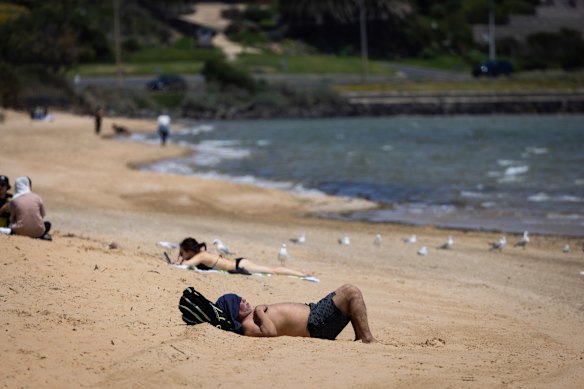
People enjoy the warm weather at Frankston beach in Melbourne on Friday.Credit: Paul Jeffers
“In fact, over Australia, they gradually increased for at least 1000 years, which was the maximum length of the climate simulations used,” Perkins-Kirkpatrick said.
“Delaying net zero by just five to 10 years will result in drastically different heatwave regimes across many global regions.”
While the results were concerning, Perkins-Kirkpatrick said it gave society time to adapt.
Dr Andrew King from the University of Melbourne, a co-author on the paper, added: “This adaptation process is going to be the work of centuries, not decades.”
Committee for Sydney chief executive Eamon Waterford said current health and productivity costs from extreme heat exceeded $1 billion annually in Western Sydney alone, and was projected to rise to $6 billion by mid-century.
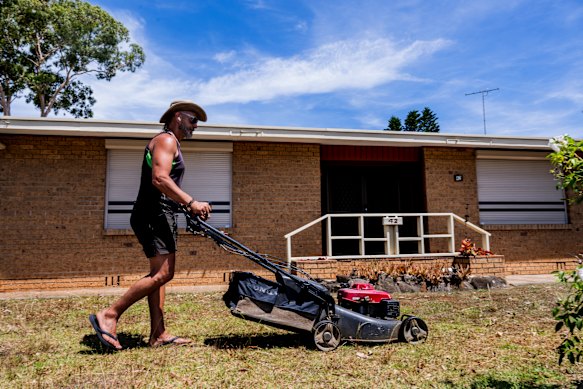
Property maintenance worker George Tsoukalidis mowing a client’s lawn in Greystanes, Sydney, on a hot day this week.Credit: Louise Kennerley
Waterford said there were already society-wide consequences of extreme heat, affecting productivity and health.
“People get sick, people die. Building sites have to shut down. People are less productive. Systems struggle when it’s really hot – train lines shut down and the like,” he said. “The good news is we can fix this problem. We can adapt to a changing climate.”
Waterford said cities needed to prioritise planting and preserving trees and ensuring clean swimming access to oceans, rivers and lakes, as well as make smart choices about the heat properties of the built environment, from the colour of roofs and pavements to bus shelters.
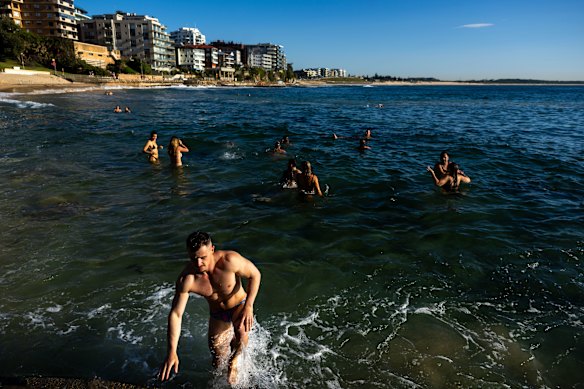
Sydneysiders cool off at Cronulla on Friday. Credit: Sam Mooy
A dry La Nina
The Bureau of Meteorology has declared a La Nina for the 2025-26 summer, while the US-based National Oceanic and Atmospheric Administration, using a different threshold, declared it some time ago.
La Nina is the phase of the El Nino Southern Oscillation, a climate driver that usually brings cooler, wetter weather to Australia.
Despite the La Nina, the bureau’s long-range forecast for summer is for above-average temperatures and below-average rainfall across most of the nation (though rainfall would be above average in parts of Queensland).
Loading
Dr Agus Santoso, a senior research associate at the University of NSW’s Climate Change Research Centre, said the La Nina was borderline and therefore likely to be outweighed by other climate drivers and the backdrop of ongoing global warming.
“The main thing is that this La Nina is not strong, so it’s quite weak, so we expect that the impact will be weak as well,” Santoso said.
However, Santoso said the marine heatwave coupled with La Nina meant there was the potential for a heavy downpour when it did rain.
Most Viewed in Environment
Loading