3 months ago
18
3 months ago
18
Every morning as Harveen Johar gets ready for work, he decides how he will spend two hours of his day.
From his home in Truganina, in Melbourne’s outer west, he can drive to Tarneit station, catch a train to the city and then a tram to the Shrine of Remembrance, where he is the chief experience officer.
Option two – his usual choice – is to join the mass of traffic crawling over the West Gate Bridge and spend roughly the same amount of time driving there.
“It’s the only part of my job I don’t like. It takes me two hours every day just to get here and go back,” Johar says.
But from February, Johar will have a new option.
Melbourne’s new cross-city rail line, the Metro Tunnel, will take him under the CBD to the new Anzac station at the Domain interchange. From Tarneit station, he will change trains at Footscray and reach Anzac in about 40 minutes.
“I will save at least 20 minutes each way. It will give me more time to read books, which I can’t do while I’m driving, so it makes even my travel time productive,” he says.
The Metro Tunnel is the most significant change to the city’s public transport system since the City Loop opened about 40 years ago.
Loading
The rail tunnel and its five new inner-city stations will open on Sunday. Limited services through summer will precede full services on February 1.
New journeys will become possible. Other trips will be faster and easier.
From February, some Melburnians face slightly longer commutes, or will need to learn a new way of getting around.
So, how will the Metro Tunnel change how you travel?
Understanding the Metro Tunnel
The Metro Tunnel is a nine-kilometre train tunnel between South Kensington and South Yarra, running via Parkville and underneath Swanston Street.
There are new stations at Arden (in North Melbourne), Parkville, Anzac (on St Kilda Road at Domain Road) and two in the CBD: Town Hall and State Library, which connect to Flinders Street Station and Melbourne Central, respectively.
Today, most of Melbourne’s rail network shares the City Loop. But only one line will use the Metro Tunnel.
The Sunbury and the Cranbourne/Pakenham lines will be connected to form a new line stretching almost 100 kilometres from the outer north-west to the outer south-east. An end-to-end journey will take two hours and two minutes.
One crucial point: don’t expect the Metro Tunnel to radically change how you get around right away.
During the soft launch, or so-called Summer Start, Metro Tunnel trains will only operate between West Footscray and Westall, in Clayton South, every 20 minutes from 10am to 3pm on weekdays. That’s 15 trains a day in each direction.
At weekends, trains will run until 7pm and some will go all the way to East Pakenham or Sunbury. All public transport will be free on weekends statewide in December and January.
These Metro Tunnel trains will operate in addition to Sunbury and Pakenham/Cranbourne services still using the City Loop during summer.
But from February 1, Sunbury and Pakenham/Cranbourne trains will come out of the City Loop and operate exclusively through the Metro Tunnel.
The state government has not released the February timetable. It has promised a “turn up and go” service, with trains between West Footscray and Dandenong every three to four minutes in the morning and afternoon peaks.
Trains will run at least every 10 minutes at other times between West Footscray and Dandenong, and less frequently at stations on those lines further away from the city.
How Melbourne compares with the world
Melbourne’s train network is a “hub-and-spoke” system. Each line runs into the CBD, stops at some or all of the City Loop stations, then travels back out to the suburbs.
The world’s best train systems – like those in London, Paris and Singapore – operate as a network of overlapping but independent lines.
Passengers frequently transfer between lines at interchange stations.
Train-to-train transfers account for only about 5 per cent of passenger trips in Melbourne today, compared with 24 per cent on London’s new Elizabeth Line.
The Metro Tunnel is a step towards Melbourne having a proper “metro” system and that means transferring between trains will become part of more people’s daily journey.
Here’s how that might work.
Next stop, Parkville
Bronte Jordan is looking forward to an easier daily commute from Richmond.
The occupational therapist at the Royal Melbourne Hospital is one of nearly 130,000 people who work in Parkville’s medical precinct or study at the sprawling University of Melbourne campus.
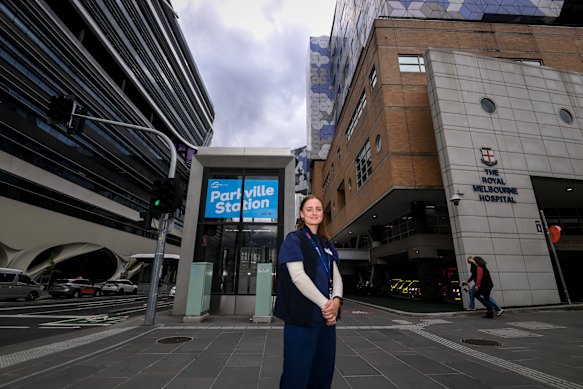
Occupational therapist Bronte Jordan says the Metro Tunnel will make her journey to work at the Royal Melbourne Hospital much easier.Credit: Justin McManus
Tens of thousands of people also travel there from across the state for medical appointments every year, and Parkville station provides a train connection for the first time.
Jordan takes the train from Burnley station to Flinders Street. From there she can take the route 19 tram to Royal Parade (15 minutes), but because of frequent delays, she usually walks instead (about 30 minutes).
When the Metro Tunnel opens, Jordan can transfer from Flinders Street to Town Hall station, where a train will take her to Parkville in five minutes – saving at least five minutes, or about 20 minutes compared with walking there.
“It will be so much easier to just jump on a train at Flinders Street and get straight to work,” she says. “It’ll be great for patients and visitors – that journey can be easier for them.”
To get to Parkville from other train lines, passengers can transfer to Metro Tunnel trains at Footscray or Sunshine (although waiting times will be shorter at Footscray), Caulfield or Malvern, or the two CBD interchange stations.
V/Line passengers can transfer to the Metro Tunnel at Sunshine or Footscray (if coming from Geelong, Bendigo or Ballarat), and Dandenong or Caulfield (from Gippsland).
Seymour and Albury/Wodonga passengers will have a harder journey. They will need to transfer twice: first at Broadmeadows, North Melbourne or Southern Cross to get on a City Loop train, then again at a CBD interchange station.
No City Loop for you
Sunbury and Cranbourne/Pakenham passengers have been promised huge benefits from the Metro Tunnel’s “turn up and go” timetable.
But the trade-off is losing direct access to the City Loop.
So to get to Southern Cross, Parliament and Flagstaff they will have to transfer to City Loop trains, either before they reach the city (at Footscray or Caulfield) or at the two new CBD stations.
To transfer between Town Hall and Flinders Street, passengers will walk for about seven minutes via the Degraves Street subway.
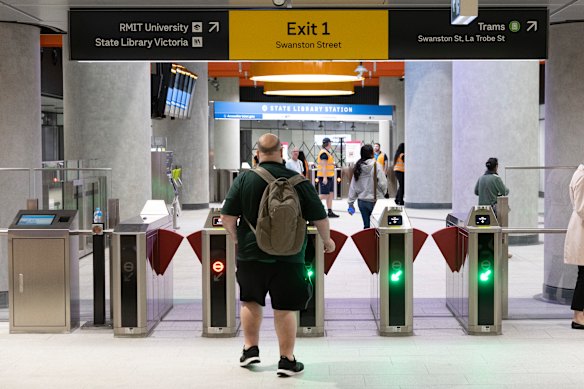
The underground concourse connecting State Library station to Melbourne Central opened to the public days before first trains begin running through the Metro Tunnel.Credit: Jason South
A walk from State Library to Melbourne Central takes four minutes via a shared concourse beneath La Trobe Street. Passengers will not need to touch their mykis on or off.
Public Transport Users Association spokesman Daniel Bowen says it will take some time for commuters to figure out which new journey option works best for them.
“People have gotten used to going straight to the stations they want without having to change,” he says.
Bowen also cautions that transfers will only work if all lines get a “turn up and go” timetable.
“The peak-hour timetables will provide a pretty frequent service, but it’s unclear how well it’ll work outside peak hours,” he says.
Some journeys will become longer.
For example, going from Sunshine to Parliament station directly through the City Loop today takes 22 minutes. From February 1, it will take 28 minutes during rush hour with a transfer at State Library/Melbourne Central.
Can’t stop, won’t stop
Cranbourne/Pakenham passengers will also lose direct access to Richmond and South Yarra, and those stations will get fewer trains to and from the CBD.
Six Metro train lines will still serve Richmond.
But South Yarra – the third-busiest station outside the CBD, after Richmond and Footscray – will experience a more noticeable impact when it drops from three lines to two. Commuters will need to wait for the February timetable to see how that affects frequency.
The state government decided in 2015 that the benefits of including South Yarra as a Metro Tunnel stop were not worth the $1 billion in additional construction costs.
At the western end, Sunbury passengers will stop at Arden, and no longer at North Melbourne.
A lighter load for St Kilda Road/Swanston Street trams
Swanston Street is the busiest tram corridor in the world, with a tram every two minutes and a pre-COVID estimate of 110,000 passengers travelling between the Arts Centre and Melbourne University every day.
But many passengers are expected to switch to the Metro Tunnel.
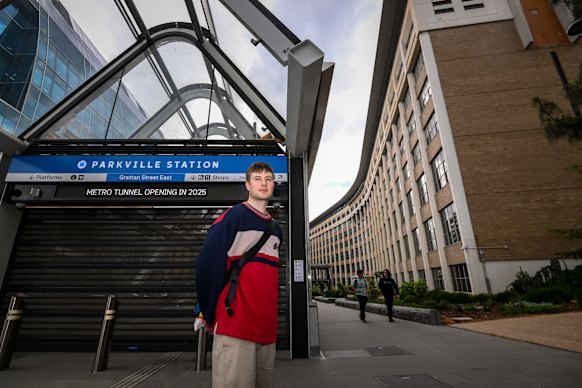
Wallace Butterfield is looking forward to his commute to Melbourne University being 25 minutes shorter each way.Credit: Justin McManus
Anzac station, on St Kilda Road, has been built as a tram-train interchange, with direct access from the tram platforms to the underground station.
Travelling from Anzac to Melbourne University (Parkville station) by train through the Metro Tunnel takes nine minutes compared with 21 minutes by tram.
University of Melbourne biomedicine student Wallace Butterfield will save about 25 minutes getting to campus from his home in Kingsville.
It now takes him about 40 minutes. He travels by train from Seddon station to Flinders Street, then catches a Swanston Street tram.
From February, he will transfer at Footscray station to a Metro Tunnel train and ride two stops to Parkville. Total travel time: 15 minutes.
“It will take time and stress off and make it more reliable. I usually have to leave a bit of time because of the unpredictability of trains in the morning,” he says. “It’ll be very useful – especially for people further out on the Sunbury line.”
From the city’s north, passengers on Lygon Street trams (routes 1 and 6) can access the Metro Tunnel at State Library to travel to St Kilda Road and beyond. Train-tram transfers will be an option at Parkville for tram routes 19, 59 and 58.
Other changes
With capacity freed up, the Frankston Line will return to the City Loop from February 1, after five years of operating just to Flinders Street, Southern Cross and on to Werribee/Williamstown.
It will run anti-clockwise all day (Parliament, Melbourne Central, Flagstaff, Southern Cross and Flinders Street).
The Werribee/Williamstown line will no longer be connected to the Frankston line and will terminate at Flinders Street.
However, the state government has said it will join Werribee/Williamstown to Sandringham in the second half of 2026.
Loading
Upfield and Craigieburn passengers have also been promised timetable improvements later next year, with trains to run at least every 20 minutes all day.
There could also be changes to the tram network given the expected drop in passengers along Swanston Street.
One possibility is that route 57 trams from West Maribyrnong will run down to Swanston Street, rather than Elizabeth Street, after a new track junction was built near Queen Victoria Market in October.
Start the day with a summary of the day’s most important and interesting stories, analysis and insights. Sign up for our Morning Edition newsletter.