3 months ago
30
3 months ago
30
In a hold-your-breath moment during a telecast full of hold-your-breath moments, all eyes were on Australian actress Rose Byrne. The 46-year-old Balmain-born star of If I Had Legs I’d Kick You sparkled as she clinched the best actress win at the 83rd annual Golden Globes, a victory that propels her down the road towards this year’s Oscars.
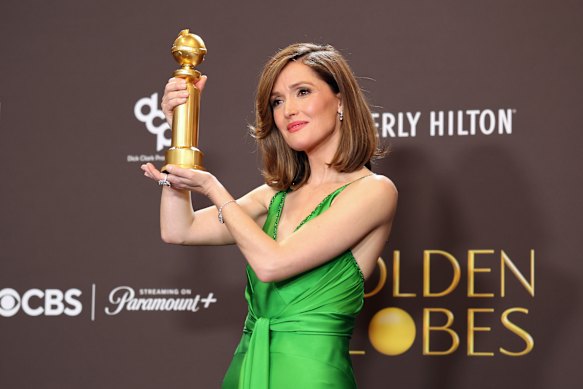
Australian Rose Byrne with her first-ever Golden Globe Award.Credit: Getty Images
Can Byrne win one of Hollywood’s most coveted film prizes? She certainly has the numbers on her side, having already secured the best actress award at three critical awards season events in December: the New York Film Critics Circle Awards, the National Board of Review Awards and the Los Angeles Film Critics Awards.
Loading
In a night full of smiles if not surprises, the roster of winners was mostly right. The stars of the critically exalted Netflix series Adolescence – Stephen Graham, Owen Cooper and Erin Doherty – took out a triple win, and the series itself knocked All Her Fault, Black Mirror and The Girlfriend out of contention. But against the impact that Adolescence had, no other outcome was possible.
Jean Smart won for Hacks, noting that she was one of the luckiest people in the business. And Noah Wyle won for The Pitt. “Truly humbling,” he said.
The Pitt also won for best television series (drama). Deserving but, again, not a surprise.
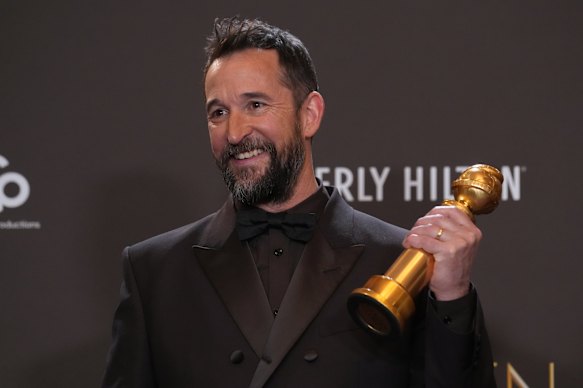
Noah Wyle with his Golden Globe.Credit: Chris Pizzello/Invision/AP
In the end, Byrne was Australia’s solitary winner. Sarah Snook, nominated for All Her Fault, lost to Michelle Williams (Dying for Sex). Joel Edgerton, nominated for Train Dreams, lost to Wagner Moura (The Secret Agent). And Jacob Elordi, who was nominated for both Frankenstein and The Narrow Road to the Deep North, had to endure a double loss, to Stellan Skarsgård and Stephen Graham respectively.
What do awards mean, anyway? On such occasions Hollywood is invariably both capricious and cruel.
The night’s two biggest awards: best picture (musical or comedy), which went to Paul Thomas Anderson’s One Battle After Another, and best picture (drama), which went to Chloé Zhao’s Hamnet. And, in an event held the night before, the outstanding contribution to film Cecil B. DeMille Award was given to Dame Helen Mirren, and the outstanding contribution to television Carol Burnett Award was given to Sarah Jessica Parker.
“There are so many A-listers, and by A-listers I do mean people who are on ‘a’ list that has been heavily redacted,” host Nikki Glaser said as the night got under way, firing off a sharp shot at the heavily redacted Epstein files, which have dominated the US media discourse for the past few years. She followed it with this zinger: “The Golden Globe for best editing goes to the Justice Department.”
Glaser then turned her aim at the US network CBS with this brutal swipe: “The award for most editing goes to CBS News.” It was a particularly provocative gag, not because CBS News has been singled out for noticeably shifting towards a conservative viewpoint under new news boss Bari Weiss but because the Globes telecast is carried by CBS-owned Paramount+.
Overall, Glaser was solid. As Ricky Gervais demonstrated to devastating effect in the early 2010s, the take-no-prisoners method always works well for the Golden Globes. But she was brilliant, until she wasn’t. And despite a strong opening with a sharp political edge, her command of the room wavered as she took aim at a bunch of easy marks, name checking George Clooney, Leonardo DiCaprio and others with soft gags.
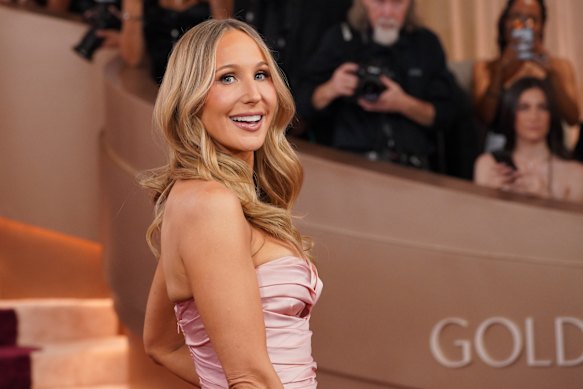
Nikki Glaser hosted the Golden Globes for the second time.Credit: Jordan Strauss/Invision/AP
Later, during a musical segment in which Glaser sang, the scripted interruption of actress and former Screen Actors Guild president Fran Drescher was as much a mercy killing as it was a gag-saving moment. “For the love of God, stop,” Drescher said. “Sweetie, you know I love you, but you have to stop singing. Your voice is so annoying.”
But before you make the mistake of thinking that this Hollywood awards show wasn’t going to get too Hollywood, we got our first “holding space” reference just 17 minutes into the telecast. Thanks, Teyana Taylor (who won a supporting actor award for One Battle After Another). Also: can someone please buy Sean Penn a hairbrush? No, really, please. Dude. Fix your hair.
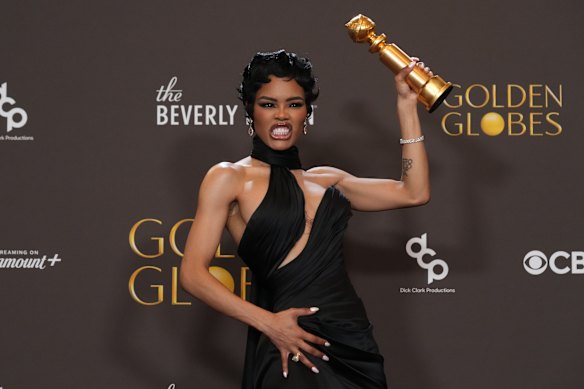
Teyana Taylor brought home the first Golden Globe for One Battle After Another.Credit: Chris Pizzello/Invision/AP
So where does all this lead? The awards-season road map ends with the Oscars; the Globes is roughly the halfway mark in that race. It is the last of six critic-voted awards ceremonies, after the Gotham Awards, the New York Film Critics Awards, the National Board of Review Awards, the Los Angeles Film Critics Awards and the Critics’ Choice Awards. (The Globes are voted by approximately 300 entertainment journalists, representing 76 countries.)
Loading
But as the next leg gets under way, Rose Byrne now has four season-to-date wins up her sleeve, and director Paul Thomas Anderson has the same. Anderson’s film One Battle After Another has an astonishing six. If you’re looking for signs in the stars, those trends are difficult to ignore.
In February and March, the Directors Guild Awards (DGAs), the Producers Guild Awards (PGAs), the Actor Awards (formerly the Screen Actors Guild Awards) and the Writers Guild Awards (WGAs) will give the strongest Oscar predictions. Their memberships more accurately mirror the memberships of the Academy of Motion Picture Arts and Sciences (AMPAS), who vote for the Oscars, which amplifies their predictive power.
A pro tip? The PGAs, scheduled for March 1, Australian time, are the ones to watch. Since they began in 1990, their Darryl F. Zanuck Award has matched Oscar’s best picture almost 70 per cent of the time. Hollywood might be all tinsel and technical wizardry, but ultimately, you can’t argue with the numbers.
Must-see movies, interviews and all the latest from the world of film delivered to your inbox. Sign up for our Screening Room newsletter.
Most Viewed in Culture
Loading