3 months ago
10
3 months ago
10
It wasn’t until she was 19 – and had dated a guy in secondary school – that Ella Wright realised who she really was.
“I realised I was queer and had never really been interested in men,” says Wright, now 26 and a teacher. “I was like, ‘that makes sense’, I have had crushes on women through my life.”
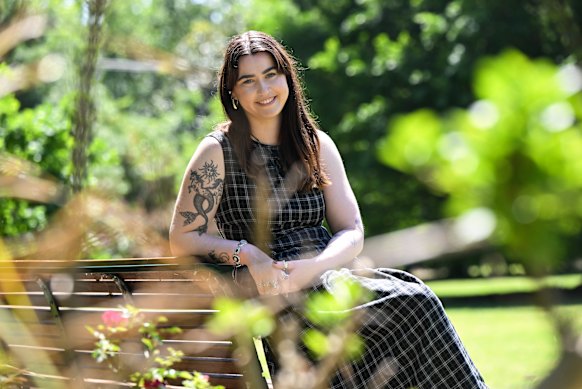
Ella Wright said it took five years for her to work out what being queer meant for her, but that she notices the process happening much earlier for younger Gen Z LGBTQ people now.Credit: Joe Armao
It was another five years before she had a same-sex romantic relationship. “And in that five years, I feel like I did fully come to understand it [not being heterosexual],” says Wright, who is at the older end of Generation Z.
Among the younger Generation Z students she teaches, Wright has noticed the time-lapse she experienced while recognising and growing into her identity is often much smaller, or non-existent.
With greater acceptance, visibility and awareness of queerness – and online communities readily available – the process that took previous generations decades has been compressed into just the high school years, and is happening well before young people experiment with sex and relationships.
Loading
This is the finding of the first comprehensive study of Australian LGBTQ young people and the development of their sexual identity, conducted by researchers in the schools of psychological sciences, and educational psychology and counselling at Monash University.
This generation often experiences their sexual identity earlier and quicker, researchers found, and half of them don’t tie coming out to when they become sexually active.
Lead researcher William Warton said Gen Z was resisting cultural and gender norms when compared with previous generations, which had positive, but also risky, implications.
“Coming out has got easier, one of the biggest findings from the study ... was that coming out, that first disclosure, is also occurring earlier; whereas in older generations it might be one of the last things to be experienced,” Warton said.
Loading
Due to ongoing discrimination, the risk is that “there’s also earlier exposure to stress and discrimination at a time when they’re quite vulnerable and don’t necessarily have support and resilience developed”.
Senior lecturer in psychology Dr Beth Johnson, of Turner Institute for Brain and Mental Health, said the trend was reflective of increasing queer visibility and acceptance in society.
“But this earlier and quicker identity development trajectory also exposes younger people to minority stressors at earlier developmental stages, which may affect their mental health,” Johnson said.
Warton said that being exposed to discrimination from a young age “can be quite damaging”.
Loading
The Australian Bureau of Statistics released first of their kind data on the nation’s LBGTQ community in December 2024, showing that more than 900,000 Australians identify as LGBTQ. It showed “about 4.5 per cent of all Australians aged 16 and over are LGBTI+”.
Younger Australians are more likely to be in the queer community, ABS head of health statistics Linda Fardell said, and nearly 10 per cent of Australians aged 16 to 24 years identify as being in this group.
Other ABS data released as part reporting on national mental health in 2024 showed higher rates of mental ill-health among the nation’s queer community, and also higher rates of self-harm.
It found three in four (74.5 per cent) lesbian, gay, bisexual or otherwise non-heterosexual (LGB+) Australians have experienced a “mental disorder” – clinically significant disturbance – at some point in their lives, compared with 41.7 per cent of heterosexual Australians.
The rate of self-harm among LGBTQ Australians was almost six times higher than among heterosexual people: 41.2 per cent had self-harmed in their lifetime, compared with 7.4 per cent.
Adrian Murdoch, general manager of the LGBTQ youth support organisation Minus 18, said the research findings backed up what his organisation had found. “I don’t think more young people are becoming LGBTQI+, [the research reflects] that the world around them has changed in ways that makes recognising and naming their identities safer, clearer and more accessible,” he said.
“But alongside that goes anti-LBGTQI hate – this is an ongoing reality for most [non-heterosexual] young people.”
Minus 18 recently released a survey of 2700 young people aged 13 to 25, Queer Youth Now, which found 89 per cent had experienced bullying and harassment in their lifetime and 57 per cent had felt it in the previous year.
Nearly nine in 10 had experienced hate, and more than half (55 per cent) had been excluded or discriminated against because of their identity. “One in two had been yelled at or insulted or harassed due to LGBTQI+ hate,” Murdoch said.
Loading
Three-quarters of those surveyed by Minus 18 said they wished teachers and school staff had more knowledge of how to support them to feel accepted.
They were most likely to feel safe among friends (61 per cent) and in online spaces (53 per cent), but only 30 per cent said they felt their school environment was conducive to feeling safe, and in sports settings this fell to 13 per cent.
Monash University educational and developmental psychologist, Associate Professor Kelly-Ann Allen, said ensuring young people felt they belonged could help them as they navigated identity.
“Our job as adults is to make sure they feel they belong … It seems that many adults are debating gender identity, but Gen Z are mapping who they are earlier and faster, often without a first relationship or first sexual experience,” she said. “Our systems need to keep up with that reality.”
Start the day with a summary of the day’s most important and interesting stories, analysis and insights. Sign up for our Morning Edition newsletter.
Most Viewed in National
Loading