3 months ago
40
3 months ago
40
The 15th iteration of the Big Bash Twenty20 league rushes to its conclusion on Sunday as the two best teams over the history of the competition once again face off for the title.
Since the league’s evolution from the six-team, state-based competition, which ran from 2005-06 until 2010-11, into the eight franchises structure, the value of the competition has been assessed mainly in terms of financial advancement, but it has also added another layer to player employment and development.
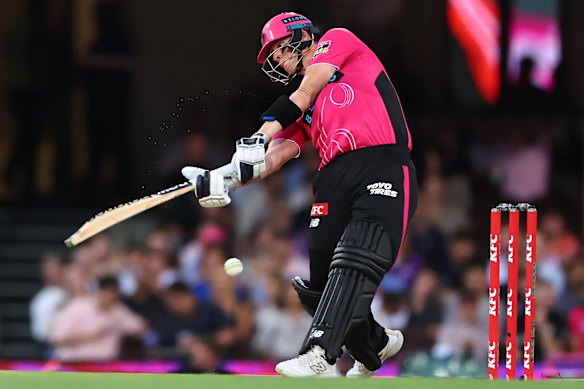
Steve Smith batting at the SCG.Credit: Getty Images
The turnstile success of the BBL has not fully filled coffers of state associations, but it has relieved the budgetary stress that comes with running bodies responsible for professional teams and junior associations.
The creation of a competition to sit alongside the state 50-over competitions and the Sheffield Shield was brilliantly conceived and delivered. The parallel conception of the WBBL has literally been a game changer for women’s cricket. It goes from strength to strength given its stand-lone scheduling after beginning life with double headers with the men. WBBL teams are setting crowd records and, perhaps more importantly, revenue records.
It is an open secret that Cricket Australia is looking deeply into selling off parts of the BBL and, I assume, WBBL franchises. As a side note, I would much prefer the teams were called “clubs” than “franchises” given their connection with local communities and fans – and even if teams are sold they won’t be moving from their home grounds. Any injection of money can lead to new venues, better training facilities, help train support staff, employ coaches, and maybe even pay the players more. More cash could also provide for a couple more clubs as eight teams aren’t covering the marketplace. As the football codes expand, cricket inexplicably pulls its head in.
Australia has had the same number of Shield teams since Tasmania’s full admission in 1977-1978, yet the population has doubled. Maybe some T20 money can change the politics of CA’s members.
CA has taken the line of least resistance recently by shortening the competition and by doing so has not backed its league to hold the interest of the fans for another week or two.
If CA reckons it can bring serious outside money into the league then it would be helpful if it intrinsically believed in the value of the actual cricket.
Running the competition solely during the school holidays is all very well but no other major winter or summer code restricts its elite leagues to school holidays. Continual tweaks to rules are not the path to spectator interest; continuity and competitive matches are far more important.
The boffins at BBL headquarters tell us the fans want to see more runs, but I haven’t seen the actual research that backs it up. As a result, they propose substitute batters to lengthen batting orders, what nonsense.
Attendance for this summer’s BBL topped the million mark last week. Fans young and old are turning up, so why keep tweaking the rules?
My suggestion for a bowling adjustment is for the fielding side to call a two-over power play where the batsmen aren’t allowed to wear helmets, that would focus the crowd and player attention. I can guarantee no current or former bowler is on the BBL marketing or rules consulting committee.
My straw poll of the 7-12 year olds at a cricket camp earlier this week was enlightening as they said that they loved watching wickets fall.
Mitchell Starc was a no-brainer favourite, with Ben Dwarshuis and evergreen Peter Siddle not far behind Joel Davies, Lloyd Pope and Tanveer Sangha. With the direction the rules are headed, they may as well roll out a bowling machine to clang down long hops.
There has not been a single overt rule change to get bowlers back in the contest. The whinge about the modern format hasn’t diminished, the contest between bat and ball has eroded to farcical levels, bats like bazookas, boundary lines drawn within spitting distance of the fielding circle, a batsman’s error rewarded when leg stumps are missed by millimetres and umpires extend their wings. The new time restrictions are about as decipherable as Einstein’s Theory of Relativity, space and time are connected but not in a BBL game apparently.

David Warner in action for Sydney Thunder in January.Credit: Getty Images
Fans want a contest, the bowlers want to be a part of the theatre not extras wandering through the background and they don’t want to run around on soaking outfields and bowl through slippery, injury inducing footmarks just to satisfy a “result” in seven overs.
T20 has rearranged the pathway from club to elite cricket. This extra rung is not new but it is expanding. David Warner changed the paradigm of state to national selection by becoming the first player to represent his country before he played Sheffield Shield cricket in 2009. His T20 debut was unprecedented, he eventually made the NSW first-class team then two years later started his glittering Test career.
The T20 franchises have become another vehicle to professionalism for excellent club players who once had very limited opportunities to progress. Craig Simmons was a trailblazer, and more recently Oliver Davies, Jake Fraser–McGurk, Cooper Connolly, and now Campbell Kellaway, Mahli Beardman, Nathan Ellis, Ben Manenti, Tanveer Sangha, the list is extensive.
The rookies get competition under pressure albeit a brief and dazzling dose before they move onto the next game. There is an ephemeral education to be gleaned within 20 overs, it may be limited and bespoke but the competition aids the exposure where success and failure are painted rapidly then erased at the same rate.
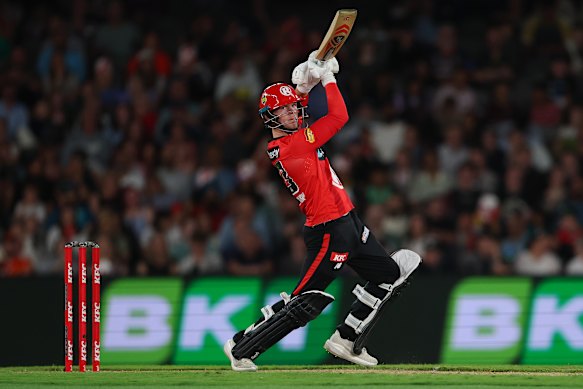
Star Melbourne Renegades batter Jake Fraser-McGurk.Credit: Getty Images
Eight teams are better than six and many of the club aspirants don’t need to journey overseas to get a game. In the southern winter months Darwin cricket runs an outstanding T20 league, the Brisbane T20 competition starts early and encourages players from the southern states to join until their own versions start.
A shining example of that success is when Oliver Patterson out of the Cranbrook school and Eastern Suburbs Cricket club journeyed north of the border for the pre-season slog and earned himself a contract and debut with the Heat. You could equate the various interstate series to US baseball’s A, AA and Triple A leagues, which provide playing experiences and close instruction to both rookies and established players in their pursuit of the majors.
Loading
Whether that structure will stay in place if the big money floods in from Indian billionaires and control of a domestic league is ceded, then contaminated is a serious issue for CA.
Australian-based players need Australian-based cricket if the pathway remains clear for the talented or the unheralded to make a living and/or represent their country.
In 12 months time we might be watching the Perth Scorching Sun Risers versus the Sydney Six Hitting Super Giants with Dwarshuis, Davies, Connolly and Aaron Hardie sitting on the sidelines while Indian superstars pick up another pay packet.
Most Viewed in Sport
Loading