3 months ago
38
3 months ago
38
“And the children of Israel wept for Moses in the plains of Moab 30 days: so the days of weeping and mourning for Moses were ended.” - Deuteronomy 34:8
So the Bible records the agonising days after the death of the beloved, charismatic leader of the Jewish people. It becomes the source for the Jewish practice known as sheloshim, Hebrew for 30, because it lasts for 30 days. It includes shiva, the primary seven-day mourning period.
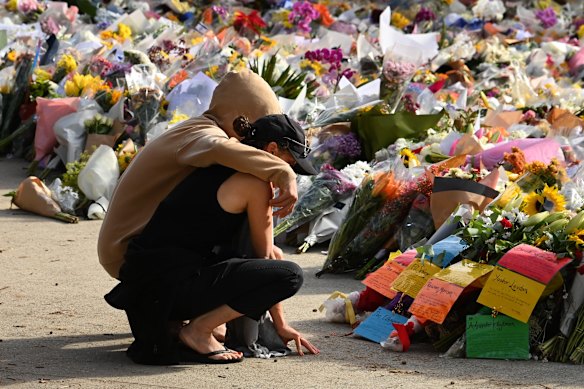
Mourners lay flowers outside the Bondi Pavilion following the massacre.Credit: Kate Geraghty
This past week we observed the sheloshim for Bondi. For the past month, our beautiful Bondi, bereft of 15 of her children, wounded by her injured offspring, has been in mourning, marked by blood and broken bodies instead of beach and bronzed bodies. No garland of flowers around her lovely neck, just a heaping of wreaths at her feet. Our nation sat shiva and has been grieving for Bondi, for the loss of our innocence, for the disfigurement of our national identity and dignity.
The sheloshim is a period of acute anguish and introspection, of so many inchoate feelings, so many unanswered questions. For many in our Jewish community and in our country, there was the deep silence of disbelief. What can you say in the face of such horror? Like Kurtz in Conrad’s Heart of Darkness, we could perhaps muster “a whisper, a cry that was no more than a breath – The horror! The horror!” In addition, there were many other bruising and conflicting emotions colliding with each other: aching sorrow, anger and blame, frustration and fear.
But too much grieving can turn the heart towards unending bitterness or stony immobility. So, in Jewish tradition, after the 30 days we are called on to slowly rejoin society, even while recognising that life will never be quite the same again.
We need to draw from the words of the great Hassidic master, Rabbi Nachman of Bratislava: “All the world is a very narrow bridge, but the main thing to remember is to have no fear, no fear at all.”
Fear is the weapon of those who hate; love is the armoury of those who bring shared comfort, attachment and joy. If antisemitism is the world’s longest hatred, the Bible reminds us that Judaism also introduced some of the earliest, longest and most profound loves: Love your God, love your neighbour, love the stranger. Don’t forget to love yourself – especially at times of crisis: “love your neighbour as yourself.”
Love is part of healing, but it’s not merely a warm emotion – it is also an action. We will be called on in this first year of mourning to remember and reflect deeply, to acknowledge the rampant antisemitism in Australia and also to find new ways of relating to each other. We will need to recognise that social cohesion is about respecting differences but not creating silos of separation, respecting what binds us together and communicating even with those who choose to other us, while confronting the haters and ensuring words are not used to poison our country.
Terrifying bushfires and floods marked this sheloshim anniversary. May soothing waters and gentle warmth shape the coming months.
Rabbi Ralph Genende OAM is the interfaith and community liaison at the Australia/Israel & Jewish Affairs Council.