3 months ago
26
3 months ago
26
The ’90s rock group Smash Mouth put it best when they sang in their hit single All Star, “Well, the years start coming, but they don’t stop coming.”
As we enter into 2026, you may be wondering where 2025 went – and the years before it.

There is no objective time, an expert says.Credit: iStock - AI generated image
So, how do we perceive time? Why do some events speed us by while others never seem to end? And is it possible to play time wizard and slow down or hit fast forward?
How we perceive time
Loading
Dr Peter Riggs from the Australian National University, a physicist and philosopher of science who researches time, says we experience time as a passage.
“We human beings live out our days in the present moment which seems to advance into the future. This is how we subjectively ‘perceive’ time.”
Temporal markers, like events of “personal or societal significance”, are what establish this sense of time moving forward.
However – and this is where it can get a bit trippy – there is no objective time.
“Our perceptions of time need not reflect time’s actual structure. There is no consensus about time’s nature and the passage of time may not be physically real but only a psychological phenomenon,” says Riggs.
Professor Hinze Hogendoorn, head of the Time in Brain and Behaviour Laboratory at the Queensland University of Technology, says unlike senses like smell, sight or taste, for which we have dedicated detectors, there is no organ for perceiving time. Rather, our brains infer it.
“There’s no time particle or wave that can be detected. So technically, we don’t perceive time as such, but we infer paths of time from the fact that things unfold.”
The time paradox
One puzzling paradox of time is the difference between prospective and retrospective time – in other words, how our brains infer time in the moment, and time in the past.
Loading
Think about the last time you did something really boring – like a long-haul flight or waiting for a pot of water to boil. In the moment, time tends to drag, but looking back it can feel like it passed in a blip.
On the other hand, “time flies when you’re having fun”, as the saying goes, but a year filled with excitement and novelty can feel slower in the rearview mirror.
“This is something that always breaks people’s heads because there is no objective time for our brains to detect, and we infer time on the fly,” Hogendoorn says.
“If you sit on the floor and stare at the wall or clock for an hour, that’s really hard because you get bored and that makes time crawl. You need distraction to make time pass.”
But retrospectively, in the absence of significant distractions or moments, our brains tend to collapse months and years together, which can give the illusion of time passing quickly.
Why some events pass faster than others
With each year that passes, most of us will feel like time accelerates. A common reason given for this is that as we age, each year comprises a smaller fraction of our lives.
Hogendoorn says this may be one factor, but a bigger reason is the absence of novelty and significant milestones.
“Young kids are doing things for the first time. They go to school for the first time, they have their first relationship, they have their first job. All those things are exciting,” he explains.
“But at some point our days become full of routine and for parents [for example], at the end of the week, they might have nothing particularly new to report and can feel like there’s not enough time in the day, but at the same time, time flies by.”
Another influence on our perception of time is our moods and emotional states, says Riggs, which is why time slows down during traumatic or near-death experiences.
“The ‘passage’ of time does seem to pass more slowly during brief, dangerous events, such as car accidents,” he says. “This is related to the brain recording such events in greater detail than usual.”
How to slow down time
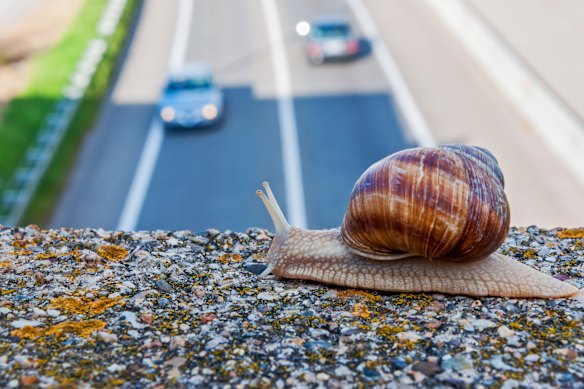
Shaking up routine, and taking time to reflect on the year gone by, can help slow down our sense of time.Credit: iStock
The answer to hitting “pause” on the clock isn’t exactly a satisfying one, Hogendoorn says.
“Sit down on the floor and stare at the wall if you want to slow down time,” he says.
However, some research suggests spending time in nature may help stretch out our minutes and hours.
In one experiment, researchers split 161 university students into two groups, and asked each to take a walk of the same length – one in an urban setting and one in the countryside. Those who walked in the city reported time passing more quickly than those who walked in nature.
Another recent study found performing a task in nature, compared with the city, slowed participants’ sense of time.
Loading
Clinical psychologist Dr Rebecca Ray says practising mindfulness can help us be more present.
“Start by noticing. Bringing attention to small moments helps, like tasting your coffee, taking a breath before the next task, or stepping outside between meetings. You can’t create more time, but you can experience it more fully.”
Slowing down time ahead of time, however, is a little easier. Hogendoorn suggests finding ways to shake up routine – which tends to make time fly by – and introduce novelty and spontaneity into our lives. This could be something big – like a holiday, or small – like changing your route to work.
But for neurodivergent people, for whom routine can provide a sense of stability and calm, big changes aren’t always desirable.
“Keep your anchors, then add gentle novelty,” Ray suggests.
“That might mean changing your environment, trying a new playlist, or shifting the order of tasks. It’s enough to signal variety to the brain without losing structure.”
Reminiscing – through journaling, or simple conversation – is another way to make memories stick and wake up our internal clocks.
Make the most of your health, relationships, fitness and nutrition with our Live Well newsletter. Get it in your inbox every Monday.
Most Viewed in Lifestyle
Loading