3 months ago
11
3 months ago
11
Fears for Ningaloo, World Heritage sites in pushback against Santos’ drilling plans
Conservation groups are mounting a campaign against a proposal by South Australian oil and gas company Santos to drill exploration wells in the Bedout Basin off the coast of Port Hedland.
According to Santos’ own modelling, submitted to regulator NOPSEMA, the worst-case scenario for hydrocarbon spills could reach as far south as Shark Bay, or a few hundred kilometres south of Timor-Leste and could impact sensitive national and World Heritage areas including Ningaloo Reef, Murujuga and Rowley Shoals.
Santos want to explore the Bedout basin.Credit: Fairfax Media
Santos plans to drill up to seven exploration wells in the basin, which, in its August 2025 environment plan currently open for public comment, says may have “the potential to be the next major liquids rich gas led development off Western Australia”.
The Conservation Council WA made a submission to the offshore gas industry regulator NOPSEMA, urging it to refuse Santos’ plans based on the dangers of an oil spill.
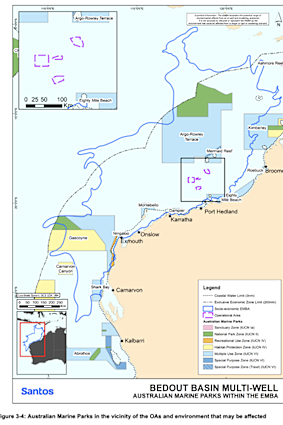
The Santos modelling showing worst-case-scenario oil spills (highlighted by the blue line).Credit: Santos
“Santos wants permission to drill near some of our most iconic Marine Parks and around 40 kilometres from the Rowley Shoals Marine Park,” CCWA executive director Matt Roberts said.
“The Environmental Plan submitted to NOPSEMA by Santos shows that oil spills from the Bedout project could have severe impacts on waterways and coastline, potentially impacting World Heritage Areas including Shark Bay, and the Murujuga Coastal Landscape, as well as coral reefs including Ningaloo, Rowley Shoals, and Scott Reef.
“Santos is risking oil spill blowouts over an area that extends all the way from Shark Bay, past Broome, and nearly to Timor-Leste.
“The company’s own Environment Plan admits this project could impact a long list of endangered species, including blue whales, southern right whales, loggerhead turtles, the dusky sea snake, and numerous species of seabirds and shorebirds.”
CCWA’s concerns stem from Santos’ environment plan, which mapped out the total area that worst-case spills could reach, but labelled the risk of such a spill as “remote” and requiring “exceptional circumstances”.
The council has also raised concerns about seismic activity and light and noise pollution.
The total spill area is a combination of hundreds of computer simulation drills based on external weather events.
“While the modelled EMBA represents the theoretical spatial extent that could be contacted by the worst-case spill event(s), an actual spill event is more accurately represented by a single simulation run, resulting in a much smaller spatial extent impacted by the spill,” the environment plan said.
“Based on industry statistics and Santos’ risk assessments, the likelihood of a loss of well control event leading to a spill of this size is considered ‘remote’ – requires exceptional circumstances and is unlikely even in the long term.
“The combination of the standard prevention control measures (i.e., safe drilling methods), and the spill response strategies, as presented in the OPEP, together reduce the hydrocarbon spill risk to a low level”
Santos was contacted for comment.
The public comment period on Santos’ proposal ends on Thursday.
Start the day with a summary of the day’s most important and interesting stories, analysis and insights. Sign up for our Morning Edition newsletter.
Most Viewed in National
Loading