3 months ago
16
3 months ago
16
By Olivia Le Poidevin and Klaus Lauer
December 5, 2025 — 6.05am
Geneva: Israel was cleared to enter the 2026 Eurovision Song Contest, prompting Spain, the Netherlands, Ireland and Slovenia to follow through on their threats to withdraw from the competition over the Gaza war.
After a meeting in Geneva, contest organiser the European Broadcasting Union decided not to call a vote on Israel’s participation, and said it had instead passed rules aimed at discouraging governments from influencing the contest.
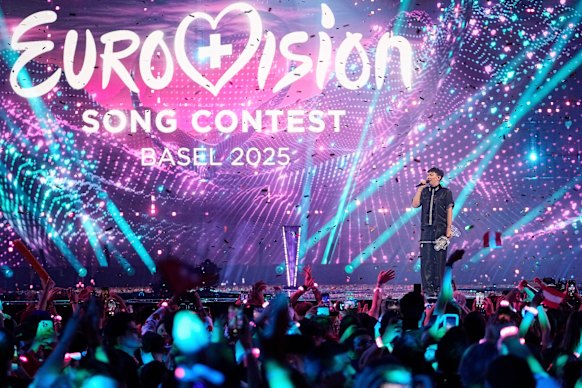
JJ, from Austria, with his trophy after winning the grand final of the 69th Eurovision Song Contest in Basel, Switzerland in May this year.Credit: AP
Israel, like Australia, takes part in Eurovision despite not being in Europe.
Right after that announcement, the Dutch, Spanish and Irish broadcasters said they would withdraw from the competition, meaning singers from their countries will not compete in the contest, which draws millions of viewers worldwide.
Irish broadcaster RTE said it felt “Ireland’s participation remains unconscionable given the appalling loss of lives in Gaza and the humanitarian crisis there which continues to put the lives of so many civilians at risk”.
Loading
Natalija Gorscak, head of Slovenia’s national broadcaster RTV Slovenija, told Reuters her country had also withdrawn.
“Our message is: we will not participate in the ESC if Israel is there. On behalf of the 20,000 children who died in Gaza,” Gorscak said.
The broadcasters who had threatened to boycott the event accused Israel of flouting rules meant to guard the contest’s neutrality.
The EBU said members backed new rules intended to discourage governments and third parties from disproportionately promoting songs to sway voters after allegations that Israel unfairly boosted its entrant this year.
“This vote means that all EBU Members who wish to participate in the Eurovision Song Contest 2026 and agree to comply with the new rules are eligible to take part,” the EBU said.
The issue has sharply divided participants in the competition that has a history of entanglement in national rivalries, international issues and political voting.
The Dutch broadcaster said it had concluded “that under the current circumstances participation cannot be reconciled with the public values that are fundamental to our organisation”.
Israel’s President Isaac Herzog thanked his country’s supporters.
“I am pleased that Israel will once again participate in the Eurovision Song Contest, and I hope that the competition will remain one that champions culture, music, friendship between nations, and cross-border cultural understanding,” he said.
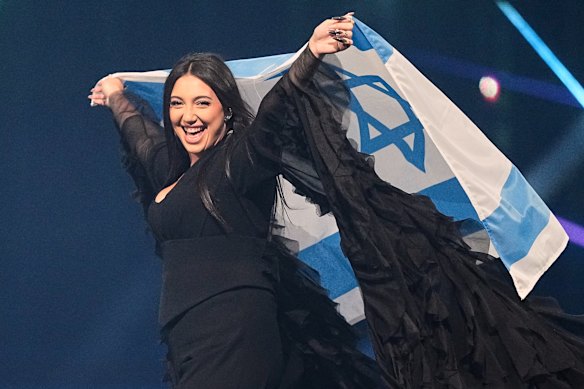
Singer Yuval Raphael, from Israel, holds the national flag during a rehearsal for this year’s contest.Credit: AP
The war in Gaza has also exposed rifts in the European broadcasting world. Austria, which is set to host the competition after Viennese singer JJ won this year with Wasted Love, supports Israel’s participation.
Germany, a major Eurovision backer, had said it would not take part if Israel was barred.
Before the decision, Israeli public broadcaster KAN said it was preparing for next year’s contest.
Israel’s 2025 entrant, Yuval Raphael, was at the Nova music festival, one of the targets of the October 7, 2023 Hamas attack on Israel that triggered the Gaza war.
About 1200 people were killed and 251 taken hostage in the assault by Palestinian militant group Hamas, according to Israeli tallies. More than 70,000 people have been killed in Gaza in the ensuing conflict, according to health authorities in the enclave.
Israel’s government has repeatedly defended its campaign as a response to the attack.
Eurovision – the feel-good pop music gala that draws more than 100 million viewers every year – has been roiled by the war in Gaza for the past two years.
The contest – the 70th edition of which is scheduled for Vienna in May – pits acts from dozens of nations against one another for the continent’s musical crown.
It strives to put pop before politics, but has repeatedly been embroiled in world events. Russia was expelled in 2022 after its full-scale invasion of Ukraine.
The war in Gaza has been its biggest challenge, with pro-Palestinian protesters demonstrating against Israel outside the last two Eurovision contests in Basel, Switzerland, in May and Malmo, Sweden, in 2024.
Eurovision expert Dean Vuletic said that a boycott by any EU member country would be significant because they are “not dictatorships” and are meant, like Israel, to share values of democracy, human rights and diversity.
“It would be the biggest boycott of Eurovision ever. There have been boycotts in the past, but they have been usually bilateral,” said Vuletic, author of “Postwar Europe and the Eurovision Song Contest.”
The fallout of a boycott could have implications for viewership and money at a time when many broadcasters are under financial pressure from government funding cuts and the advent of social media.
The countries walking away include some big names in the Eurovision world.
Spain is one of the “Big Five” large-market countries that contribute the most to the contest. Ireland has won seven times, a record it shares with Sweden.
The controversy over Israel’s 2026 participation threatens to overshadow the return next year of three countries – Bulgaria, Moldova and Romania – after periods of absence because of financial and artistic reasons.
“There are no winners here. Regardless of what happens – whether Israel is in or out, whether countries stay or go — it’s not what Eurovision should be. It’s meant to be joyous and about bringing people together despite our politics,” Jordan said.
Most Viewed in World
Loading