3 months ago
28
3 months ago
28
London: Australia has stepped up talks with the European Union on a defence pact that aims to counter threats and build up military power on both sides amid rising concerns about Russia and China.
Australian officials have been sent to Europe to discuss the terms of the partnership and clear the way for closer work on threats ranging from terrorism to drones, cyberattacks and direct military force.
European Commission President Ursula von der Leyen put the idea to Prime Minister Anthony Albanese at a meeting in May, and the two leaders confirmed the plans when they met again at the G7 summit in Canada in June.
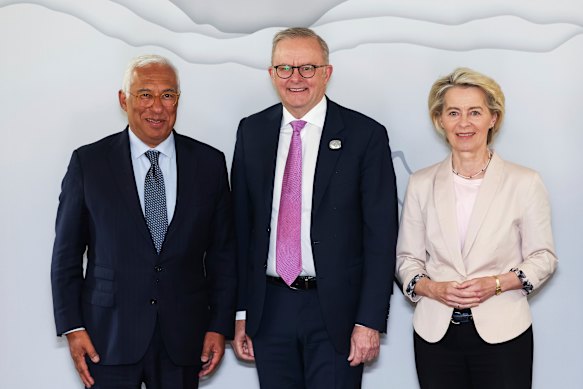
Prime Minister Anthony Albanese (centre) with European Commission President Ursula von der Leyen (right) and European Council President António Costa at the G7 in June.Credit: Alex Ellinghausen
But the security and defence partnership will not be a formal alliance that commits either side to military action, say those involved in the discussions. Instead, the agreement would see both sides work together to prepare for common threats.
The security talks are separate from a long negotiation with the EU on a free-trade agreement, but could help smooth the way for a final trade deal by the end of this year.
Loading
Crucially for Australian defence companies, the partnership is an essential step before a country can take part in an EU military spending boost worth €150 billion ($270 billion) and known as SAFE, for Security Action for Europe.
European and Australian leaders are emphasising the strategic goal of the partnership more than the procurement benefits, however, because both sides face similar threats from “hybrid” warfare such as cyber.
Von der Leyen sealed similar agreements with Japan and South Korea last year and added deals with the United Kingdom and Canada this year, highlighting the European push for greater co-operation with liberal democracies.
EU foreign policy chief Kaja Kallas hailed the UK partnership in May as a new model for international agreements.
The terms of the partnerships include working together on maritime security, freedom of navigation, cybersecurity, hybrid threats, foreign interference, counterterrorism and international peacekeeping.
With Japan, for instance, the EU partnership has led to defence industry co-operation despite strong competition between the two sides in areas such as shipbuilding. Australia awarded a $10 billion contract to Japanese company Mitsubishi in August for three new frigates, rejecting Germany company TKMS.
European Australian Business Council chairman Duncan Lewis said the two sides of the proposed agreement shared the same values and should be working together to deal with strategic uncertainty in the world.
“The EU has concluded that the Asia-Pacific region is inextricably linked to global security and therefore their own security and safety,” said Lewis, a former ASIO chief and Australian ambassador to the EU and NATO.
“We have much to gain from a strategic and defence partnership with the EU, including access to co-operative defence procurement and technical development opportunities.
Loading
“Australian defence industry, the Australian Defence Force and our nation’s security preparedness would benefit from a quick but well-negotiated SDP [security and defence partnership].”
Behind the defence push is a growing belief in the EU that security in Europe is linked to the Asia-Pacific because of the “no-limits” partnership struck by Russian President Vladimir Putin with Chinese President Xi Jinping three weeks before the full-scale invasion of Ukraine in February 2022.
Chinese companies are making motors and electronics for drones based on Iranian designs and manufactured by Russia, sometimes using munitions from North Korea. Russia has scaled up daily manufacturing to the point where it can launch hundreds of drones against Ukraine in a single night.
Deputy Prime Minister and Defence Minister Richard Marles framed the partnership as a way to tighten the connections between Europe and Asia.
Loading
“While our regions are geographically distant, security in Europe and the Indo-Pacific is increasingly interconnected,” a spokesperson for Marles said.
“A security and defence partnership will strengthen our collaboration on shared security challenges, enhance strategic dialogue, and create new opportunities for joint defence procurement.”
A spokeswoman for the Department of Foreign Affairs said the partnership would provide a framework for co-operation in areas such as defence industry, cyber and counterterrorism.
Griffith University associate professor Matthew Sussex noted in June that the partnership did not need to be a “complex and granular” accord to work for both sides because the objective was to build on the agreement over time.
“The threats we face, our political and normative alignment, and our preference for free and liberal trade are all shared,” he wrote in an analysis for the Lowy Institute.
“And while it will not magically smooth the complex and fraught security order we must navigate, it would be a missed opportunity if we did not try to chart that course together.”
Get a note directly from our foreign correspondents on what’s making headlines around the world. Sign up for our weekly What in the World newsletter.
Most Viewed in World
Loading