3 months ago
40
3 months ago
40
Will GrantBBC's Mexico, Central America and Cuba correspondent

 EPA
EPA
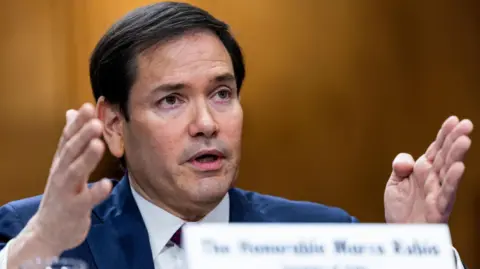
Many members of Senate Foreign Affairs committee have wanted an opportunity to question the US Secretary of State on Venezuela for some time.
They have called for a hearing since well before the unprecedented US airstrikes on Caracas and the removal of Nicolás Maduro from power in the early hours of 3 January. Wednesday, their wish was fulfilled.
"Finally, a public hearing," said Tim Kaine of Viriginia, a Democrat, before launching into a recap of how the Trump Administration had reached this point on Venezuela, where Maduro is now in a US jail and the country is being led by Interim President Delcy Rodriguez.
Kaine pointed out that the first US strike on alleged drug boats in the Caribbean took place on 2 September 2025 – some five months ago – and lamented the fact that the discussions about the legality of those strikes had been classified and took place behind closed doors.
Secretary Rubio was careful to stress that the US was not at war with Venezuela, saying in his written opening statement for the hearing: "We did not occupy a country. There are no US troops on the ground."
It was a key point for him to register in the face of arguments that the Trump administration has circumvented Congress, which under the US Constitution has the sole power to declare war, and ignored the 1973 War Powers Act.
Instead, Rubio, a former US Senator, repeatedly characterised the US military action in Caracas as a "law enforcement operation".
A "drug bust", retorted Senator Rand Paul, a Republican who has argued the justifications for military action were lacking. But as the Trump administration's critics questioned the logic, wisdom and the legal basis of its decisions on Venezuela, Rubio remained robustly on message.
Rubio challenged over 1798 law now used to deport Venezuelans
He was, as expected, thoroughly unapologetic over the military action and removal of Maduro from power. Maduro was an indicted drug criminal, he said, and not the legitimate president of Venezuela.
Furthermore, it was impossible to make a deal with the man as "he couldn't be trusted" having strung along negotiators and diplomats so often in the past, Rubio added.
"The glue that held the regime together was corruption and graft," Rubio said at one point. "His removal has created the conditions to begin to move away from that."
Rubio insisted the Trump administration's actions would eventually improve the situation in Venezuela – which he likened to a "critically ill patient" – and make the region safer and more prosperous.
The secretary also laid out the administration's plan for Washington to maintain full control over Venezuela's oil industry. The funds from sales of Venezuelan crude were being held, at least initially, in an offshore account in Qatar but would eventually be transferred to "a US Treasury blocked account in the United States".
The Venezuelan government would have to request the use of those funds for a set of narrowly defined needs and Washington would decide on releasing them, he said.
The upshot, according to Rubio, would be Venezuelan oil profits being spent on US-made goods, from basic foodstuffs to chemicals for oil refineries, rather than in Russia or to service debt to China.
Analysts continue to wonder how government figures in Caracas, all of whom have made a career through vocal anti-Americanism, will receive such intervention in Venezuela's oil wealth
Rubio, however, refused to take the further use of military force in Venezuela off the table.
"We don't want that and we hope we don't have to use it," he repeated.
But undoubtedly, the action against Maduro has served as a stark warning to others in Venezuela's government and armed forces that they could face a similar fate should they step out of line.
Watch: What it was like in the courtroom at Maduro's hearing
The ultimate goal of Washington's energy plan, said Rubio, was to eventually transfer the control of the oil-rich nation's natural resources back to Venezuela under a stable democratic government.
It was the roadmap to that destination which most concerned a number of Secretary Rubio's critics in the hearing room.
Still, Rubio exuded confidence when talking about Latin America, one of his strongest area of expertise. Rubio chaired the committee he was facing for many years, and also led its subcommittee on the region.
"We are not even four weeks into this thing," he responded to a question about how success could be defined and measured.
Already things were moving in "the right direction", he insisted.
A hydrocarbons law passed under Maduro's political mentor, Hugo Chavez, had been redrafted to allow greater private investment from US energy companies and Rodriguez was proving to be a willing partner – so far.
"Four, five or six months from now cannot look like now," he conceded but cited the examples of Spain and Paraguay's 20th Century transitions to democracy.
Rodriguez as the country's leader and an energy policy devised and executed by Washington were both immediate necessities, he argued, not long-term strategies.
Eyes across the region will have been fixed on Rubio's appearance on Capitol Hill -- particularly in Venezuela itself and its long-standing communist-run ally, Cuba.
One statement from Rubio, a Florida-born Cuban American with a deep enmity towards the Cuban Government, will have worried authorities in Havana above all. Rodriguez "has pledged to end Venezuela's oil lifeline to the Cuban regime", he said in his prepared remarks, and she is "well aware of the fate of Maduro; it is our belief that her own self-interest aligns with advancing our key objectives."
The coming months will reveal whether that belief is well placed.
But either way, the US government's vision as set out by Rubio involves nothing less than transformative change in Venezuela – and, by extension, in Cuba.