2 months ago
16
2 months ago
16
Ditch the hot-housed poinsettia. This Christmas native puts on a better show
For some there is only one plant for Christmas and it stands up to all the baubles, tinsel, flashing lights and other decorations we dare dangle on it. The Pinus radiata might be weedy in the wild but it’s welcome in our houses and it remains the cut tree of choice – in Australia at least – in the lead up to December 25.
With its conical shape and conifer scent it does everything we’ve come to love about a Christmas tree. It has soft, flexible needles and branches that don’t buckle, even when you really go for it with the ornaments. Keep its trunk in water and it stays perky all month.
But the Pinus radiata is just the start of what’s possible. Many plants in many forms can become a Christmas centrepiece. They might not have the lengthy Yuletide associations as holly or European mistletoe but they still make an Australian Christmas feel like Christmas.
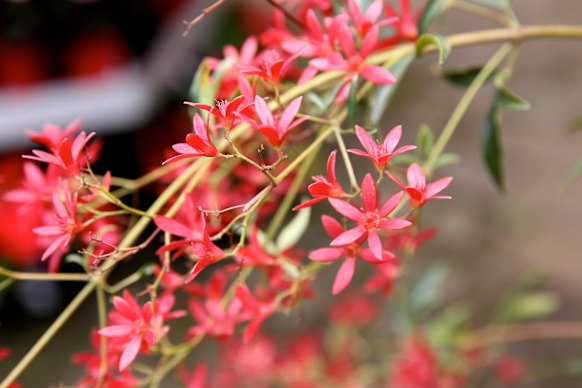
Christmas Bush has brilliant red sepals to rival any exotic flowering plant at this time of year. Credit: Janie Barrett
Our most festive plants – whether native or exotic – don’t thrive under a dusting of snow but have flowers that stand up to 30-degree heat and leaves so thick they survive the dry. December is the time for paper daisies and waxy brachychiton flowers, for hazy purple plumes on smoke bush and hotly coloured blossoms on eucalypts.
It’s the season for gumnuts and banksia cones. Kangaroo paws are unfurling and casuarina leaves have new feathery green growth. All of this and more can help deck the halls for Christmas.
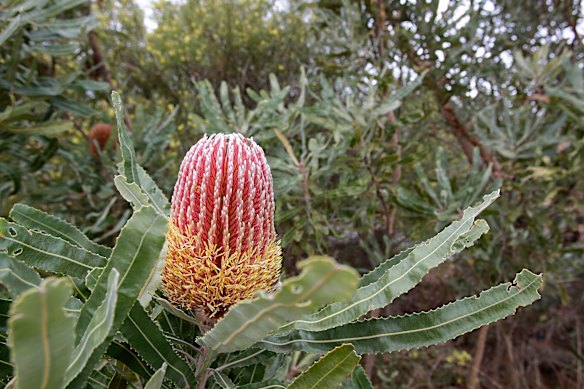
Banksias are at their best at this time of year.Credit: Elle Borgward
Some of these plants can also be worked into dry, textural wreaths that don’t need wheels of water absorbing foam to make a merry addition to the front door. You can even add produce from edible beds as well. There is no reason to limit the role of sage, rosemary, thyme and other fresh herbs to the stuffing for turkey.
Likewise, raspberries and strawberries can double as table decorations and dessert. Hang cherries from the handles of champagne buckets and then pop them in your mouth. Mix foraged blackberry canes with Christmas lilies and other seasonal flowers to make arrangements that are decorative to look at and delicious (at least in part) to eat.
While the name Christmas lilies is given to various species across different countries, in Australia it refers to the fragrant, white Lilium longiflorum, which is sold in florists around now. Buy unopened buds of these trumpet-shaped blooms to maximise their lifespan. You can also grow your own by planting Christmas lily bulbs (in a frost-free spot in full to part sun) in winter or early spring.
Staying with plants with Christmassy names, by this time of year the NSW Christmas bush (Ceratopetalum gummiferum) is also coming into its own. This shrub or small tree has blink-and-you-might-miss-them tiny white flowers that are followed by sepals so red they rival the poinsettia for show.
Poinsettias, which hail from Mexico and Central America and turn naturally red in winter, have to be cossetted in specially darkened, climate-controlled greenhouses to colour in time for a summer Christmas. The NSW Christmas bush requires no such fuss. It reddens in any temperate-to-warm climate where there is moist, well-draining soil and protection from heavy frost and strong wind.
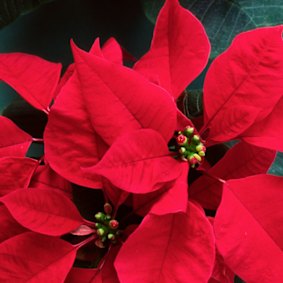
Poinsettias are at their best in winter. There are better options for an Australian Christmas.Credit: iStock
Alternatively grow a small cultivar (such as “Johanna’s Christmas”) in a container that can be moved to suit the conditions to hand, including indoors for the festive season. Given a sunny enough spot, it can even be kept inside as a permanent houseplant. More temporary but just as high-impact are the cut NSW Christmas bush “blooms” currently available in florists. Remember to change the water every couple of days and they will last from now until 25 December.
The Victorian Christmas bush (Prostanthera lasianthos) has a less traditional colourway (white flowers with purple and orange markings) but the same floral timing and a knockout menthol fragrance to boot. This native mint prefers moist soils and protection from strong winds and – with regular watering – can also be grown in a container that can be moved indoors for a brief period over Christmas.
But back to conifers, which garner a particular devotion at Christmas. If a cut-off-at-the roots Christmas tree is not your thing, consider a live one cut into topiary or a bonsai small enough to spend the festive season on a mantelpiece. Some potted conifers, such as Norfolk Island Pines, can even become permanent houseplants.
Loading
Alternatively keep a potted conifer just for Christmas and then, when the weather cools down in autumn, plant the tree outside. Do the same next year and you’ve got a festive tradition.
Make the most of your health, relationships, fitness and nutrition with our Live Well newsletter. Get it in your inbox every Monday.
Most Viewed in Lifestyle
Loading