2 months ago
3
2 months ago
3
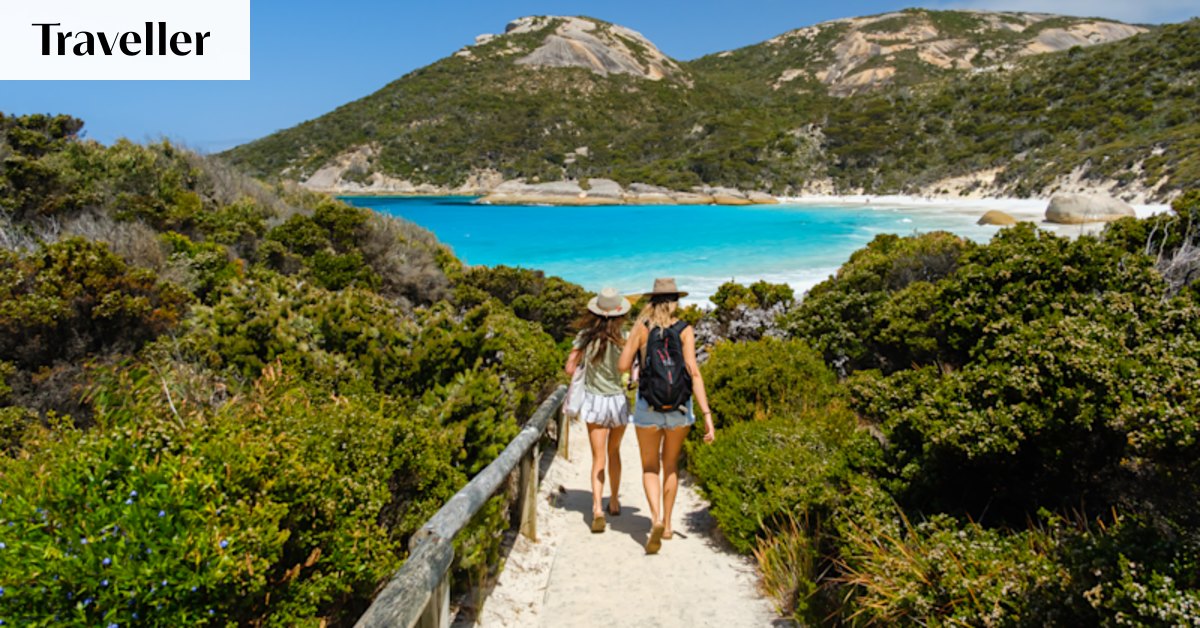
For many Australians, the Philippines is the road less travelled on the backpacking route through South-East Asia, where white sandy beaches, snorkelling and cocktails can all be packaged into a cut-price tropical island holiday.
But in the country’s southern regions, strains of radical Islam have fomented for decades, making it a breeding ground for militant groups and foreign fighters who travelled there to access a network of terrorist training camps and to raise funds.
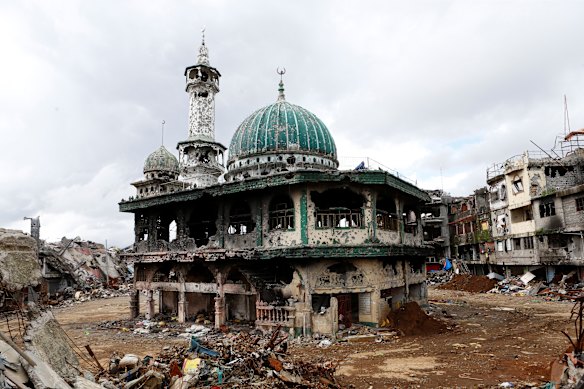
Philippine government forces fought an intense battle to recapture the southern city of Marawi on Mindanao from Islamic State fighters in 2017.Credit: Getty Images
Australian police are now investigating the movements of Bondi terrorists Sajid Akram, 50, and his son, Naveed Akram, 24, who travelled to the Philippines last month and spent time on the southern island of Mindanao, known for its links to Islamic State groups.
One of the major questions now confronting authorities is whether the father and son received training from terrorist networks in the Philippines weeks before the massacre of 15 people with guns in an attack targeting the Jewish community on the first day of Hanukkah.
Philippine immigration authorities on Tuesday confirmed that the pair arrived in the Philippines on November 1 and departed on November 28. Their final destination was Davao, a city in Mindanao, before they left the country on a flight to Sydney that connected through Manila.
Professor Greg Barton, a terrorism expert at Deakin University, said Mindanao had long been a hotbed for grassroots insurgency activities, which morphed into jihadi extremism, firstly with links to al-Qaeda and then the Islamic State after 2014.
“Davao is the largest city on Mindanao, and you can easily go by road to western Mindanao, where there are Islamic State people,” said Barton.
“Although the Philippine government has been very good at cracking down on training camps, I’m sure there are small groups operating discreetly in the hills, in the jungles.”
The Akrams’ exact movements in Mindanao have not been detailed by Philippine or Australian authorities.
Loading
But Australian Federal Police Commissioner Krissy Barrett said police believed the father and son carried out “a terrorist attack inspired by Islamic State”. Homemade Islamic State flags, alongside explosive devices, were found in the Akrams’ car at Bondi Beach.
“The reasons why they went to the Philippines, and the purpose of that and where they went when they were there, is under investigation at the moment,” NSW Police Commissioner Mal Lanyon said on Tuesday.
As Australian authorities race to piece together the picture of the Akrams’ radicalisation, they are expected to home in on Naveed Akram’s ties to extremist circles in western Sydney that landed him on the radar of Australia’s counter-terrorism authorities in 2019, but which were not considered significant enough at the time to prompt serious monitoring.
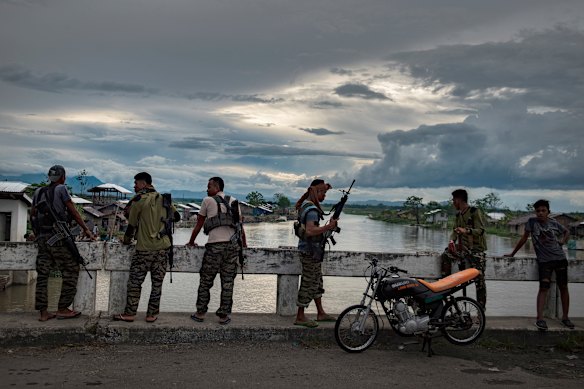
Moro Islamic Liberation Front fighters in 2017.Credit: Getty Images
It is a six-hour drive from Davao to the city of Marawi, in northwestern Mindanao, where in 2017, supporters of the Islamic State waged a five-month-long siege in an attempt to establish a caliphate in the predominantly Muslim city of 200,000 people.
The city was ravaged in the process, with the Philippines’ armed forces eventually triumphing over the militants, with Australian and US forces playing a role to support counterterrorism efforts there.
Marawi is part of the Bangsamoro Autonomous Region, which is home to around 4 million Filipinos in a majority-Muslim part of the southern Philippines.
Loading
Dr Levi West, a terrorism expert at The Australian National University, said former fighters from insurgent groups such as the Moro Islamic Liberation Front were now part of the Bangsamoro government.
“What there is in the southern Philippines is a bunch of training facilities and training infrastructure for insurgency and guerrilla warfare,” he said.
He said the Akrams would have needed substantive relationships with insurgent groups to access training facilities.
“You can’t just show up at a training camp in the southern Philippines. If you just show up, you’ll be shot,” West said.
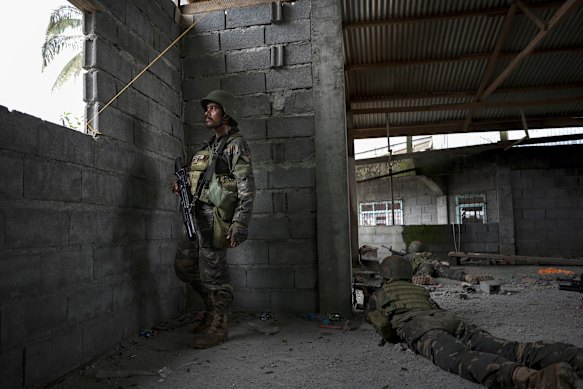
Philippine soldiers during the operation to recapture Marawi from the Islamic State in 2017.Credit: Getty Images
“You would have needed connectivity to those camps, which then raises questions about how it is that two people living in Australia were able to establish that connectivity and not have it show up as some sort of indicator or red flag.”
Loading
Barton said the Akrams may not have needed to have travelled to the remote areas of Mindanao to access extremist training, and that psychological reinforcement of their aims could have proved equally important.
“If it was some firearms training, which they may have done, that can be done in any number of locations. It doesn’t have to be a large camp,” he said.
“We need to understand that this father and son seem to have operated as lone actors. But lone actors doesn’t mean that they are loners or that they don’t feel themselves part of a larger community.”
The Australian government listed the Islamic State East Asia as a terrorist group in 2017, noting that it incorporated a number of extremist factions operating in the Philippines. The group was severely weakened following the Marawi siege, with much of its leadership wiped out. But it continues to conduct frequent violent attacks, including detonating a bomb on a passenger bus in Mindanao in 2023.
“ISEA remains a deadly terrorist threat in the Philippines, with the South-East Asian country a target destination for foreign terrorist fighters,” the Australian government’s national security website says.
The government’s Smart Traveller website has a “do not travel” advisory listed for central and western Mindanao due to “the very high threat of terrorism and kidnapping”.
Get a note directly from our foreign correspondents on what’s making headlines around the world. Sign up for our weekly What in the World newsletter.
Most Viewed in World
Loading