3 months ago
32
3 months ago
32
By Peterr McCallum, Katie Lawrence and Chantal Nguyen
January 18, 2026 — 11.11am
Sydney Festival is upon us for another year. Here is everything you need to know - reviews, previews and interviews - to plan your festival experience.
See all 7 stories.OPERA
Turandot
Opera Australia
Joan Sutherland Theatre, Opera House, January 15
Until March 27
Reviewed by PETER McCALLUM
★★★★½
In Opera Australia’s new production of Puccini’s last (and incomplete) opera, Turandot, director Ann Yee and designers Elizabeth Gadsby (set), David Fleischer (costumes) and Paul Jackson (video) have placed a magnificent trio of principals, Rebecca Nash (Turandot), Young Woo Kim (Calaf) and Maria Teresa Leva (Liu), in a dark dystopia of the mind.
Everyone wears the same drab blue and grey (except Turandot who first appears in pristine white). The walls and fabric have creeping dark patches at the edges like mould suffocating the soul, while a projected video-game avatar lurks on the back wall, blinking creepily.
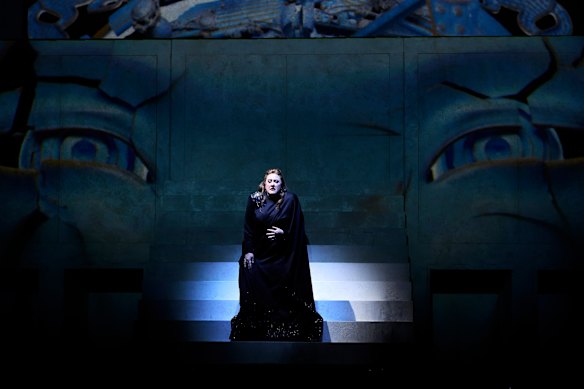
Rebecca Nash as Turandot. Credit: Keith Saunders
Side-stepping the original’s racist stereotypes, Ping, Pong and Pang (Luke Gabbedy, John Longmuir, Michael Petruccelli) become P1, P2 and P3, cynical techno-geeks whose retro-technology inure them from reality.
Central to Yee’s conception is to make the ancestor who spurs Turandot’s hostility towards men, Lou-Ling, into an embodied character – a dancer (Hoyori Maruo), whose writhing convulsive movements return at salient moments.
Although the silent dance before the music began had moments of awkwardness, it placed the persona firmly in the listener’s mind as a driver of action. When Lou-Ling unites with the gentle Liu, “so good, so sweet”, at the end, the message is clear: it is the suffering of both that creates healing from intergenerational trauma.
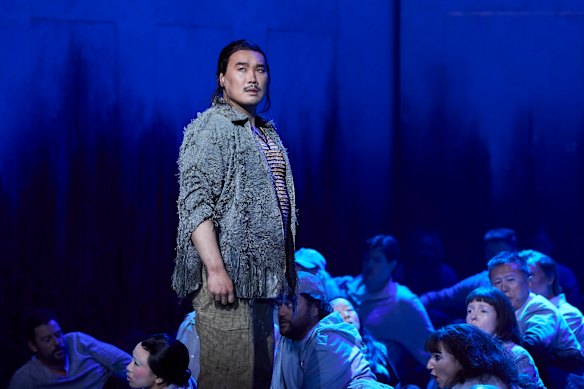
Young Woo Kim as Calaf. Credit: Keith Saunders
In this context, the problematic final scene (completed by the composer Adami from Puccini’s sketches) was meaningful where it is often ineffective (though one wonders if Puccini himself would have shortened it to create more verismo impact after the emotional climax of Liu’s death).
Conductor Henrik Nanasi maintained dramatic momentum incisively up to that poignant moment, so the score moved forward with the decisiveness of the story, while leaving ample flexibility for the singers to expand expressive moments.
As Calaf, Kim sang with gorgeous, richly tanned velvety colours and stentorian strength that he seemed able to push to the limits without cracking the beautifully burnished finish. He leavened the soaring lines of Nessun Dorma with phrases of quieter nuance to give classic shape to this most famous of moments and, more broadly, created a rounded character, which avoided pushing Calaf’s forceful dominance too far into wearying and overbearing self-centredness.
Nash was every bit his equal as Turandot, matching his tone in the riddle scene with vivid dramatic colours and riveting, almost frightening, intensity, which she transformed to a softer glow in the final scene.
Leva captured both simplicity and depth as Liu singing with light charm in Act 1 and allowing more full-blooded passion into the sound in Act 3. Her most memorable note was the high B flat in her first aria, which emerged like a quiet truth in a mist of melancholy.
Richard Anderson was a poignant Timur giving well-shaped lines unvarnished eloquence. As the three Ps, Gabbedy, Longmuir and Petruccelli provided sarcastic comic counterpoint, sustaining Puccini’s slightly overlong scene in Act II strongly, with well-articulated vocal lines and witty deflection, as though responsible for the running of the machinery of a surveillance state.
In fading respectable skivvy and slacks Gregory Brown sang the Emperor’s role with frail clarity like one keen to return to his retirement village, while Shane Lowrencev made the Speaker’s role into a mindless vehicle of autocratic edicts. Placed on a revolving stage with static symbolic movements, the Opera Australia Chorus sang with vivid openness, subtlety and power to bind together these fragments of the excesses of human passion.
DANCE
EXXY
Sydney Opera House, Drama Theatre
January 15
Until January 18
Reviewed by KATIE LAWRENCE
★★★★★
Think of something in the world that makes you question the future of humanity. I’ll wait.
(Actually, I won’t — we’d be here all night.)
Whatever came to mind, Dan Daw’s Exxy is the antidote.
Exxy is a dance-theatre love letter to the best of us: to survival, to tenderness, and to a tiny boy with cerebral palsy and his ballsy Nan, belting out The Power of Love into the red dust of the outback. It is hilarious, ferocious, devastating – and somehow also an incredible night out.
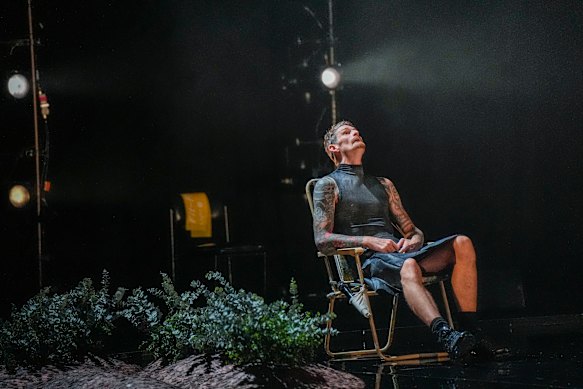
Dan Daw Daw is resplendent in a tank top and kilt. Credit: Neil Bennett
The action unfolds against corrugated iron, framed by deck chairs and the vast Australian landscape. The cast of four (Daw, Tiiu Mortley, Joseph Brown and Sofia Valdiri) are stunning. Monologues and movement land like gut-punches, then pull you in for a hug.
From the jump, Exxy commits hard to inclusion. Participation isn’t just welcome; it’s actively directed via flashing overhead captions. Don’t panic. I have never enjoyed being gently bossed around by a show more, including the singalong (no spoilers, but it goes off).
The costumes and sets (by Kat Heath) are Mad Max survival chic: industrial greys, bodies braced for impact. It’s battle gear with a forehead kiss. Daw is resplendent in a tank top and kilt, tattoos on full display. His solos are breathtaking in their intelligence and clarity; the definition of a dancer working with his body.
Guy Connelly’s soundtrack ranges from lilting melodies to techno thuds, matching the movement. The stage is carpeted in saltbush and light. Daw’s metaphor is clear: saltbush doesn’t just survive; it bursts through concrete.
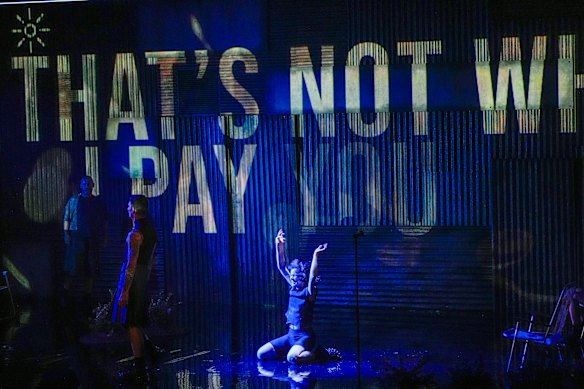
Exxy is packed with camp, gleeful absurdity. Credit: Neil Bennett
Exxy doesn’t sugarcoat. It tells stories of sexual rejection and casual cruelty: doors slammed in faces; turning up for a hookup only to be asked to leave after undressing; encounters with people who need someone else kneeling in order to feel tall.
Don’t be misled into thinking Exxy is solemn. It is packed with camp, gleeful absurdity – performers on all fours, drooling onto the stage; a “who’s better at cerebral palsy” battle that ends in applause; a group marathon where the destination is unclear but the vibe is unadulterated “I got you.” Exxy is 90 minutes in a room full of people who vocally have your back.
Like saltbush, Exxy doesn’t ask for permission to take up space. It insists on participation, demands tenderness – and turns the theatre into an intimate, raucous, glorious celebration of being alive.
DANCE
Save the Last Dance for Me
Palm Grove, Sydney Town Hall, & Leichhardt Town Hall
January 15
Until January 23
Reviewed by CHANTAL NGUYEN
★★★★½
In Save the Last Dance for Me, a white dance floor is marked out with masking tape in a diamond pattern. A slow, electro-swing beat begins (Aurora Bauzà and Pere Jou’s soundscape), and two men pace onto the dance floor (Gianmaria Borzillo and Giovanfrancesco Giannini).
They both have neat, toned physiques; upright posture; slick fashionable clothes; and impassive facial expressions. Stylistically, they are clearly European contemporary dance artists.
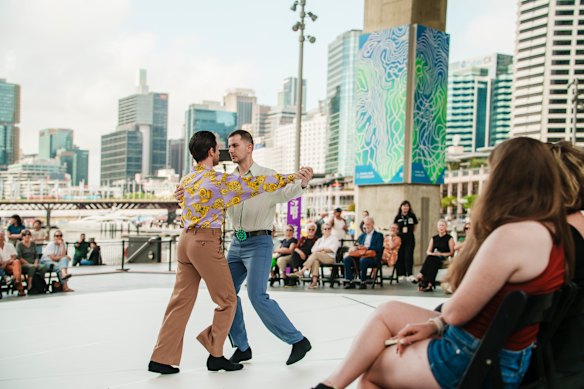
Gianmaria Borzillo and Giovanfrancesco Giannini. Credit: Stephen Wilson Barker
But the dance itself has more earthy roots. It is the polka chinata, a folk dance from Bologna, Italy when early-1900s social norms prohibited men from dancing with unmarried women. So the men danced with each other, exerting to attract female attention with the polka chinata’s rapid complexity.
Borzillo and Giannini slowly grasp each other in a ballroom embrace, their bodies gently lifting like two lungs inhaling. A pause like a wave cresting, then they begin gliding down each arm of the diamond, their feet moving in a swift, syncopated pattering step.
The travelling step becomes hypnotic in its speed and liquid intricacy. One false move and the dance would meet the kind of tangled end you see in cycling race pile-ups.
Loading
But Borzillo and Giannini never misstep, their bodies moving with such smooth, disciplined synchrony that it is like watching one entity rather than two (interestingly, the two male bodies are far more visually uniform than ballroom dancing’s usual male-female pairing). There are dizzying spins and a remarkable scooching turn, where Borzillo and Giannini grasp each other’s biceps, crouch down, and begin to whirl.
When the choreographer, Venice Golden Lion-winner Alessandro Sciarroni, first learnt about the polka chinata, you could count on one hand the number of couples who still knew how to dance it. He sent Borzillo and Giannini to Bologna to learn the dying artform. That effort led to this extraordinary piece, a rediscovery of a folk dance form, beatified and resurrected in a modern, fine arts setting.
A smile breaks through Borzillo’s face, his neat shirt now drenched with sweat. As they break through a wall of exhaustion, the audience begins clapping along, uplifted by the combination of tradition and modernity. Passers-by linger, entranced. The finale is a joyous crescendo of movement, with grins all round.
With Canadian import Kris Nelson directing this year’s Sydney Festival, the dance offerings have been exceptionally strong. At just 30 minutes, Save the Last Dance for Me is a clear winner.
Get the day’s breaking news, entertainment ideas and a long read to enjoy. Sign up to receive our Evening Edition newsletter.
Most Viewed in Culture
Loading