3 months ago
48
3 months ago
48
My scheduled rail departure to Strasbourg is less than an hour away this morning, and I’m already well and truly making tracks. I’m a part of what could be dubbed the “Samsonite Express”, a human train in the form of a single-file procession of multi-wheeled luggage belonging to me and my fellow members of a Paris-to-Istanbul rail odyssey.
We’re concentrating on navigating a challenging pathway between long-suffering, workaday Parisians and tourists like us, from the hotel where we’ve just spent a night to Paris’ Gare de l’Est. Led by our Croatian tour guide, Ivan the Wonderful, if ever there was a tourist train, we are it.
If I was about to take the actual Orient Express, in one of its many present-day manifestations, rather than my “Express to the Orient” tour, a luxury limo would have collected me and my mandatory Louis Vuitton luggage and accessories from my five, perhaps six-star, hotel for the trip to the station.
Orient Express services now tend to depart from elsewhere in Paris, but the fabled train service first took to the tracks from Gare de l’Est back in 1883 for its classic route between Paris and Constantinople, now known as Istanbul.
In those days, the Orient Express, truer to its name, took three days to travel between Paris and Istanbul, with each journey building the legendary status by which it trades today.
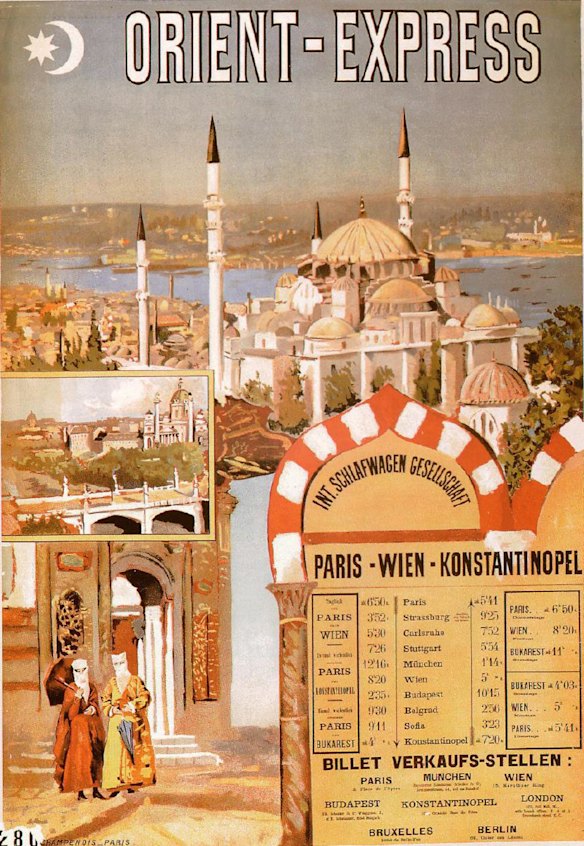
An equivalent modern-day Orient Express rail luxury journey spans six days between those two great metropolises with fares from $35,000 a passenger.
Compare that to my own, 15-day and few-if-any-frills Express to the Orient, trans-Continental trip, operated by Australian tour company Intrepid. We travel aboard a series of everyday scheduled passenger trains but trace roughly the same route as the original Orient Express. The cost? A minimum of about $7000 a person.
For that price, you’d surely be tempted to hang the limo and stride to the station, wheeled luggage and all, particularly seeing that deluxe or otherwise, the view from any rail carriage is always the same, urban ugliness included.
For many of us, travel has become a conflict between authenticity and artificiality. Often, for those who can afford it, we perhaps too quickly succumb to fantasy over reality. I admit to having led an at times indulgent travelling life, so this trip is an opportunity for a modicum of character rebuilding, if not just a decent workout.
Unlike the Orient Express, in which passengers sleep in lavish train compartments, on this 2728-kilometre journey-cum-adventure between Paris and Istanbul, we stay in hotels of varying quality and comfort, some at a distance from arriving and departing stations and with nary a taxi, let alone limo, transfer on offer.
DAYS ONE TO THREE
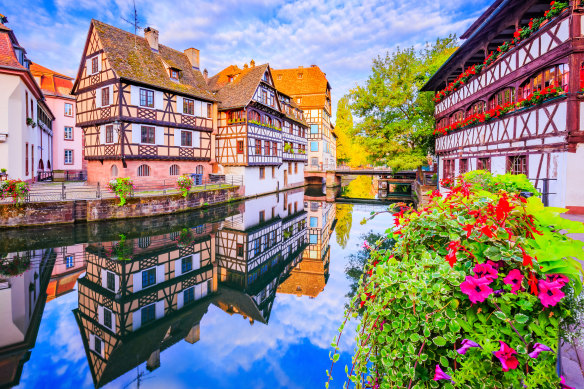
Paris to Strasbourg
In the chill of a late autumn, as I’m in a jostling queue at Paris’ Gare de l’Est – the beauteous station immortalised in an astonishing tracking (no pun intended) scene in the classic French film Amelie – to board the train to Strasbourg, I’m enveloped in a sea of more puffers than a Tokyo sushi bar.
The only visual relief or hint of colour as I gaze across an ocean of bobbing Gallic heads, is the sight of an Australian male clad in a kind of Big Wednesday-meets-Crocodile Dundee tableau, that is, in a blue Rip Curl T-shirt and yellow shorts.
Quelle horreur. Such attire would simply never do on the fabled Orient Express where jeans, let alone shorts, are verboten. That said, while I’ve left the T-shirts and shorts back home in Australia, all I’ve packed are various iterations of jeans, and one black puffer jacket.
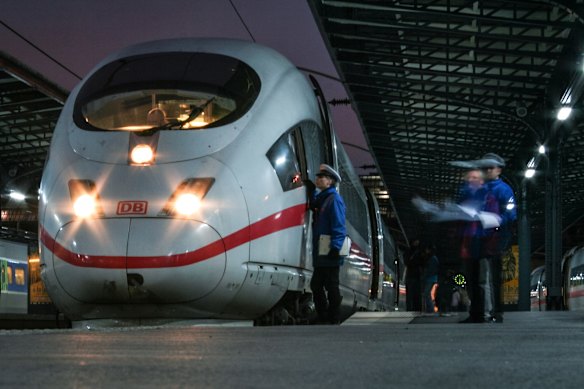
On this relatively short sweep aboard a packed high-speed train on the 493 kilometres between Paris and Strasbourg there’s not a great deal of interest outside the window. The two-hour or so trip is more like a bloated commute than the adventure that lies down the line. But what does exist is that certain frisson of a much anticipated journey having finally begun.
Not long ago, some of those passengers aboard my Paris-Strasbourg train service may have opted to fly between the two points, but that was before the climate change-aware French authorities banned short-haul domestic flights if there’s a high-speed train alternative taking 2.5 hours or less.
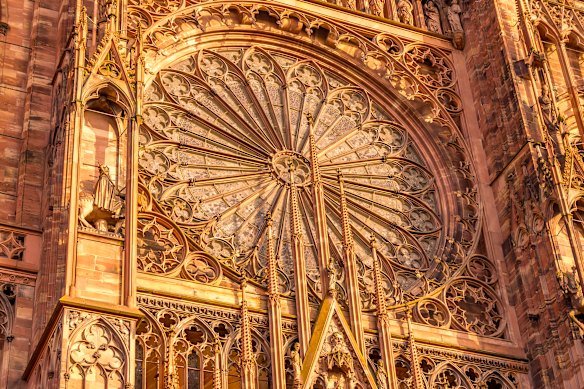
In Strasbourg, a city that’s passed between France and Germany continuously over the centuries, the architectural blockbuster is its magnificent 12th-century cathedral. But also impressive is its striking modern central station where we arrive, and that speaks, at least in part, to the 21st century.
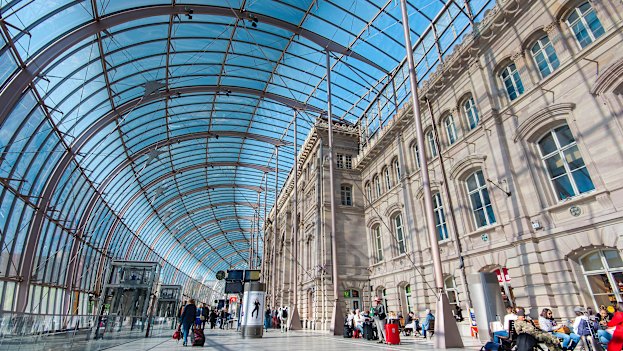
More than 150 years after its plans by German architect Johann Eduard Jacobsthal came to fruition, his French contemporary counterpart, Jean-Marie Duthilleul, engineered an inspired solution to preserve the integrity of the historic station while simultaneously expanding and modernising it.
The result? The station’s original red sandstone facade is today boldly encased within a sunlight-drenched glass canopy. From a distance, it resembles a massive beetle-shaped alien craft that has somehow landed in this 2000-year-old city, one of the most liveable in France.
DAYS FOUR TO SIX
Strasbourg-Munich-Salzburg-Vienna
My mostly female travelling companions on this trip – now back on track after an overnight stay in Strasbourg – include an architect from Brisbane, a PA from Perth, and two senior Canadians.
On each train of varying speeds and usually in second class, we’re all bunched, get-to-know-you-or-else style, with the window seats being something of a lottery.
Oh, and it turns out that bloke in the T-shirt and shorts back at Gare de l’Est, who is actually a member of our tour group, is a Queenslander, which leaves some of us wondering why he doesn’t feel the late autumnal Continental cold.
Both retired, he and his wife soon reveal themselves to be the sort of laconic salt-of-the-earth Australians whom it can be easy to undervalue these days, with eyes forever out for a cosy bar to adjourn to in the stops between trains.
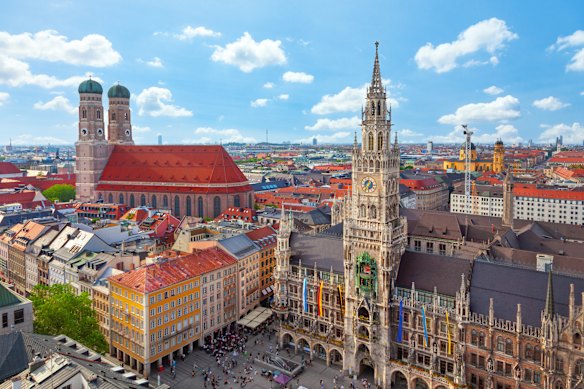
Once we arrive in the German beer capital of Munich, a journey of about four hours, my plan is not to make a beeline for a biergarten, but to take a pilgrimage of sorts to the site of a more notorious feature of German society.
Railways have been the making of Europe, and in recent times the subject of a stunning renaissance, something of which I’m beneficiary of on the tour. But, like almost all such technological breakthroughs, trains on the Continent have also been used as instruments of evil, as evidenced by their role in the Holocaust.
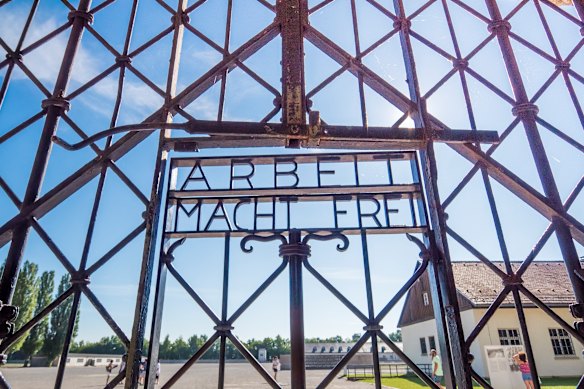
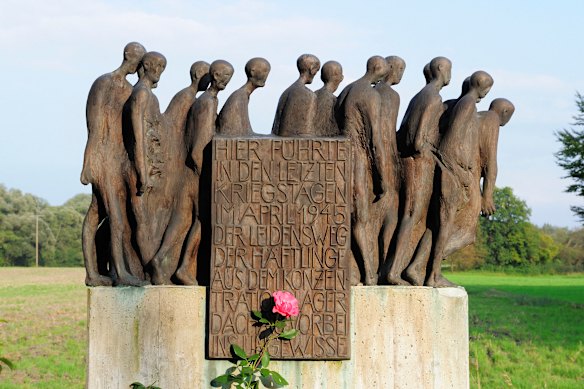
The morning after arriving at Munich Hauptbahnhof, the Bavarian capital’s main railway station, I’m back on a train again bound for Dachau, the site of the Nazi concentration camp, less than half-an-hour away.
On arrival at Dachau Station, visitors, like me, can elect to walk there instead of taking a free bus. This moving, specially created remembrance walk traces the route along which prisoners were routinely marched in full view of the local townspeople.
Today tourists take about 45 minutes to complete the remembrance walk, which includes a sombre sculpture depicting a Nazi SS-led death march of at least 25,000 prisoners from Dachau as conquering US troops neared the camp. Here the foundations of an abandoned train platform still exist.
At least 1000 inmates died of disease, malnourishment, and exhaustion. Those who could not continue were beaten or shot dead by their guards. All told, more than 40,000 people lost their lives at Dachau.
DAYS SEVEN TO 10
Vienna-Budapest-Novi Sad-Belgrade
After Dachau, back on our Paris to Istanbul rail journey and en route from Munich to Vienna, it feels wholly indulgent to complain about the decline in quality and availability of food aboard today’s European trains.
It’s especially the case when you consider the fact the concentration camp today includes a rather (too?) jolly cafeteria for visitors, complete with a fulsome menu of German cuisine crowd pleasers, that seems moderately incongruous at such a solemn site.
But the truth, when it comes to long-distance trains, is that while you could once feast in the dining car in what is one of the most civilised of human traditions, nearly all such carriages have been removed by cost-cutting train operators.
The more popular the rail travel experience in Europe becomes, the more it adopts airline-style posture. Much of the rail romance of yore has gone out the carriage windows, not that you’re able to open them.
Unless you’re travelling first-class, or are aboard the original Orient Express – where black tie is required for dinner – modern-day high-speed trains, perhaps suitably, now offer what amounts to fast food bought at an on-board cafeteria and eaten at your seat.
No wonder today’s rail passenger is led to stare longingly out the window of the train daydreaming of the real food to be had at the destination.
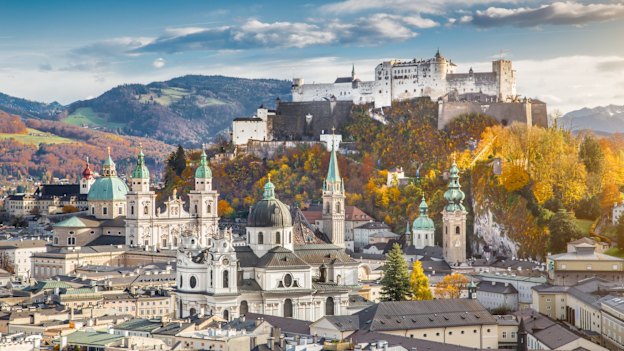
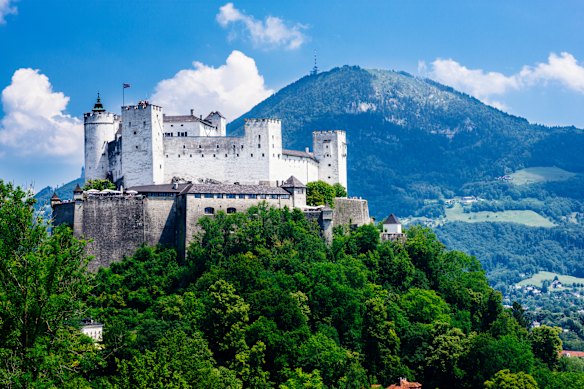
On this section of the journey, a highlight is a visit via a vertiginous funicular to Salzburg’s 11th-century Fortress Hohensalzburg.
But a hunt for good food is still on my mind so after arriving in Vienna in the early evening, I frame my next day in the Austrian capital around a visit to a restaurant called Figlmuller, which since 1905 has fashioned itself as the premier restaurant for wiener schnitzel, and in doing so, become a major drawcard for visitors.
Figlmuller’s literal recipe for success, which has made it a favourite among tourists, is a 250-gram cut of fine tenderloin pork, rather than veal. It’s pounded until it’s almost razor-thin and then drenched in egg and flour. The finishing touch is “a coat fit for a Kaiser” in the form of specially made breadcrumbs.
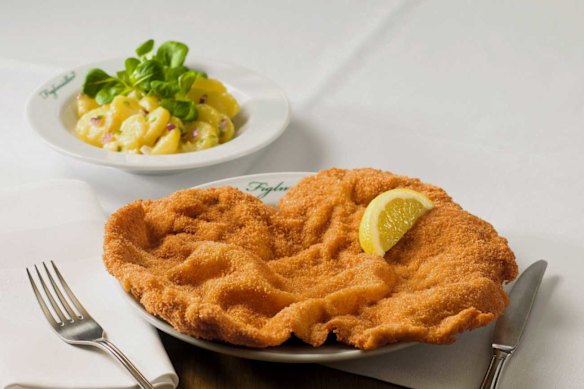
Nearly as important as all of the above is that the schnitzel occupies not the entire circle of the plate, preferably with parts of the schnitzel hanging off the side. Really, it’s all about as far removed from your basic Australian pub “schnitty” as you can get.
Istanbul is still almost 1300 kilometres down the line, meaning it’s not long before it’s time we exchange schnitzel for goulash with Budapest beckoning. By the time we reach the Hungarian capital the next day – a journey by train of about three hours from Vienna – it’s becoming starkly apparent that this is a journey of two Continental halves.
In what seems almost an instant, our latest train transitions from the palpable affluence of Western Europe to its comparatively penurious east. This is made all the more obvious when our train arrives in Budapest, not at its grand central station but at some other scruffy terminal that provides a cultural jolt after Wien Hauptbahnhof, Vienna’s sparklingly modern main rail terminal belonging to a nation whose GDP per person is as much as three times that of its neighbouring Hungary.
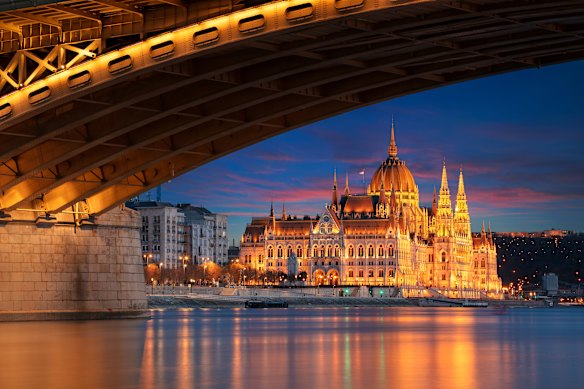
Here in Budapest, there’s an opportunity to visit the city’s multitudinous main attractions, including its magnificent Danube-side Hungarian Parliament Building dating to the early 20th century. It’s here that jumpy constabulary guarding the Gothic Revival institution are kept busy wiping tourists’ smartphone snaps ahead of a proposed but ultimately aborted Trump-Putin summit.
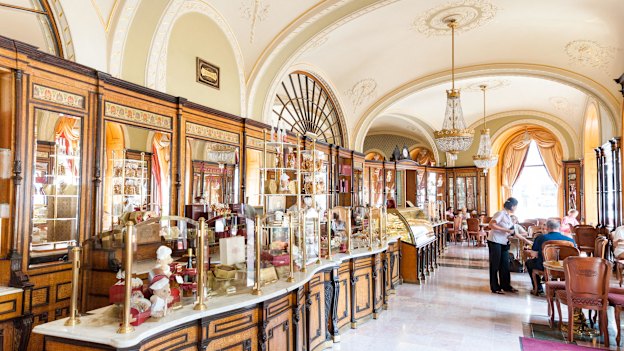
Denied a grand Budapest hotel – this is the Express to the Orient, not the Orient Express – I devote much of my full-day in the city to hopping between its grand, historic coffeehouses which, in opulence and heritage, rival those of Vienna.
There’s also time to take a ride on mainland Europe’s oldest underground metro. The quaint Line 1, or yellow line, is eclipsed only by the London Underground in vintage. Its matching petite yellow carriages run from Vorosmarty ter, right outside Cafe Gerbeaud, which opened in 1858.
In its heyday, clientele included everyone from Franz Liszt to Empress Elisabeth of Austria (or Sisi, as she was nicknamed) and Cafe Gerbeaud remains a fine place to sample old Budapest, as well as its signature cake, zserbo szeletm, a layered torte consisting of layers of apricot jam and ground walnuts, topped with a thin, decadent dark chocolate glaze.
The roughly five-kilometre Line 1, beloved of Budapesti and well-researched tourists alike, runs to Mexikoi ut, or Mexican Street, with stops at many landmarks including the city’s famed Szehenyi thermal baths.
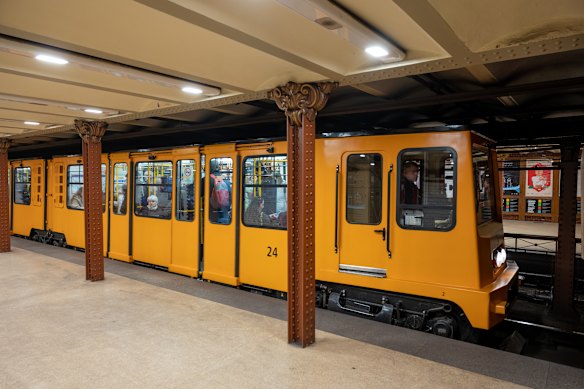
The antique white-tiled and timber-clad stations are a treat in their own right with this part of the Budapest underground, one of the world’s shallowest stations, all remarkably close to street level.
For me, railway stations are as much part of a rail journey adventure like this one as are the trains themselves. Yet, as it eventuates, it’s a major railway station beyond Budapest that abruptly impedes our progress.
Due to a combination of politics, protest and calamity, our group is required to transfer to a decidedly less romantic, though comfortable enough, mini-bus for the journey to the Serbian city of Novi Sad. On a sober note, on November 1, 2024, the concrete canopy of Novi Sad’s city’s main railway station collapsed onto a crowded footpath below, killing 16 people. Built in 1964, the station was renovated by Serbia’s right-wing authoritarian government between 2021 to mid-2024 with support from China’s Belt and Road Initiative.
Among Europe’s poorest nations, with a GDP per capita of only $US15,320 in 2025, and unlike some of its neighbouring countries not a member of the European Union, everyday Serbians viewed the accident as an example of profound government corruption and incompetence. Ever since the Novi Sad station disaster, Serbia has been roiled by protest, at times violent.
But this Eastern European’s own version of The Troubles seems a world removed when we make a lunch stop at a salas, one of the nation’s rustic farms that are peculiar to the country’s scattered Vojvodina plain and the slopes of Fruska Gora, a mountain that extends across both Serbia and Croatia.
Our table is attended to by a team of waiters of such professionalism and bonhomie that they render their Paris equivalents mere amateurs.
I’m fully expecting some kind of charming but basic Serbian ma and pa-style operation, frankly, with faint echoes of Borat. However, inside the humble though cosy salas farmhouse, shaded by fruit trees and with massed multicoloured garden watering cans as a form of decoration, our table is attended to by a team of waiters of such professionalism and bonhomie that they render their Paris equivalents mere amateurs. And the hearty and delicious food is served in generous portions.
Serbian cuisine renowned for its grilled meats, savory pies, and fresh salads. Among the classic local dishes is cevapi (grilled minced meat sausages) and sarma (cabbage rolls with meat or rice). Some salasi, including this particular one, provide accommodation in rooms furnished in the “Altdeutsch”, or “old German” style, as well as horse riding. I’d have loved to have stayed a night or two.
DAYS 11 TO 15
Belgrade-Nis-Sofia-Plovdiv-Istanbul
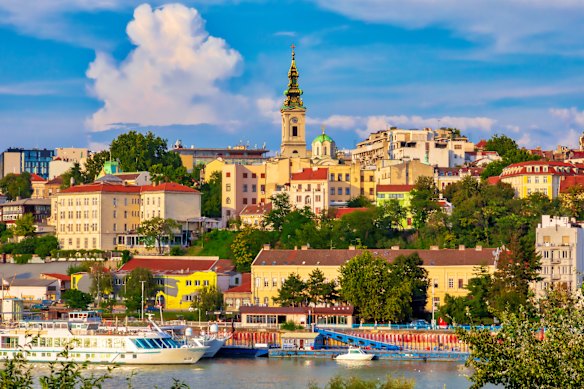
In Belgrade, it’s back to reality with the ubiquity of anti-government protest signs impossible to ignore. Indeed, only days later did I learn of a demonstration outside the capital’s parliament house, by which our tour group had passed, where shots had been fired and a tent erected by protesters.
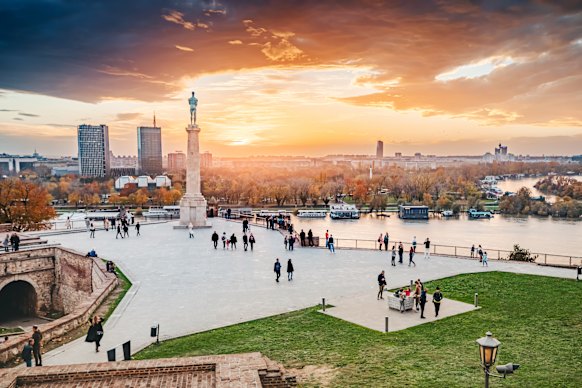
While Novi Sad feels, frankly, a little sad, Belgrade, set around the confluence of the Danube and the Sava, its longest tributary, makes the grade for this visitor, with my stay including (yes, a pattern is forming) an essential sampling of the signature cake at the city’s eccentric – and for some possibly now politically incorrectly named -Hotel Moscow.
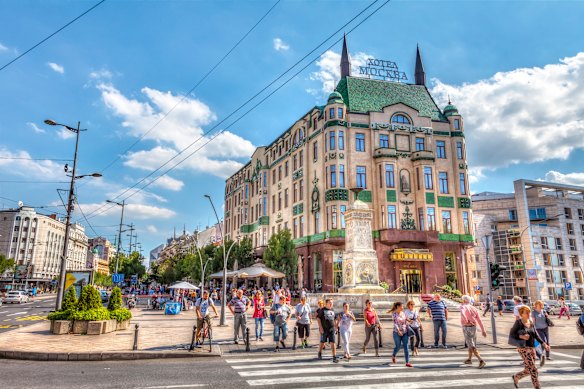
It’s the Moskva Schnitt (or Moscow Slice), a fruit and cream cake with layers of sponge, walnuts, almonds, pineapple, sour cherries, and a special homemade cream served inside the grand and cavernous ground level dining room of the Russian Secessionist-style building.
After Belgrade, it’s on to Bulgaria, back in the bosom of the EU, with a brief stop in the Roman ruins-filled capital of Sofia, en route to Plovdiv. What may sound like some kind of stodgy Balkan delicacy is, in fact, one of the Continent’s most ancient cities, and quite the unexpected stunner.
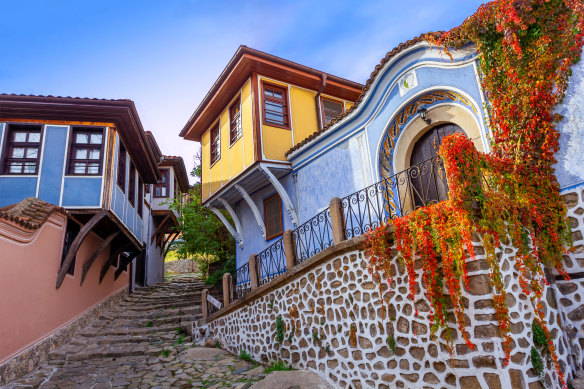
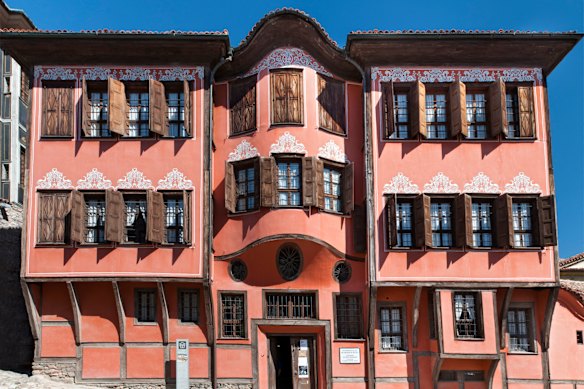
When it comes to the cobbled old towns of Europe, after a while everything old is not new but old yet again. But Plovdiv’s version is a revelation. It’s laid out along a series of cascading streets below the remnants of a citadel with marvellous views, including a well-preserved Roman amphitheatre, of what is widely regarded as one of Europe’s oldest cities.
About 10pm that evening we bid Bulgaria a fonder-than-first-imagined goodbye, taking the daily Sofia-Istanbul Express night train from Plovdiv Station. It runs daily between the two cities, and on this occasion we swap a hotel room for a basic but comfortable rail carriage sleeper.
After the relative sterility of France’s TGV and Germany’s ICE bullet trains, this feels like a real, old-fashioned rail experience. But with so many middle-of-the-night interruptions by border guards and train attendants, including the discovery of a couple of passengers sans passports, “sleeper carriage” is a misnomer, especially as we near the Turkish border at a most ungodly of ungodly hours.
“Up, out! Up, out! Up, out. Up, out…” The mostly mono-lingual guard in our sleeper carriage is marching up and down its corridor, thumping on every door to awaken the passengers.
In the wickedly wee hours, each of us is required to take themselves and all of their luggage and personal effects off the train onto the platform for it to be screened by border officials.
But by 4am or so, when it’s far too cold for shorts (even for the Queenslander) we’re back on the train and on our way to Istanbul, meaning there’s roughly five or more hours of slumber ahead, should I be able to return to sleep, which I manage to do.
As if to confirm once again that this is the Express to the Orient and not the Orient Express, the Sofia to Istanbul arrives at the prosaic Halkali Station, rather than the more atmospheric Sirkeci Railway Station, on the western outskirts of Turkey’s largest city and a distance from the city centre.
After seven countries, as many trains and nearly 3000 kilometres later, with the journey at its end, I’m relieved to learn that the Samsonite Express doesn’t need to be reformed. Waiting for us outside the station to transfer us to the last lodgings of the tour on the other side of Istanbul is not an Orient Express-style limo, but a not uncomfortable Express to the Orient-like people mover.
Five more things to see and do
Sample a Strasbourg delicacy
Flammekueche, Flammkuchen, or tarte flambee, is a flatbread typically topped with a combination of fromage blanc or creme fraiche, thinly sliced onions and lardons. It’s a must-try speciality of the French region of Alsace, of which the French city of Strasbourg is its capital.
Pause for a senior moment in Vienna
There’s a grande latte and then there’s gran latte. After exploring Vienna’s myriad historical landmarks and attractions, make a deserved pitstop at a branch of Vollpension, a kaffee and kuchen (coffee and cake) where Viennese seniors share their baking secrets with young and old clientele.
Where rivers run through it
In the underrated Serbian capital of Belgrade, take a guided tour from Ulica kneza Mihaila, the city’s long and lively main shopping street, to Kalemegdan Park and Kalemegdan Fortress, which has overlooked the confluence of the Danube and Sava Rivers for centuries.
Go Roman in Sofia
On the train journey between Belgrade and Plovdiv, pause for a few hours’ exploration of Bulgaria’s capital, Sofia. Store your luggage at Sofia’s brutalist, Communist-era central station and take the metro into the city’s heart where you’ll encounter tree-lined boulevards and parks and an extraordinary number of Roman ruins.
Satisfy your Constantinople craving
Finish your epic west-to-east rail journey across Continental Europe on a high with a guided tour of Old Istanbul including historical treasures such as the bedazzling Blue Mosque, the ancient Hippodrome and the Milion Stone. Make some time for a public ferry ride across the Bosphorus from the European side at Karakoy to the Asian side of Kadikoy.
THE DETAILS
TOUR
Intrepid Travel’s 15-day small group (up to 12 people), guided Express to the Orient: Paris to Istanbul tour includes all rail tickets, three overnight hotel stays with breakfast and one night aboard the featured Sofia to Istanbul train. The Budapest to Belgrade section of the tour is due to reopen this year for rail traffic with a new, direct, more modern train service.
BOOK
From $6995, flights not included. Departures run between April and October with a visa required to enter Turkey. A rail transfer from London to Paris is optional. See intrepidtravel.com
FLY
Singapore Airlines operates flights from Sydney and Melbourne, via Singapore to Paris, where the tour begins, and to Istanbul, where it ends. See singaporeair.com
The writer travelled as a guest of Intrepid Travel and with the assistance of Singapore Airlines.