3 months ago
11
3 months ago
11
The Ashes captains, Steve Smith and Ben Stokes, were so expressive on Tuesday at the Sydney Cricket Ground that they formed two poles drawing the onfield energy towards themselves. As everyone else flagged or failed and the contest trended towards the inevitable, Smith and Stokes maintained the competitive rage, a pair of vivid colourfast characters on a sun-faded canvas.
Stokes, let it be said, was towering in adversity. With the ball, he ran in like one of those Survivor contestants who, having burnt their last bridge, can rely only on their own self. His figures – 17 wicketless overs for 47 runs – won’t show it, but he was consistently England’s most dangerous bowler, passing the edge repeatedly and maintaining speeds at and around 140kmh throughout a sapping and dispiriting day. He did all of his work with the older ball, too, arguably putting self-sacrifice above strategic sense.
England’s bloopers were hardly Stokes’s fault. He didn’t drop the catches or bowl the long hops, and the three reviews were wasted thanks to his teammates’ opinions. When some of the miscreants glanced over their shoulder to see their captain wincing in pain or bent over in despair, you wondered how thin England’s “no consequences” philosophy was wearing. If anyone has dramatised the consequences of defeat in this series, it’s the man who has been let down by his lessers.
Fielding at mid-on or mid-off rather than the cordon, Stokes cut an isolated figure, clapping or raging or encouraging or simply doubling over on his haunches. This summer he has often resembled Allan Border in Australian cricket’s dark days, setting a standard of fortitude that is impossible for his teammates to live up to, and openly exasperated when they can’t.
His irritability, bubbling ever closer to the surface, was brought to the boil by Marnus Labuschagne late on Monday, but whose wouldn’t be?
Steve Smith also looked to be in an irritable mood as he fretted his way towards another vital century, although, unlike Stokes, his annoyances were typically endogenous and mysterious. Whenever he mistimed a ball, which was not all that often, he flailed about with strange gestures and motions, apparently incandescent with self-directed annoyance.
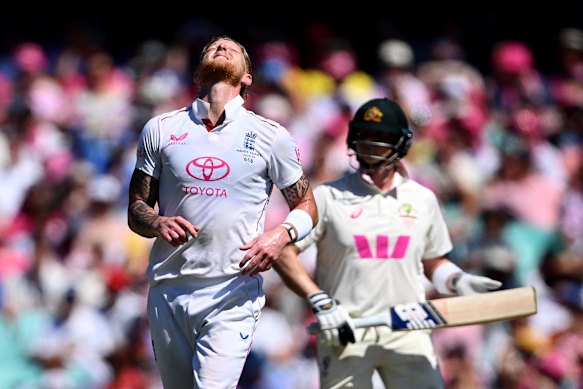
Intensity: Ben Stokes and Steve Smith.Credit: Getty Images
He fussed and fidgeted in the time-honoured Smith ways, and halted the game when hapless spectators or SCG employees caught the corner of his eye. When he slipped on a foothold, you’d have thought he’d torn his Achilles; 10 seconds later he’d made a miraculous recovery. Some England players tried in vain to engage him in conversation. He was too busy.
Australia spent the day moving towards a point of safety that kept receding. As Smith lost one partner after another to soft or softish dismissals, he grew more intense; like Stokes, the responsibility fell more and more upon the man with the ‘C’ next to his name. Smith had more help from his teammates, but you wouldn’t know that from his onfield demeanour.
Loading
Smith’s tactical acumen this summer has been an important and underrated factor in Australia’s success, but it took until now, his home Test match, before he made a game-shaping impression with his bat. His wasn’t a brilliant or classic Smith century, but it was pig-headedly utilitarian. Not an artist on this day, just a tradesman working in his smithy.
The signature stroke of his innings was the one with which he raised three figures, twisting on his back foot and tapping a short ball from Jacob Bethell into the acres of space behind square leg – ad hoc, imaginative, and exactly where Stokes didn’t want him to hit it. He wouldn’t have played such a shot against Stokes, whom he treated with more respect than any other bowler; he scored from just 11 of the 36 balls his counterpart bowled him.
In a summer (and a day) of some memorably dumb cricket, Smith’s was off-the-charts high IQ batting. With his 13th Ashes century, he went past Jack Hobbs and now stands behind only Don Bradman, a ranking he can get used to when he grows old.
When so much of sport is converging towards the middle, and with so much psychological coaching around emotional flatlining, it’s entertaining to have two such uninhibited personalities commanding the cricket field. If a series ends with the last two people who are still fighting, you know that the captains will be the ones to switch out the lights.
Most Viewed in Sport
Loading