2 months ago
23
2 months ago
23
By Tom Ryan
December 10, 2025 — 5.30am
MEMOIR
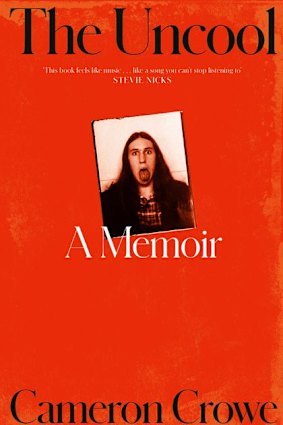
The Uncool: A Memoir
Cameron Crowe
HarperCollins, $52.99
It’s been said that everyone has a story in them worth telling. Whether that’s true for all of us, it certainly is for Cameron Crowe. Drawing heavily on his own experiences, the award-winning film Almost Famous (2000) provides a fictionalised version of one of his stories. Set in the 1970s, it follows the sentimental journey taken by his youthful surrogate, a 15-year-old rock journalist wannabe (played by Patrick Fugit), after Rolling Stone assigns him to go on the road with a rock band.
Now, 25 years after the film’s release, in his enjoyable The Uncool: A Memoir, Crowe offers another version of this coming-of-age story. When it begins, his parents’ dream is for him to become a lawyer, but the siren song of popular music already has him in its thrall. “Music was already more than music,” he writes. “It was a door that opened for three minutes.”
So, when he’s offered the chance to write about it by a man wearing John Lennon glasses – Bill Maguire, editor/publisher of San Diego’s underground Door magazine – he hears destiny whispering in his ear. “I felt the earth move, ever so slightly. Free records!”
Still only 14 and despite his parents’ misgivings, he’s swept out of a troubled home and into the world of rock culture, where he joins up with a wider family of writers and musicians. Along the way, surrogate fathers in the writing trade take him under their wing, most notably journalist Lester Bangs (played in Almost Famous by Philip Seymour Hoffman) and Rolling Stone co-founder Jann Wenner. And, as he nervously negotiates his way into the behind-the-scenes wonderland, his informed enthusiasms are welcomed by artists and their PR people. Or at least some of them.
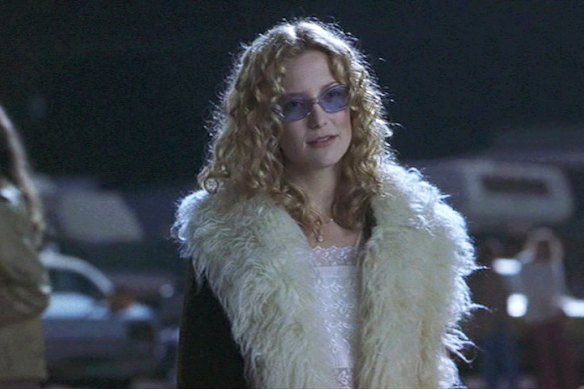
Kate Hudson, whose character was based on Pennie Lane, in Almost Famous.Credit:
Much of the material in Crowe’s book stems from his privileged access. And, as a wide-eyed witness, he has plenty of stories to tell about his encounters with a veritable who’s-who of the business. He’s there when Bruce Springsteen makes his debut for the media at West Hollywood’s Troubadour. When the sparks are flying between Kris Kristofferson and Rita Coolidge. When the chemistry between Emmylou Harris and Gram Parsons begins crackling (“If I ever fall in love, I thought, I wanted to fall in love like that”).
On tour with the Allman Brothers Band (the assignment that laid the foundation for Almost Famous) and courtesy of a recommendation by Jackson Browne, he has a memorable encounter with Gregg Allman that he’d rather forget. Introduced by a Warner Bros. publicist, then-Faces guitarist Ron Wood becomes “Woody”, makes him feel at home and entrusts him to David Bowie, who in turn becomes a regular confidant.
He’s standing around as an extra when Orson Welles is shooting a sequence for The Other Side of the Wind at Peter Bogdanovich’s house. With the help of a friend of a friend who’s secretly dating Cary Grant and has his private number, he makes a prank call to the screen legend and is awed by the response. He gets to know “Band-Aide” Pennie Lane (played in Almost Famous by Kate Hudson) after Rolling Stone sends him on the road with Led Zeppelin.
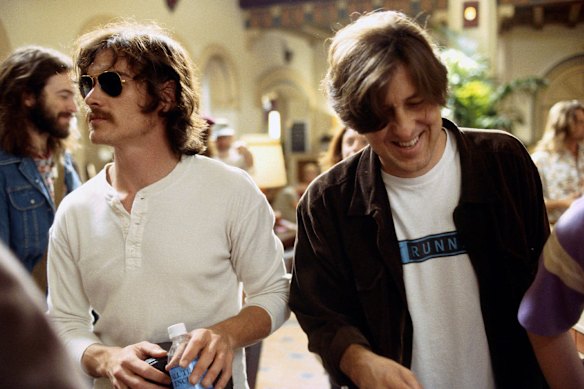
Crowe (right) on the set of Almost Famous with actor Billy Crudup.Credit: AP/DreamWorks
He also receives some sage counsel from those father figures, advice he often appears to have ignored. As in the film, the irascible Bangs warns him of the need to stay “uncool” with those he’s writing about, of the risks entailed in cosying up to them. “Soon it’ll just be an industry of … of cool.” He also cautions him about the ethical dangers of “getting in bed with the corporate pursuits of Rolling Stone”.
Along the same lines, Wenner wonders about what Crowe was trying to do with the Led Zeppelin story he’s written for Rolling Stone, aside from getting the band on to the cover. “You didn’t write about what you saw, what you felt. You wrote what they wanted you to write, not what you wanted to write. What did you see? What did you feel?” Wenner loans him a well-thumbed copy of Joan Didion’s essay collection Slouching Towards Bethlehem to set him straight.
Filled with the flavour of their times, the stories Crowe has to tell provide plenty for readers to feast on, and they are instructive. But he never looks especially hard in the mirror, requiring one to peer between the lines to try to find what might lie behind the “uncool” demeanour of the goofy guy on the book’s cover.
Loading
Nor is there anything substantial on offer about Crowe’s work as a filmmaker. He’s made 11 features and an undervalued miniseries (with a documentary about Joni Mitchell now in production), but only his 1981 novel, Fast Times at Ridgemont High: A True Story, which he turned into the screenplay for Amy Heckerling’s film the following year, receives any attention.
Also absent is the time he spent with famous writer-director Billy Wilder for their 1999 Conversations book. Perhaps there’s a Volume 2 in the works?
The Booklist is a weekly newsletter for book lovers from Jason Steger. Get it delivered every Friday.
Most Viewed in Culture
Loading